
Never Again is Now
Never Again Requires a Plan
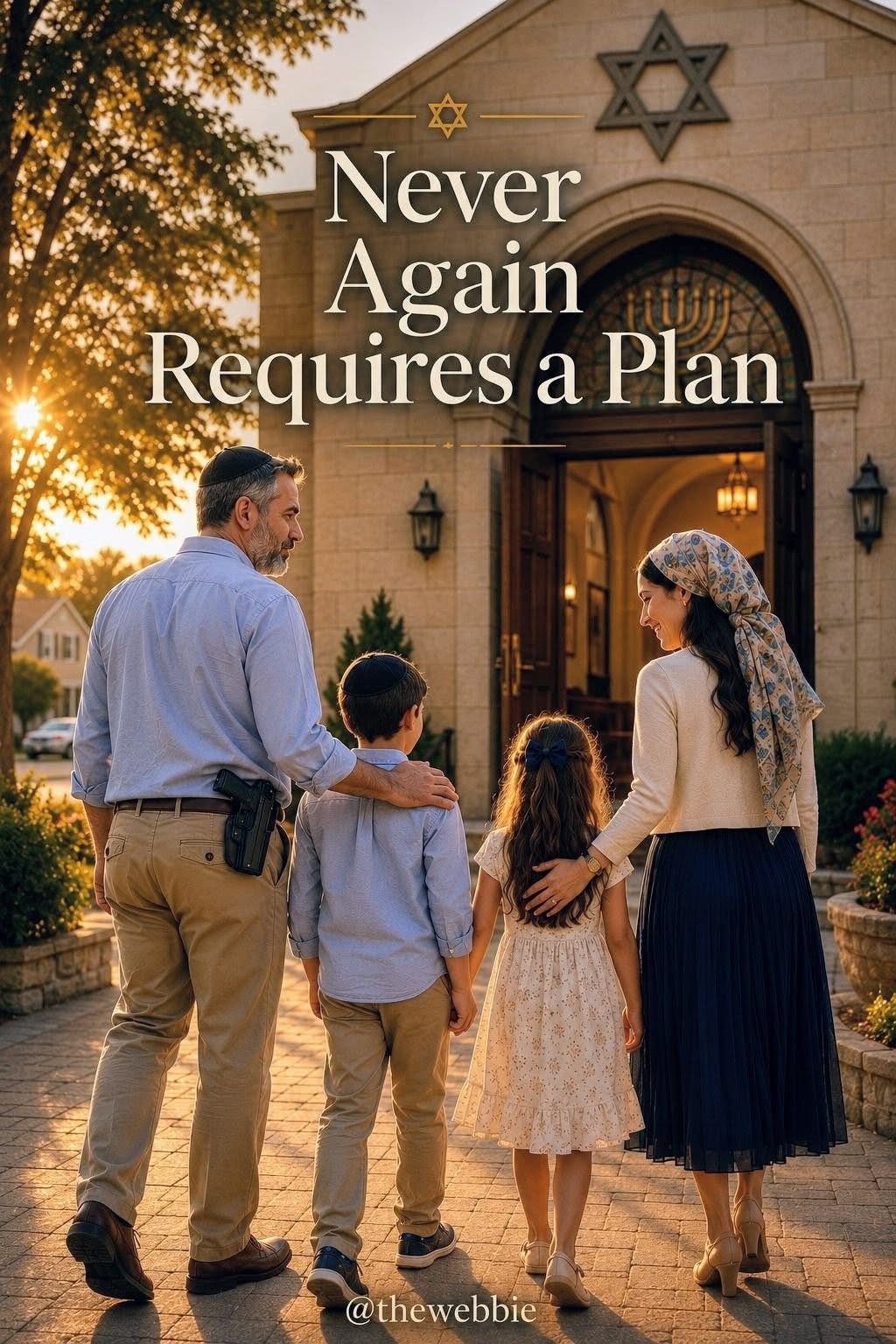
There is a sound every Jewish parent knows.
It is not the shofar. It is not the clink of kiddush cups. It is not the sound of a child asking why this night is different from all other nights, usually while spilling grape juice on the tablecloth your wife swore was “for guests.”
It is the sound of checking the lock twice.
Maybe three times.
It is the pause before opening the door when someone knocks unexpectedly. It is the quick scan outside the synagogue. It is the way we now notice exits in restaurants, cameras in parking lots, and whether the mezuzah on the door is visible from the street.
That sound is memory wearing a lock.
Jews have spent 3,000 years being told, “Don’t worry, the authorities will protect you,” usually by people who were either naïve, useless, or already drafting the paperwork to confiscate our homes.
We have heard this story before.
In Kishinev, Jews waited for protection.
In Hebron, Jews waited for protection.
In Europe, Jews waited for protection.
On October 7, Israelis in their homes, in kibbutzim, at a music festival, waited for protection that arrived too late for too many.
And here in America, after years of rising antisemitism, campus mobs, synagogue attacks, kosher market shootings, and masked cowards screaming “globalize the intifada,” we are still expected to behave as if the police are a force field.
They are not.
Police matter. Good officers matter. Security partnerships matter. We should support them, work with them, train with them when possible, and thank them when they stand between us and the mob.
But when evil kicks in your door, the police are minutes away.
Your family is seconds away.
That gap is called responsibility.
And Jews need to stop outsourcing it.
The Jewish Case for Self-Defense
There is nothing un-Jewish about self-defense.
Judaism is not a suicide pact.
The Torah commands us to choose life. Pikuach nefesh, saving life, overrides almost everything. We are not commanded to be helpless. We are not commanded to be polite while someone tries to murder us. We are not commanded to be sacrificial lambs so antisemites can feel historically consistent.
The Talmud teaches: “If someone comes to kill you, rise up and kill him first.”
That is not bloodlust.
That is moral clarity.
The goal is not violence. The goal is the preservation of life. The ideal Jewish home is not a bunker. It is a table full of food, arguments, children, laughter, books, candles, and someone complaining that the brisket is dry even though they took thirds.
But peace without protection is a wish.
And wishes are not a security plan.
We teach our children Hebrew. We teach them history. We teach them to be proud Jews. We teach them not to bow before mobs, not to apologize for Israel’s existence, not to confuse antizionism with “human rights activism” wearing a keffiyeh and a Che Guevara poster.
We must also teach them that safety is a skill.
Owning a firearm is not a personality. It is not a costume. It is not an excuse to become some discount action hero.
A firearm is a tool of last resort.
A serious person approaches it with humility, training, discipline, legal knowledge, and fear of God.
If you are angry, do not buy a gun.
If you are unstable, do not buy a gun.
If you think having a gun makes you powerful, do not buy a gun.
If you think training once is enough, do not carry one.
The armed Jew we need is not reckless. He is sober. She is disciplined. They know the law. They store firearms safely. They train. They practice. They avoid stupid places with stupid people doing stupid things. They understand that the best defensive gunfight is the one you never enter.
This is not about becoming violent.
It is about refusing to be helpless.
“But This Is America”
Yes. Baruch Hashem.
America has been one of the safest and most extraordinary homes Jews have ever known outside Israel. That is why this conversation matters here. Because America gives citizens rights that most Jewish communities in history never had.
Our ancestors would have given anything for the right to defend their homes legally.
We have it.
And too many of us treat it like a hobby for people with pickup trucks and suspiciously strong opinions about barbecue sauce.
That must change.
Jewish self-defense is not right-wing. It is not left-wing. It is not a culture war accessory. It is a civilizational instinct that should have survived every exile, every pogrom, every betrayal, and every promise that “this time will be different.”
This time will only be different if we are different.
“Never Again” cannot just be a slogan we embroider onto communal trauma.
Never Again means locks.
Never Again means cameras.
Never Again means synagogue security.
Never Again means situational awareness.
Never Again means legal self-defense.
Never Again means Jews learning how to protect Jewish life.
Not because we seek violence.
Because we understand history.
Same Duty, Different ZIP Codes
Here is where the American Jewish conversation gets complicated.
The duty does not change by state.
The legal reality absolutely does.
A Jew in Florida, Texas, or Pennsylvania is living in a very different self-defense environment than a Jew in New York, New Jersey, California, Illinois, Massachusetts, or Maryland.
That matters.
In more permissive Second Amendment states, the law generally gives responsible citizens more tools. Florida allows permitless concealed carry for eligible people under state law, while still requiring valid identification when carrying without a license. Texas law no longer requires a license to carry a handgun in most public places. Pennsylvania allows people 21 and older to apply for a License to Carry Firearms, which permits concealed carry or carrying in a vehicle and is generally valid for five years.
That freedom should not make anyone casual.
It should make them serious.
If you live in a more permissive state, leverage the freedom responsibly. Take quality training beyond the minimum. Defensive pistol. Use-of-force law. Regular range time. Safe storage. Family education. Synagogue security planning. Relationship-building with law enforcement. Carry insurance. Situational awareness.
The law may give you room.
Your judgment still has to fill it.
In more restrictive states, the government often treats self-defense tools with suspicion. New York, New Jersey, California, Illinois, Massachusetts, and Maryland all impose significant licensing, permitting, training, or location restrictions. New York requires licensing, training, references, and an interview for concealed carry. New Jersey uses its Firearms Application and Registration System for firearm purchaser identification cards and handgun permits. California requires dealer processing, a DROS process, a 10-day waiting period, and generally a Firearm Safety Certificate for buyers. Illinois requires a FOID card and 16 hours of approved training for a concealed carry license. Massachusetts requires an LTC or FID card to possess or carry firearms unless exempt. Maryland requires a permit from the Maryland State Police to carry, wear, or transport a handgun, and also has a Handgun Qualification License process for acquiring handguns.
That does not mean Jews in those states get to shrug and say, “Well, I guess the state has this covered.”
The state does not tuck your children into bed.
You do.
A larger barrier to entry is not an excuse to leave your family unprotected. It is a reason to get serious.
Do the work.
Fill out the forms.
Take the class.
Make the appointment.
Pay the fee.
Show up.
Sixteen hours is not a lifetime. It is a weekend. Most of us have spent more time than that binge-watching Netflix on a rainy Sunday while pretending we were “resting.”
This is life or death.
Make the time.
In restrictive states, compliance is non-negotiable. Complete every required class. Submit every document. Track every renewal. Know every sensitive-place restriction. Work with knowledgeable local firearms attorneys. Understand reciprocity before traveling. Secure firearms legally. Build layers of defense at home and synagogue: alarms, cameras, reinforced doors, lighting, emergency plans, security teams, and community watch.
If the law makes carry difficult, then home defense, institutional security, awareness, and legal preparation become even more important.
Never let restrictions become an excuse for zero preparation.
“Never Again” means different tactical realities by ZIP code.
The mindset does not change.
The State-by-State Reality
The states with the largest Jewish populations, New York, New Jersey, California, Florida, and Illinois, are not identical legal environments. Some are relatively permissive. Some require a small mountain of paperwork, references, training, waiting periods, and patience normally reserved for assembling IKEA furniture while fasting on Yom Kippur.
This is not legal advice. Gun laws change. Local rules matter. Judges matter. Licensing officers matter. The fine print matters because American gun law was apparently written by people who thought the Talmud needed more footnotes.
Before buying, carrying, transporting, or storing a firearm, check your state police, local licensing authority, and a qualified firearms attorney.
Here is the basic path.
New York
New York requires a license to possess or carry a pistol or revolver.
For a concealed carry license, the state requires proof of firearms safety training, four character references, disclosure of household adults, and an in-person interview with the licensing officer. New York no longer requires applicants to show a special need for self-defense.
The state requires a 16-hour classroom course plus 2 hours of live-fire training for new concealed carry applicants. New York City, Westchester, Nassau, and Suffolk licenses expire and require renewal every three years. Outside those areas, concealed carry license holders must recertify every three years.
New York also bans carry in a long list of “sensitive locations,” including public transportation, schools, bars and restaurants serving alcohol, polling places, Times Square, and many government-controlled locations.
Practical path: Apply through your county or local licensing authority. Take the required course. Gather references. Expect interviews, background checks, and delays. Learn the sensitive-place rules before you carry.
New Jersey
New Jersey generally requires a Firearms Purchaser Identification Card for rifles and shotguns and a Permit to Purchase a Handgun for each handgun.
State regulations require applicants to be qualified and not subject to disqualifying conditions. Each handgun purchase permit is tied to one handgun.
For carry, New Jersey uses an online Permit to Carry system, and approved carry permits are renewed every two years. New Jersey also requires familiarity with safe handling and use of handguns, and the carry process includes documented training and qualification.
Practical path: Apply through NJ FARS for the Firearms Purchaser ID and handgun purchase permits. Buy only through lawful channels. Complete approved carry training and qualification. Apply online for the Permit to Carry. Track renewal dates carefully.
California
California requires almost all firearm purchases and transfers, including private party transfers and gun show sales, to go through a California licensed dealer using the Dealer’s Record of Sale process.
California imposes a 10-day waiting period before release. Buyers generally need a Firearm Safety Certificate before purchasing or acquiring a firearm, unless exempt. The FSC requires passing a written test and is valid for five years.
For concealed carry, California requires a CCW license issued by the local sheriff or police chief. Local issuing agencies require training for new applicants, often no less than 16 hours, depending on the agency and current state rules.
Practical path: Get the Firearm Safety Certificate. Purchase through a licensed dealer. Complete DROS and the waiting period. Apply to your county sheriff or city police chief for CCW. Do not take CCW training until your issuing agency tells you how it wants it done.
Illinois
Illinois requires a Firearm Owner’s Identification Card to acquire or possess firearms or ammunition.
To apply for a FOID card, Illinois State Police list a valid driver’s license or state ID, a recent head-and-shoulders electronic photo, and a fee.
Illinois also requires a Concealed Carry License to carry concealed. New resident applicants must complete 16 hours of concealed carry firearms training from an Illinois State Police-approved instructor and upload the training certificate. Applicants need an ISP account, valid ID, and a valid FOID card unless applying while the FOID is in process.
Practical path: Apply for FOID. Buy through lawful channels with background checks. Take the 16-hour ISP-approved concealed carry course. Apply for CCL through Illinois State Police.
Florida
Florida does not require a permit to purchase a firearm.
The state imposes a three-day waiting period, excluding weekends and legal holidays, between purchase and delivery, or until completion of the required records checks, whichever occurs later. Florida allows permit less concealed carry for eligible people under state law. A person carrying concealed without a license must carry valid identification and display it upon demand by law enforcement.
Practical path: Confirm eligibility. Buy through lawful channels with the required background check and waiting period. Even with permit less carry, take a serious concealed carry course anyway. Consider getting the Florida concealed weapon license for reciprocity in other states, better structure, and proof that you took the responsibility seriously.
Training Is Not Optional
The legal minimum is not the moral minimum.
A Jew who owns a firearm for defense should do more than satisfy the state.
Take a beginner safety class.
Take a legal use-of-force class.
Take a defensive pistol class.
Learn safe storage.
Practice regularly.
Teach your family what to do and what not to touch.
Use a safe.
Respect every firearm as loaded.
Know your state’s laws on transport, storage, prohibited places, magazine limits, ammunition restrictions, and when deadly force is legally justified.
And perhaps most importantly, train your mind before your trigger finger.
A firearm does not replace wisdom. It magnifies judgment. If your judgment is poor, the firearm does not make you safer. It makes you a liability with paperwork.
In friendly states, the emphasis is personal responsibility and skill-building.
In restrictive states, the emphasis is compliance, planning, and layered defense.
In every state, the point is the same.
Protect Jewish life legally, effectively, and seriously.
Carry Insurance Is the Second Fight
Carry insurance or self-defense legal coverage is the piece responsible gun owners often overlook.
Because surviving the attack is not always the end of the story.
Defending your life may be only the first fight.
The second fight comes in court.
Even a lawful act of self-defense can trigger police questioning, criminal charges, civil lawsuits, attorney fees, expert witnesses, bail costs, and years of stress. This is not fearmongering. This is reality.
In America, surviving the attack does not always mean surviving the legal aftermath.
So if you carry, get reputable self-defense legal coverage.
Read the fine print. Know what is covered and what is not. Criminal defense. Civil defense. Bail. Appeals. Expert witnesses. Attorney choice. Reimbursement versus upfront payment. Coverage in your state. Coverage while traveling.
Do not assume.
Ask questions before you need answers.
This is responsible planning. The same mindset that says, “I hope I never need this firearm,” should also say, “If the worst day of my life happens, I need a lawyer before I need a microphone.”
A firearm without training is irresponsibility.
A firearm without legal preparation is unfinished.
If you carry, carry seriously.
Community Defense Is Also Jewish Defense
This cannot only be an individual project.
A Jewish man or woman getting trained is good.
A Jewish community getting organized is better.
Synagogues should know who in the community is trained, licensed where required, stable, disciplined, and willing to serve responsibly. Not everyone should be on a security team. In fact, some people should be kept far away from one. Enthusiasm is not qualification. Owning a gun is not leadership. Loud opinions at kiddush are not tactical experience.
But serious people should be identified.
Train together.
Coordinate with law enforcement.
Bring in professionals.
Run emergency drills.
Create communication plans.
Know who calls 911.
Know who locks which doors.
Know where children go.
Know who has medical training.
Know where trauma kits are.
Know what happens if the rabbi is unavailable, the president is panicking, and Uncle Morty is standing in the lobby yelling, “I told you this would happen,” which may be true but is not operationally useful.
Security is not just firearms.
It is doors, cameras, lights, radios, tourniquets, planning, calm, and leadership.
It is the discipline to notice the suspicious person before the screaming starts.
It is the humility to bring in experts.
It is the courage to say, “We are not waiting for the worst day to invent a plan.”
That is Jewish adulthood.
The Bigger Point
There is a sickness in the modern Jewish world, especially in the comfortable parts of the diaspora.
We confuse vulnerability with virtue.
We think being harmless makes us moral.
It does not.
A harmless person is not automatically righteous. Sometimes he is just easy to harm.
Jewish morality has never required Jewish weakness.
The Maccabees did not rededicate the Temple by writing strongly worded letters to the Seleucids. They fought. They sacrificed. They survived. Then they lit the menorah, because Jewish strength is not the opposite of Jewish light.
It is what protects it.
We should build alliances. We should call the police. We should demand enforcement. We should insist that elected officials stop treating antisemitism like a public relations inconvenience.
But we should not bet Jewish life on someone else arriving in time.
That is not cynicism.
That is adulthood.
October 7 reminded the Jewish world of something our grandparents knew in their bones: the line between civilization and barbarism is thinner than we want to believe. Sometimes it is a border fence. Sometimes it is a locked door. Sometimes it is a father standing between his family and evil.
I pray none of us ever need to use force.
I pray our synagogues are filled only with song.
I pray our homes know only laughter, Shabbat candles, and the sacred chaos of family life.
But prayer is not a substitute for preparation.
In Jewish life, faith and action have always walked together. We pray for healing, and we go to the doctor. We pray for livelihood, and we go to work. We pray for safety, and we lock the door.
Now we must go one step further.
Legally.
Responsibly.
Seriously.
Because Never Again is not a mood.
It is a duty.
And when the next pogrom comes, whether it wears jackboots, masks, keffiyehs, or “social justice” merch, let it meet a generation of Jews who finally understood the assignment.
Am Yisrael Chai does not mean the Jewish people politely request permission to live.
It means the Jewish people live.
And we intend to keep it that way.
Written By Mathew Feinberg 
Related Topics
Related Posts