


Never Mind, God. I’ve Got This

Parashat Eikev and the Amnesia of Success.
There is a story of a man desperately searching for parking in Tel Aviv. Late for the most important meeting of his career, he circles the streets again and again until, in complete desperation, he looks heavenward and prays. “God, I really need Your help. Please, help me find a parking space.”At that very moment, a car pulls out. The man looks back toward heaven and says, “Never Mind, God. I’ve Got This” It is funny because it is painfully familiar. And it is precisely the spiritual disease that Moses diagnoses in Parashat עקב.
Standing on the threshold of the Promised Land, after forty years of wandering through the wilderness, Moses is not worried that the Israelites will stop believing in God during moments of suffering. Human beings usually remember to pray when life falls apart. He worries about something far more dangerous. He worries about what success does to memory.
Remember the entire journey by which the Lord your God has led you these forty years in the wilderness (Deuteronomy 8:2)
Then comes the warning that echoes across generations:
Take care lest you forget the Lord your God (Deuteronomy 8:11)
Not because God suffers from low self-esteem. The Torah’s concern is not divine insecurity. It is human amnesia. Moses understands something that modern psychology has only recently begun to describe. Human beings quickly adapt to success. We normalize what once felt miraculous. Good health becomes invisible until it disappears. The new home soon feels ordinary. Stable relationships become expected. Freedom becomes the background noise of life. Even extraordinary achievements quietly transform into things we believe we somehow deserved. Eventually we begin telling ourselves the story Moses feared most:
My own power and the strength of my own hand have produced this wealth for me (Deuteronomy 8:17).
Moses is not condemning success. He is exposing one of the oldest illusions in human history: that we are entirely self-made. Every achievement rests on gifts we did not create: freedom, health, opportunity, the people who believed in us, and the countless circumstances that made our work possible. None of us succeeds alone.
The Torah’s command to remember is an antidote to arrogance and isolation.
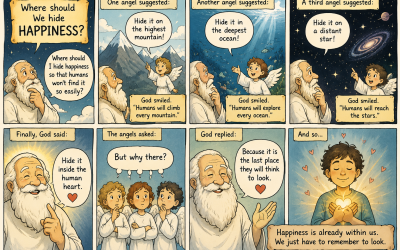
There is an old Hasidic tale that imagines God asking the angels where happiness should be hidden. One suggests the highest mountain. Another proposes the deepest ocean. A third recommends a distant star. God rejects each idea because humanity will eventually climb every mountain, explore every ocean, and reach the stars. Finally, God smiles and says, “Hide it inside the human heart. That is the last place people will think to look.” Parashat עקב offers a similar insight: Perhaps happiness is not found by accumulating more possessions but by noticing more gifts. Modern research consistently finds that practicing gratitude increases resilience, strengthens relationships, improves emotional well-being, and even enhances physical health. Long before positive psychology coined the phrase “gratitude practice,” the Torah had already established gratitude as a daily spiritual discipline. Not because God needs our praise, but because we need the perspective that praise creates.
This has become especially difficult during these painful months. War, loss, political division, anxiety, and uncertainty can make gratitude sound naïve, even offensive. But biblical gratitude has never required denying suffering. The Israelites are commanded to remember while carrying the scars of Egypt. Gratitude is not forgetting pain. It is refusing to let pain become the only story we tell. Even now, amid grief, we have witnessed extraordinary courage, breathtaking volunteerism, neighbors opening their homes to strangers, young soldiers risking everything for people they have never met, communities discovering reservoirs of solidarity they never knew they possessed.
Parashat Eikev reveals why the Torah commands gratitude, not because God needs our thanks, but because we do.
Perhaps Moses understood that the question is never whether both exist. The question is which one we choose to notice, nurture, and multiply. This week, before rushing to the next goal, or the next achievement, pause for one small act of remembrance. Call your parents and thank them. Write down ten things that already make your life rich. Thank the colleague whose quiet support made your success possible. Notice the rain that feeds the fields, the friend who answered your call, the freedom you often forget is extraordinary. Because gratitude is not merely good manners. It is a moral discipline. It makes us humbler, kinder, and happier. Perhaps that is what Moses wanted us to remember all along: God does not ask us to say “thank you” because heaven is waiting for compliments. God asks us to say “thank you” because grateful people build better families, stronger communities, and ultimately, a more hopeful world.
Shabbat Shalom!