

Nineteen Months. Then Five Days.
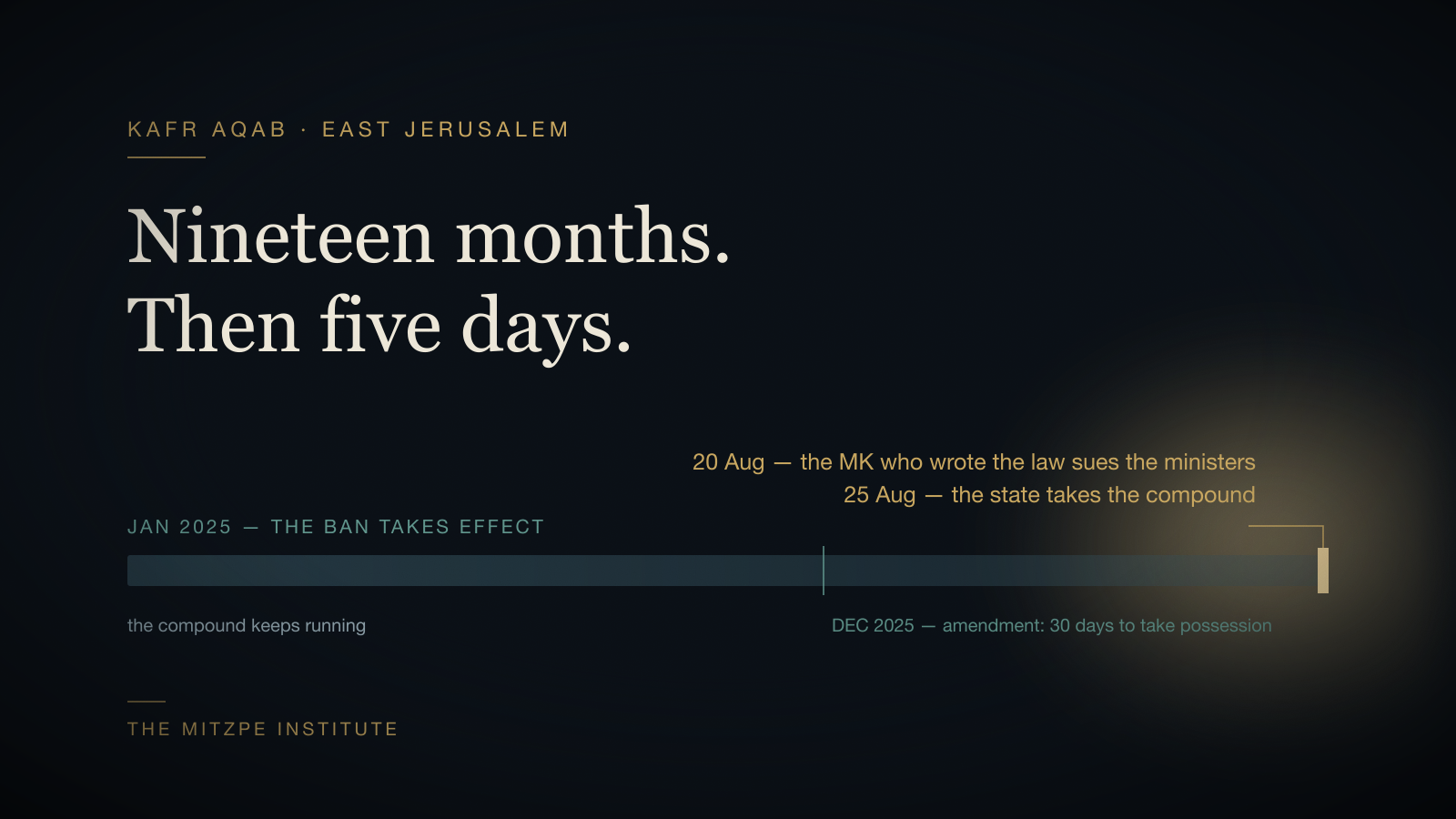
The last UNRWA compound in Jerusalem was excised like a malignant tumor on 25 August, nineteen months after the law banning the agency took effect. What finally made it happen was a lawsuit from the Knesset member who wrote the law. She sued the ministers responsible for enforcing it five days before the forces arrived.
The Knesset banned UNRWA from territory Israel holds as sovereign in 2024, eastern Jerusalem included, and the ban took effect in January 2025. A December 2025 amendment went further and authorized the state to take possession of two named sites outright: Ma’alot Dafna and the Qalandiya vocational training center in Kafr Aqab. Ma’alot Dafna was taken in January. Kafr Aqab kept running.
The amendment set a thirty-day deadline on Kafr Aqab. The state missed it. The Jerusalem Municipality asked for security forces in January and was told the forces were not available (and that answer held for seven months). The agency went on enrolling students the whole time. Registration for the year starting 1 September was still open in August, on UNRWA’s own account.
On August 20, Yulia Malinovsky, the Israel Beytenu MK who initiated the legislation, petitioned the High Court against Itamar Ben Gvir and other ministers over their failure to implement her own law. She was joined by the organization B’Tsalmo and by Yaakov Samerano, whose son Yonatan z”l was murdered on October 7 and whose body an UNRWA employee carried into Gaza. The petition asks the court to require the police and the IDF to supply the forces, or to set a binding deadline. Five days later the forces arrived.
Ben Gvir arrived with them, called it history, and posted a photograph of the Israeli flag over the entrance captioned “UNRWA in our hands.” Netanyahu had asked him not to go, and when that failed, asked him to keep a low profile. He turned up with a Channel 14 crew. Malinovsky accused him of taking credit for an operation her petition forced: “Without my High Court petition, and if we were not in an election period, he would have continued sleeping.” They are arguing about who removed UNRWA from Kafr Aqab, seven months after the deadline to do it expired.
The petition may not even be spent. The court has not ruled, and the case resolves only if the state confirms it has formally taken possession of the site — not merely that municipal contractors were let through the gate.
Israel legislated and then found that legislating it and doing it are separate projects with separate budgets. Somebody has to find Border Police for a walled compound on the far side of the security barrier, in an election year, when every unit is already spoken for. For nineteen months nobody did, and the agency the Knesset had banned went on teaching.
Something real closes with it. The center opened in 1952, the first training center UNRWA built, and it trains about 340 young Palestinians a year, by UNRWA’s count, from across Judea and Samaria — carpentry, masonry, car mechatronics, telecommunications, sixteen trades in all. Israel does not have to pretend otherwise. Netanyahu gave the reason that day: the state “will not allow an organization whose employees were involved in terrorism and in the October 7 massacre to operate on its territory.” That does not soften because the agency also teaches carpentry.
The Jerusalem Municipality is putting more than forty million shekels into the first stage of what replaces the center, and said a municipal boys’ high school would open with the start of the school year. The longer plan adds more schools, a mosque, and sports and health facilities for the Arab residents of the neighborhood. None of it was improvised. UNRWA itself dates the municipality’s plan for the site to April.
Kafr Aqab sits at the northern edge of Jerusalem, inside the municipal boundary and outside the security barrier. Israel’s Foreign Ministry says the Jewish National Fund has owned the plot since 1937 and allocated it to the city, and that UNRWA holds no property rights there. The ministry’s charge is that the agency fenced off land local residents needed for schools and public services.
UNRWA’s account is that Jordan made the land available under an agreement concluded in October 1952, fifteen years before Israel took eastern Jerusalem, and that the training center is a United Nations installation, inviolable and immune from legal process. The property fight will be argued for years. The day before the forces arrived, the Palestinian Authority’s foreign ministry walked twenty-eight diplomatic missions through the compound.
Kafr Aqab was not the only place the municipality went this summer. In mid-August UNRWA said municipal personnel had broken locks at its school, health center, and community services office in the Shuafat camp. The city argued the same thing there: private owners, a usage agreement it holds, rent the agency never paid. The argument in both is about title.
The law named two compounds in Jerusalem, and both are out now. Ma’alot Dafna went in January. Kafr Aqab took seven more months, a High Court petition against the minister responsible for supplying the police, and the woman who wrote the law telling the country he would have gone on sleeping without it.