


Distinguished Professor of Sociology Emeritus CUNY
No Escape from Israel
I have just returned from a month of travelling in Europe – primarily Norway – followed by an equal number of days in the U.S. northeast, where I lived for most of life before moving to Jerusalem. Escape is particularly necessary for those who, like me, live in the small country of Israel that has been at war for nearly two years. This war has been not only with an array of enemies in our neighborhood – Hamas, Hezbollah, the Houthis, (perhaps now also Qatar) and of course the Islamic Republic of Iran, who manipulates and encourages the others to work for the elimination of Israel. There has also been a war among ourselves — and except for a short respite on October 7 — has gone on even longer. On one side are religious nationalists, Haredim, supporters of the Netanyahu government, and those who are ready to sacrifice democracy as well as the remaining hostages in order to expand the borders of the state and remain in power and diminish the presence of Arabs among us. On the other side, those who seek to protect democratic freedoms, support a liberal democracy, put saving the hostages above all else, and move quickly to free and fair elections as well as a peace with our Arab neighbors, near and far. Both these political and military conflicts have taken a heavy toll in blood and in spirit — on all sides. Even recent immigrants like me, who fulfilled their Zionist dream, have been beaten down by these wars.
Despairing of an imminent end to these hostilities, my wife and I took off on our getaway. It was a complicated journey since many airlines that used to serve our peripatetic Israeli population have ceased serving our airports and entering our airspace while the war rages. These days, most departures and arrivals to Israel must be via Israel-based air carriers. It is a reminder that Israel is not the center of the world, but a small country in the Middle East whose portal is either by sea or air. The long road trips that were once available to me in America that has the geographic room to go away without having to cross often hostile international borders are not part of an Israeli reality.
In our hoped-for vacation holiday, what we discovered when, after a series of complicated connecting flights, we reached our various destinations, was that just because we were at last beyond our country’s physical borders, the wars in Israel were still with us. No escape, no forgetting where we live.
Arriving in Norway, in addition to the ubiquitous Norwegian flags, we noticed several Ukraine flags, clearly displayed as a public sign of sympathy for this embattled country, which had been brutally attacked by Norway’s neighbor, Russia. I thought to myself, why is the flag of Israel, who likewise, was brutally attacked by its neighbors, not displayed in a similar way? Had we not had our innocent citizens slaughtered by our neighboring enemies? Had not our civilians been murdered and abused, been abducted and held hostage, as had the Ukrainians? They were fighting back as did we.
Like Ukraine, we were dependent on arms from America. Like them, we looked for support, both diplomatic and strategic, from the free world. There was of course the thought – endemic to a child of Holocaust survivors like me – that Israel is a Jewish state, the only one in the world where we are a majority, a government, and have a defense force. For thousands of years, we were barely tolerated minorities living in ghettoes, or precariously in someone else’s state. The free world, and certainly Europe as well as parts of the Muslim world, does not have a long history of sympathy for Jews, the oldest but smallest of the Christian and Muslim faiths that dominate much of the world. Truth be told, it took the genocidal slaughter of six million of our people to get the fledgling United Nations to vote to grant us statehood and barely a generation for people to start to deny the evidence of the Holocaust, and even less time to forget the insecurities that my people lived with in the seventy-seven years as Israel turned itself into a state in a hostile neighborhood. Maybe that was why we were not loved.
Was the problem that Israel fought back and with overwhelming force and tactical success and that our intelligence services that proved to be too remarkable? Was it the divisions among us and our growing nationalism and the endless inability to make peace with or show respect for our Palestinian neighbors that undermined the brief sympathy the world had for us in 1947, 1967, 1973 and then after October 7th that led increasingly to a perception that in these days has led to a growing perception that we had brought this war on ourselves with our divisions over the Netanyahu government’s ill-conceived ‘judicial reform,’ that inflamed political divisions among us and gave our enemies the impression that these conflicts were tearing the fabric of our state and make us distracted, weak, and easy defeat? Was it our failure to come to terms that we share a land with a Palestinian people who cannot allowed to share the same benefits of democracy we demand for ourselves?
While we who demonstrated both for and against the judicial reform and for an end to the occupation believed that this public dispute showed our democracy at work, there was some truth to that widely held impression held by those outside Israel and some inside too that we were tearing the fabric of life in our common home. While all this went on our government and military were caught unprepared and it

showed.
The nearly two-year war, though initially militarily successful, has become for the government that had failed to protect us and for our enemies an end in itself. Lacking a real strategy and an end game the Netanyahu right wing government coalition keeps on fighting without any idea of what real peace requires, as do Hamas and Iran whose battle also has to end game in which peace is an option. All survive politically only by virtue of war. What had been a quick counter-punch after October 7th, reminiscent of our comebacks in other wars, has because of the Netanyahu’s government’s and our enemies’ failure to have a concrete vision of peace become a slog and a war of attrition. With no clear end in sight, it leaves us all wanting a change. In the process, as the cliché goes, everyone seems to have snatched defeat from the looked like the jaws of victory. And in the process we have lost the sympathy and support of the world.
If there was any doubt that Ukraine retained the sympathy of the Norwegians and others while Israel did not, the answer was posted clearly in the graffiti we saw on the walls in Norway. These displayed the contempt for Israeli overkill and its lack of a clear moral vision for how to solve the reasons for the war. In Oslo, the city once associated with the phrase “peace accords,” the walls were a tableau of scrawls like “Israel War Criminals” and “Israel terrorist” and instead of the tallit-
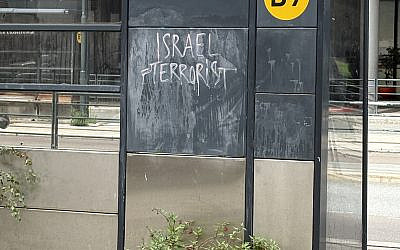
Photo S. Heilman
colored flag with the star of David in the middle. I saw many more Palestinian flags, while even on the heavily guarded and camouflaged Oslo synagogue, there was no sign of the Israeli flag.

Photo: S. Heilman
As we travelled through the fjords and over mountains, hoping to be wrapped in the beauty of Norway’s natural marvels, we were often asked where we were from. To answer that question, we once again were reminded we were Israelis. We needed to guess whether to reveal our home. Were we from Israel or America? Neither of these two were terribly popular these days – in large part because of their governmental leadership and their actions. But for the moment, America was less stigmatizing. What to say?
Paradoxically, it was to the American evangelicals we met to whom we revealed ourselves as coming from Jerusalem. Our instinct was right.
“Oh, we love Jerusalem,” they responded. In most cases we guessed correctly.
But the fact that my wife and I spoke to each other in our American-accented English and were not with other Israeli travelers made people assume we were from the U.S., and that still felt safer. How ironic: the state that was supposed to make Jews safe after the Holocaust, the place where Jewish national sovereignty was reclaimed after two millennia, the state for which we had abandoned our American life, had now made many Jews actually feel less safe in the world. The state that said “never again” made many who had forgotten the Holocaust say “not again!” Israel attacked…. “Not again.”
I suppose it should not have surprised me in Europe, where our near genocide happened.
But to my chagrin, in the America where I grew up and spent most of my life, things were not all that different. By the time we arrived back in the U.S., the campuses had long turned on Israel, and the opposition to Israel was in full view. Jewish people who were associated with surviving a near genocide were now being increasingly labeled as perpetrators of it. Many so-called “liberals” had turned on Israel and along with the old-time rightist anti-Semites people like us seemed edging toward pariah status.
Even in the White Mountains of New Hampshire where we went to hike and swim, we were confronted by stickers on lamp poles that labeled Israel as a genocidal terror state and boosted the Palestinian cause – as if it was either/or: either you support Israel or the Palestinians. And when I visited my home town of Brookline in the Boston area, there was news of anti-Semitic acts there. Americans seemed to have a hard time imagining someone could feel sympathy for both, and recognize that both peoples were hostages of their extremist governments and leadership.
In Israel the majority still seem to think wrongly that the Trump-dominated US is in support of Israel, but up close, that is simply not an accurate portrait. In the perception of American Gen X and Gen Z (or Zoomers, as they have been called), the reputation of Israel is not as a small Jewish state formed in the shadow of the Holocaust, fighting for its survival (as people of my generation and my parents perceived it). For them, Israelis are conquerors, and their state is the strongest power in the Mideast, capable of imposing its will. Their commitment to peace is not taken for granted. Taking America’s support into the future as a given would be a tragic mistake.
Those who say that the growing Orthodox community, now firmly in the Republican camp, will act as a counterweight to the deterioration of Israel’s reputation are also fooling themselves. The Republicans are anything but predictable, as is Trump who has molded them in his image. Moreover, their constancy in supporting Israel is far from assured. As for the Orthodox they are not all the same. I visited my old modern Orthodox pro-Israel shul on my way home. A surprise visitor from Israel – other than me – was there for Shabbat: MK Simcha Rothman, the member of the Tzionut Hadatit party whose family immigrated from Cleveland, Ohio and who is deeply involved with the government coalition’s attack on the judiciary. While the shul rabbi, a Haredi sympathizer and right-winger (whose Israeli children do not serve in the IDF), extolled Rothman and used the Bible portion which speaks of Israelites at war as a template for what the Almighty tells us how to fight a war and used his sermon to suggest his sympathy for the Israeli government’s prosecution of the war, many of his congregants were outraged not only at the rabbi’s remarks but also at the sudden invitation to Rothman to be a guest speaker, and only a minority came to his talk later in the day. (I did wonder why Rothman was willing to answer questions of Jews in an American suburban synagogue but not in Israel, where his actions have real consequences for the people in the audience.)
So now I am back home in Jerusalem, and rather than returning refreshed and ready for the new Jewish year, hopeful for the “besorot tovot,” the ‘good tidings’ that everyone here keeps wishing one another, I am troubled that after two years, we are still fighting. People are still dying from the war in Gaza and the nationalist actions in the occupied territories. As this week’s attack in Jerusalem that killed six Israelis and the war in Gaza that killed four young soldiers, and yesterday’s Israeli attack on the Hamas leadership in Qatar as they were presumably meeting to consider the latest ceasefire and hostage release proposal that Israel had already accepted has once again left us no closer to peace than we were when I left – and maybe further.