
Teacher and activist in Jerusalem
Featured Post
Australia is no longer my second home
When I moved to Israel, I was fulfilling a dream, not escaping the intolerable. Recent immigrants from down under cannot say the same
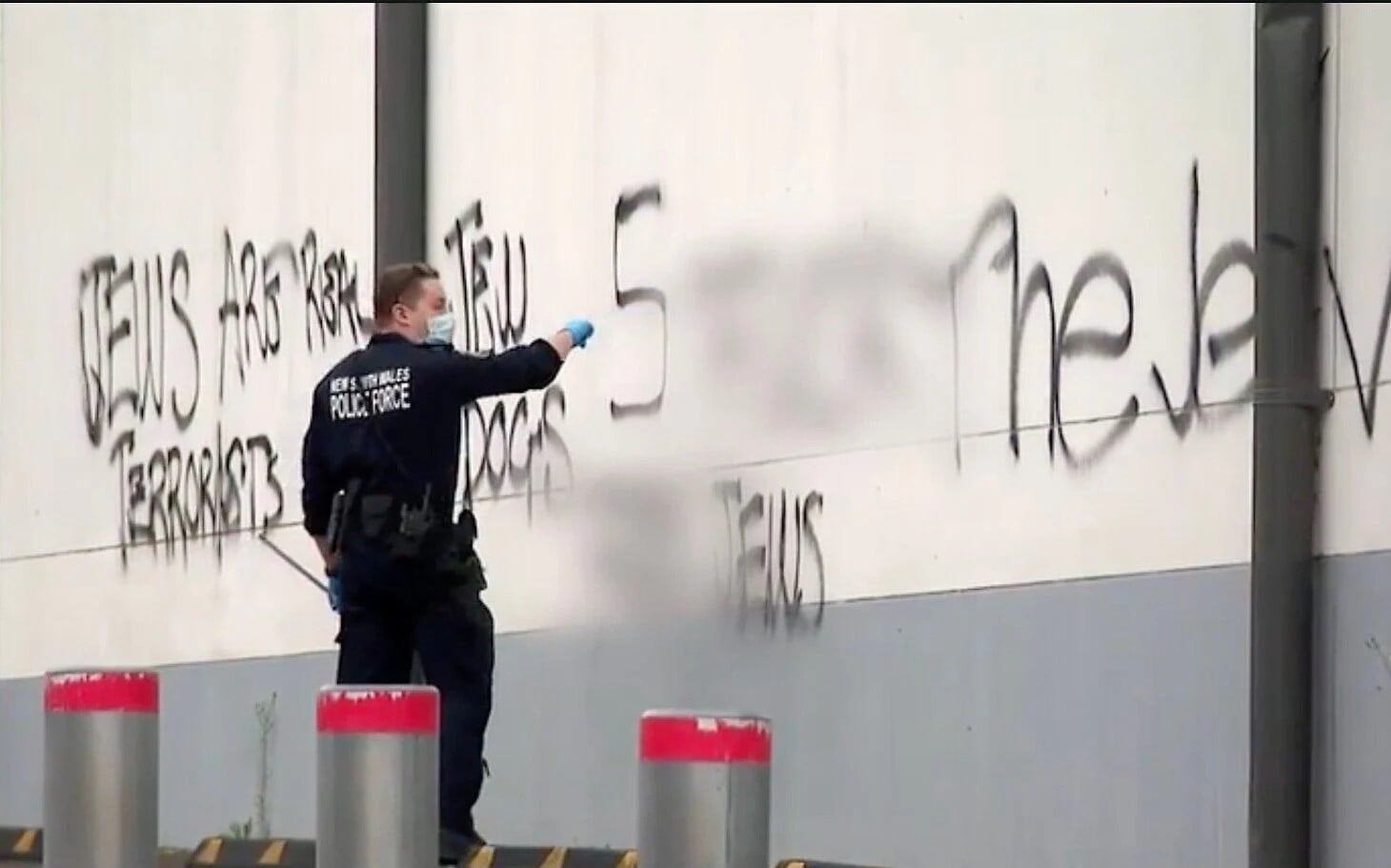
Screen capture from video of antisemitic graffiti found in Sydney, Australia, January 30, 2025. (9News. Used in accordance with Clause 27a of the Copyright Law)
Australia — the place of my birth, the birth of three of my children and the birth of my father, my grandmother and my great-grandfather — I am perplexed, ashamed, shocked, horrified… all of that and more. When I moved here, I thought that Australia would always be my second home. I no longer think so.
Who would have believed that the levels of antisemitism could have risen so much so quickly?
Who would have believed that the government would give the antisemites fuel?
Who would have believed that the public media would join the throng?
When SBS radio stopped the program from Israel in 2024, it was a warning of worse to come. Much of Australia’s media simply does not want to hear Israel’s side of the story.
Antisemitism is not new to Australia or the world. In 1938 at the Evian Conference, Australia’s chief delegate, Colonel T. W. White, declared: “as we have no real racial problem, we are not desirous of importing one by encouraging any scheme of large-scale foreign migration,” thus denying refuge to Jews trying to escape Nazism.
Not only was his response callous but it was false. Jewish immigrants arrived in Australia as early as the late 18th century. Despite their contributions to Australian society, Jews faced discrimination and prejudice from the right and from the left. Antisemitism appeared in forms ranging from casual stereotyping to organized hate campaigns, reflecting global trends of prejudice and scapegoating. A survey of cartoons in newspapers from the 19th and 20th Centuries show that Jews in Australia were subject to the same stereotypes that were to have fatal consequences in Europe.
During the 20th century, the horrors of the Holocaust led to widespread condemnation of antisemitism, yet subtle forms of discrimination persisted. The Australian Jewish community, protected by strong anti-vilification legislation, responded by building schools, synagogues, and cultural institutions, fostering resilience and solidarity in the face of prejudice.
In recent years, and particularly since October 7th, 2023, antisemitism in Australia has taken on alarming new forms. Reports of vandalism, hate speech, and online harassment targeting Jewish individuals and institutions have increased. Synagogues and kindergartens have been defaced with graffiti, Jewish students have faced bullying, and social media platforms have become hotbeds for propagating antisemitic conspiracy theories.
And I return to the conventional media. I remember during the Second Lebanon War in 2006, the nightly television news featured graphic pictures of the death and destruction in Lebanon inflicted by the Israeli army without ever contextualizing what was happening.
If I were an ordinary Australian, I am sure I would have seen Israel as an evil aggressor. What was particularly difficult for me was that at that time, my son was serving in the IDF. I maintained hope in Australia because of the support I received from colleagues and friends in the interfaith community in which I lived. What was particularly heartwarming was the concern and care I experienced from church leaders, even when their churches’ positions were very hostile to Israel. Mother to mother, women religious leaders overrode ideological positions to support a friend in distress.
That is not the case today. Jewish women and men, whether they have family or friends in Israel (as most do) or not, are accused of complicity in the murder of Gazan children. There is no sympathy for the stress they are under. The Australian Jewish community is seen as synonymous with the Israeli government, as if they support every action they take.
I admit that the Jewish community itself contributes to this association. In its attempt to show solidarity with Israelis, it can appear to unconditionally support the government. There is little room for the voices of those who support the Israeli opposition, much less the Israeli left.
So, Australian Jews are held accountable for what Israel does. And, as far as the media goes, Israel does only one thing — war!
Australians are bombarded with images of Gazans in dire situations, including repeating images of death and of distressed children. There is minimal coverage of the havoc in Israel: there is no awareness of the displacement of thousands of people here and there is no appreciation of what it has taken to protect the civilian population so that even when we attacked by hundreds of sophisticated and dangerous weapons, our death toll is not high.
Somehow, that has become a cause of criticism rather than one of appreciation.
Legitimate criticism of Israel should be welcomed. It is part of the freedom of thought and speech which we value. Hurtful as it may be to hear the country which we love condemned for particular decisions or actions, we should be able to listen.
But what is happening in Australia is well beyond legitimate criticism. There is a delegitimization of the very existence of Israel. Calls “from the River to the Sea” are calls to wipe Israel off the map and, with it, to eradicate the people who live there. There are also calls to eradicate Jews, who are seen as inextricably connected to Israel.
I want to make it clear that I do not believe that all Australia is antisemitic. I myself have been heartened by the support I have experienced from friends, including a friend from over 50 years ago who made a point of getting in touch to express her concern.
But the very fact that she felt the need to renew contact underscores the change in the attitude towards Jews and Israel that she sensed.
The rise of antisemitism in Australia calls for urgent attention and action. While the roots of this prejudice run deep, it is within the collective power of Australian society to confront and eradicate these harmful attitudes. Through education, advocacy, and unity, Australia has the potential to reaffirm its commitment to a multicultural and tolerant future, ensuring that antisemitism has no place in its communities.
I hope that by the time I visit Australia at the end of August, the war in Gaza will be over. Only then, will it be possible to have a rational assessment of what steps need to be taken to restore a sense of security to Australian Jewry as they, together with fair-minded Australians, tackle the damage that has been done by the media coverage of that terrible tragedy. The war has given antisemites cover and they need to be exposed.
When I left Australia to move here, antisemitism was the last thing on my mind. I left to fulfill a dream, not to escape the intolerable. The same may not be said of Australians who come to live here now. Welcome to you all. History suggests that it may be safer here than there — even when rockets are fired at us by Iran and its allies, aimed not at military targets but at all of us, including hospitals.
However, it would be much better if we could change the trajectory of history and make Australia safe again, so that Jews come to Israel not out of fear but out of love and perhaps, like me, a drive to make this society better. It would be great if Australian Israelis could feel that they had two homes in which they were welcome.
Related Topics