No Longer Home

A lifelong Democrat reflects on the hardest box he’s ever checked.
I wasn’t expecting Boy George to play any role in a deeply personal political decision.
Last week, the former Culture Club frontman released We Will Dance Again, a song honoring the victims of the October 7 Hamas massacre and expressing his solidarity with Israel and the Jewish people. The reaction was immediate and predictable. Admirers praised him. Critics accused him of betraying progressive values. Social media did what social media always does.
But it wasn’t really the song that stayed with me. It was the courage behind it. The willingness to say something he knew would disappoint many people who had long assumed he was on their side. That kind of courage seems increasingly rare—not because people lack convictions, but because expressing them sometimes comes with a price.
Watching Boy George reminded me that there comes a moment when conviction matters more than comfort—when saying what you believe becomes more important than remaining in good standing with your own tribe.
Earlier this week, Abdul El-Sayed won Michigan’s Democratic primary for the United States Senate. His victory wasn’t the reason for my decision. It was the moment I finally stopped pretending my decision hadn’t already been made.
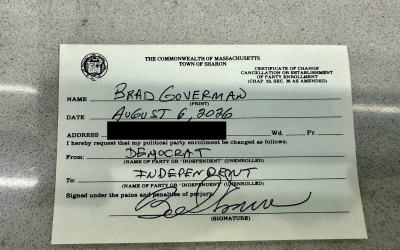
After spending virtually my entire adult life as a Democrat, I have decided to change my voter registration in Massachusetts to Independent.
I made this decision not in anger, but with sadness. One election did not drive me from the Democratic Party. One candidate did not suddenly change my politics. If that were true, I would have left years ago. This decision has been building inside me for a long time. The Michigan primary simply forced me to acknowledge what I had been reluctant to admit, even to myself.
The Democratic Party no longer feels like home. I never imagined I would write those words.
To understand why that sentence was so difficult to write, you have to understand what being a Democrat once meant to me.
I came of age politically during Watergate. I admired George McGovern, later volunteered on Barney Frank’s first congressional campaign, and celebrated Barack Obama’s election. Even when I disagreed with Democratic leaders—and there were many times that I did—I never questioned where I belonged.
I wasn’t a Democrat because I agreed with every policy or every candidate. I was a Democrat because I believed the party represented something larger than itself. It championed civil rights, religious liberty, pluralism, and the belief that Americans from every background could build a common democratic future. It believed government could improve people’s lives without becoming the center of them. It believed that immigration and pluralism wasn’t a weakness to be tolerated, but a strength to be celebrated.
For most of my life, I believed the Democratic Party best embodied those values. That is why this decision has been so painful. I’m not walking away from a political label. I’m walking away from a place that shaped my understanding of public life.
That doesn’t happen because of one election. It doesn’t happen because of one candidate.It happens only after years of telling yourself the loudest voices don’t represent the majority and that the fever will eventually break.
I wanted to believe that. Perhaps more than anything else, I wanted to believe that the Democratic Party I had spent a lifetime supporting would eventually find its way back to the broad, liberal coalition that first inspired me to join it.
Instead, I found myself asking a question I never imagined I would ask.
Had the party changed? Or had I simply been the last one to notice?
For a long time, I wasn’t sure there was an answer. Then came October 7.
October 7 did not change my support for Israel.
October 8 did.
Not because Israel changed. But because the reaction to October 7 changed the way I saw the people with whom I had stood politically for most of my adult life.
Like millions of people around the world, I watched in horror as Hamas carried out the deadliest massacre of Jews since the Holocaust. I expected fierce debates about what would follow. Democracies argue. They always have. I welcomed those debates.
What I did not expect was how quickly the conversation moved past the massacre.
Before Israel had launched its military response, demonstrations were already celebrating what many called “the resistance.” Student organizations blamed Israel before the victims had even been buried. Chants that I once assumed belonged only on the political fringe suddenly echoed across college campuses and city streets. Jewish students found themselves needing security escorts at universities where they had previously felt perfectly safe.
I kept waiting for something that, until then, I had taken for granted. Moral clarity. Not unanimity. Not unquestioning support for Israel. Just the ability to say that deliberately murdering, raping, kidnapping, and terrorizing civilians is wrong, regardless of the cause in whose name it is committed.
Reasonable people can disagree about almost everything that followed October 7. They can disagree about the conduct of the war. They can disagree about settlements. They can disagree about Benjamin Netanyahu. They can disagree about American military aid.
Those are the kinds of arguments democracies should have. What I found increasingly difficult to understand was why it had become controversial simply to affirm that Hamas bore moral responsibility for the massacre it had meticulously planned, proudly celebrated, and repeatedly promised to carry out again.
That was when something inside me began to shift. Support for Israel was no longer simply being debated. Increasingly, it was being treated as evidence of moral failure. Zionism, once understood by many liberals as the national liberation movement of the Jewish people, was increasingly portrayed as something shameful—something to explain, apologize for, or renounce altogether.
I don’t believe that describes most Democrats. I know too many thoughtful Democrats to make such a sweeping claim. But politics is shaped not only by where a party stands today. It is shaped by the direction in which it is moving.
I gradually realized this wasn’t just about Israel anymore. Israel had become the lens through which I began seeing broader changes within the political movement I had called home.
Debates over Zionism, antisemitism, identity, free expression, and liberal democracy no longer felt isolated. They reflected a deeper shift in how the party understood power, history, and moral responsibility.
Whether that perception is entirely fair is almost beside the point.
Once I recognized it, I couldn’t unsee it.
For the first time in my life, I found myself wondering whether there was still room within the Democratic coalition for someone who believed deeply in liberal democracy, pluralism, civil rights, and social justice, while also believing that the Jewish people have the same right to self-determination as every other people.
That question has been with me ever since.
Earlier this week, those questions found their way onto the ballot in Michigan. Abdul El-Sayed won the Democratic nomination for the United States Senate.
It would be easy to overstate what happened. El-Sayed did not win by the double-digit margin that several polls had predicted. He did not even win a majority of the vote. He prevailed by roughly one percentage point in a closely contested primary.
That narrow margin matters. It tells me the Democratic Party remains deeply divided over its future. I find that encouraging. But El-Sayed still won.
This is not really an essay about Abdul El-Sayed. Reasonable people can support him. Reasonable people can oppose him. Elections are supposed to be contests between competing visions of the future. What concerns me is not simply his candidacy. It is what his candidacy revealed.
El-Sayed has described Israel’s conduct in Gaza as genocide, called for ending or sharply restricting U.S. military aid, and, in a CNN interview, described the Israeli government as “pretty damn evil.” Asked whether the same description applied to Hamas, he replied, “We can say both.”
That answer has stayed with me because it places a democratic government and a terrorist organization on the same moral plane. That distinction matters. Not only for Israel. For democracy itself.
During the campaign, El-Sayed promised that he would protect Michigan’s Jewish community as fiercely as he would protect his own daughters. I do not question the sincerity of that promise. Every public official should be committed to protecting Jewish Americans from hatred, intimidation, and violence.
But a few days ago, Rabbi Steven Abraham wrote a sentence that crystallized something I had been struggling to express.
“A promise of Jewish safety cannot be severed from the question of Jewish sovereignty.”
That sentence stopped me. Of course I want my senator to defend Jewish Americans against antisemitism. Every elected official should. But Jewish history has taught us that protecting Jews as individuals is not the same as recognizing the Jewish people’s right to protect themselves collectively.
Since 1948, that protection has taken the form of the State of Israel. I don’t expect politicians to support every Israeli government. I do expect them to recognize that Jewish sovereignty is not simply another foreign-policy question. For many Jews, it is the answer history painfully taught us to seek.
That is why the Michigan primary affected me so deeply. Not because it settled the future of the Democratic Party. It didn’t. Not because it guarantees Abdul El-Sayed will win in November. It can’t.
It affected me because it crystallized a question I had been asking myself for nearly two years. Can I honestly remain a member of a political party whose future increasingly appears comfortable blurring that distinction?
For me, the answer—painfully—became no.
If you’ve read this far, you may be asking the obvious question.
If not the Democratic Party, then where?
The honest answer is that I don’t know. If you’re expecting me to announce that I’ve become a Republican, you’ll be disappointed. I haven’t. If you’re expecting me to tell you that I’ve found a new political home, I can’t honestly say that either. I haven’t.
Changing my voter registration doesn’t change my values. Tomorrow morning I’ll still believe in liberal democracy, civil rights, religious liberty, equal opportunity, and the Jewish people’s right to self-determination.
Those convictions have not changed. My political address has.
Perhaps I’m wrong. Perhaps the Democratic Party will once again become the broad, pluralistic coalition that first drew me to it. Perhaps support for Israel, opposition to antisemitism, and belief in Jewish self-determination will once again feel ordinary within the party.
I hope so.
Because despite everything I have written, I take no satisfaction in leaving. You don’t celebrate walking away from a place that shaped you. You mourn it. For most of my adult life, I was proud to call myself a Democrat. I hope that one day I will be again.
Until then, I can no longer pretend that I am home.
So today, I walked into Sharon Town Hall and checked a different box.
It took less than five minutes.
It took me fifty years.