
Geopolitical Advisor | Foreign Policy | Defense & Security
No TACO, Ayatollah!
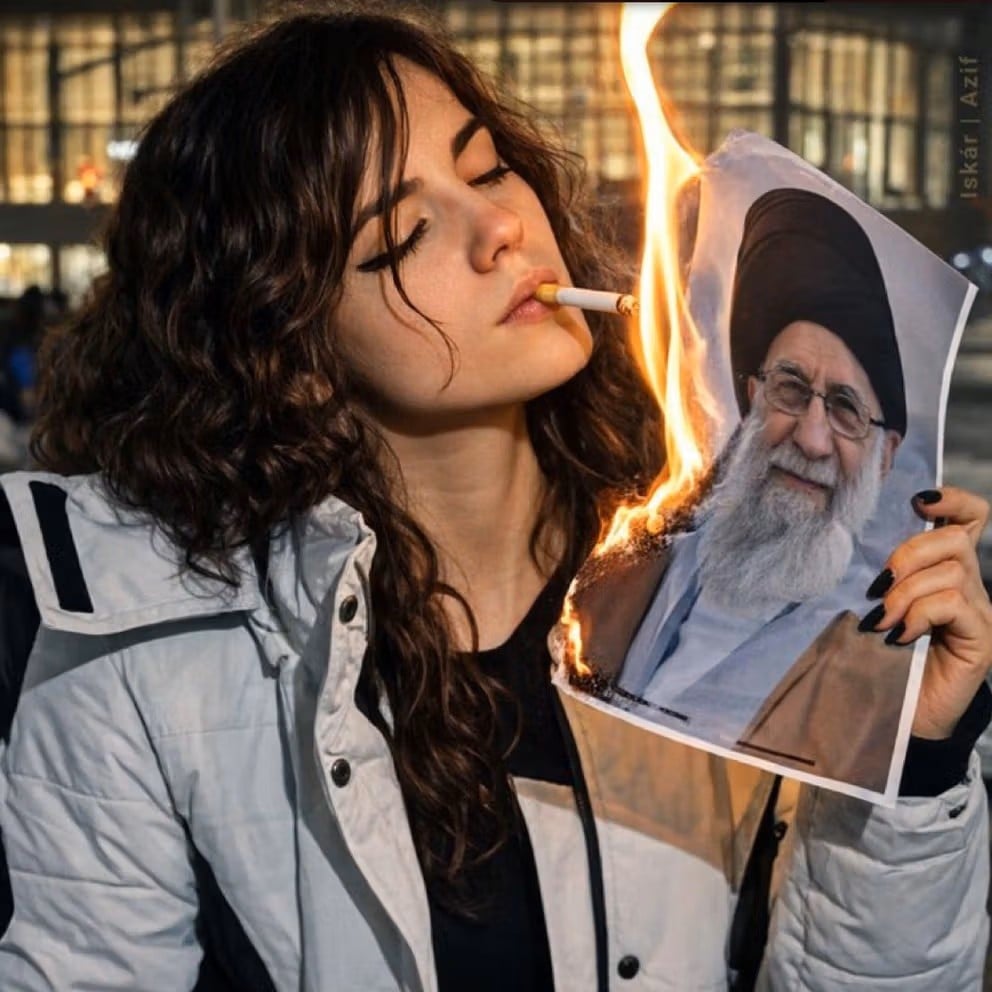
A woman burns a photo of Iran's Supreme Leader Ayatollah Ali Khamenei and uses it as a cigarette lighter. /X
Why Bipartisan Western Hesitation Has Left a Terrorist Regime in Place for 47 Years
For too long, Tehran has operated with a single assumption: when the moment of maximum pressure arrives, the West will blink first. From the corridors of Washington to the capitals of Europe, policymakers have promised resolve, only to revert to diplomatic ambiguity, tactical concessions, or tactical retreat. It is high time to remove this terrorist regime — not because Iran is invincible, but because Western strategy has lacked consistent teeth.
In July 2015, the Joint Comprehensive Plan of Action (JCPOA) was labeled one of the most consequential diplomatic agreements in decades. In theory, it was supposed to cut Iran’s enriched-uranium stockpile by 98 percent, slash the number of centrifuges, and subject Tehran’s nuclear program to rigorous monitoring by the International Atomic Energy Agency. In exchange, the West offered immediate relief from sanctions that had crippled the Islamic Republic’s economy. For a brief moment, many believed proliferation risks were meaningfully constrained.
Iran proved otherwise. Behind the façade of compliance it accelerated toward nuclear weapons — weapons intended not merely for regime survival (as with North Korea or Russia) but for the destruction of the Jewish state. The regime’s nuclear ambitions cannot be separated from its ideology. Supreme Leader Ali Khamenei declared in 2015 that “Israel will not exist in 25 years.” The Islamic Republic’s founder, Ruhollah Khomeini, described Israel as a “cancerous tumor that must be removed.” Former president Mahmoud Ahmadinejad spoke of the “regime occupying Jerusalem” vanishing “from the page of time.” This is not the language of conventional deterrence. It is the vocabulary of an Islamist terrorist mission.
The JCPOA’s promise failed not because Tehran suddenly grew stronger, but because Western governments never anchored the deal in a coherent, long-term strategy. European and U.S. efforts to revive it continued during the Biden administration even as Moscow openly boasted of leveraging the process on Tehran’s behalf.
To be clear: this is not simply an American problem or a European one. It is a transatlantic pattern of reactive, short-term policymaking that has repeatedly rewarded Iranian intransigence. American administrations — Republican and Democratic alike — have swung between withdrawal, re-engagement, military warnings, and renewed negotiation, but never sustained a unified doctrine of deterrence. Europe, meanwhile, has oscillated between cautious diplomacy and commercial engagement with the regime, often blocking Washington when the United States was prepared to impose harsher punishment.
The result? Tehran has been emboldened; its proxies have proliferated across the Levant and Yemen; and its nuclear advancements have outpaced any credible safety framework.
The strategic costs are clear: a nuclear-capable Iran would dramatically alter the balance of power in the Middle East, undermine the global non-proliferation regime, and fuel regional instability. Moreover, the mixed signals sent by the West — threats of military action followed by unconditional diplomatic outreach — have taught Tehran that time itself is its greatest ally.
But there is an alternative. The West can still craft a policy grounded in deterrence, clarity, and consistency: articulated red lines backed by credible consequences, not public wish-lists, and a unified transatlantic strategy that treats the Iranian regime not as a negotiation puzzle to be reset every presidential cycle, but as a calculated adversary whose behavior triggers predictable costs.
For now, the United States under President Trump has said — “No TACO, Ayatollah!” (‘TACO’= a 2025 meme which claimed that “Trump Always Chickens Out”).
Trump has joined Israel in confronting the regime that is fresh off killing tens of thousands of freedom-seeking Iranians. He did not “chicken out.” Like the destruction of Daesh’s territorial caliphate, the Summer 2025 U.S. and Israeli strikes on in Iran showed the same truth: when American power is applied decisively, the regime’s destructive ambitions can be set back years. Now is the time to help the Iranian people end the nightmare of this regime entirely!
Make no mistake: such clarity and action protect America from catastrophic surprise, the kind the nation suffered on December 7, 1941 and September 11, 2001. It sends an unmistakable warning to Russia, China, and the rest of the emerging axis: those who plan to destroy the United States will themselves be reduced to a footnote in history.
No TACO for any member of the Axis of Evil — Iran, Russia, China, or North Korea.
This must become doctrine, not merely a slogan. The West must stop yielding at the point of confrontation and commit to a long-term strategy that neither capitulates nor flinches.
Related Topics
Related Posts