


Time for Positive Change...
No Vote, No Referendum, No Comparison
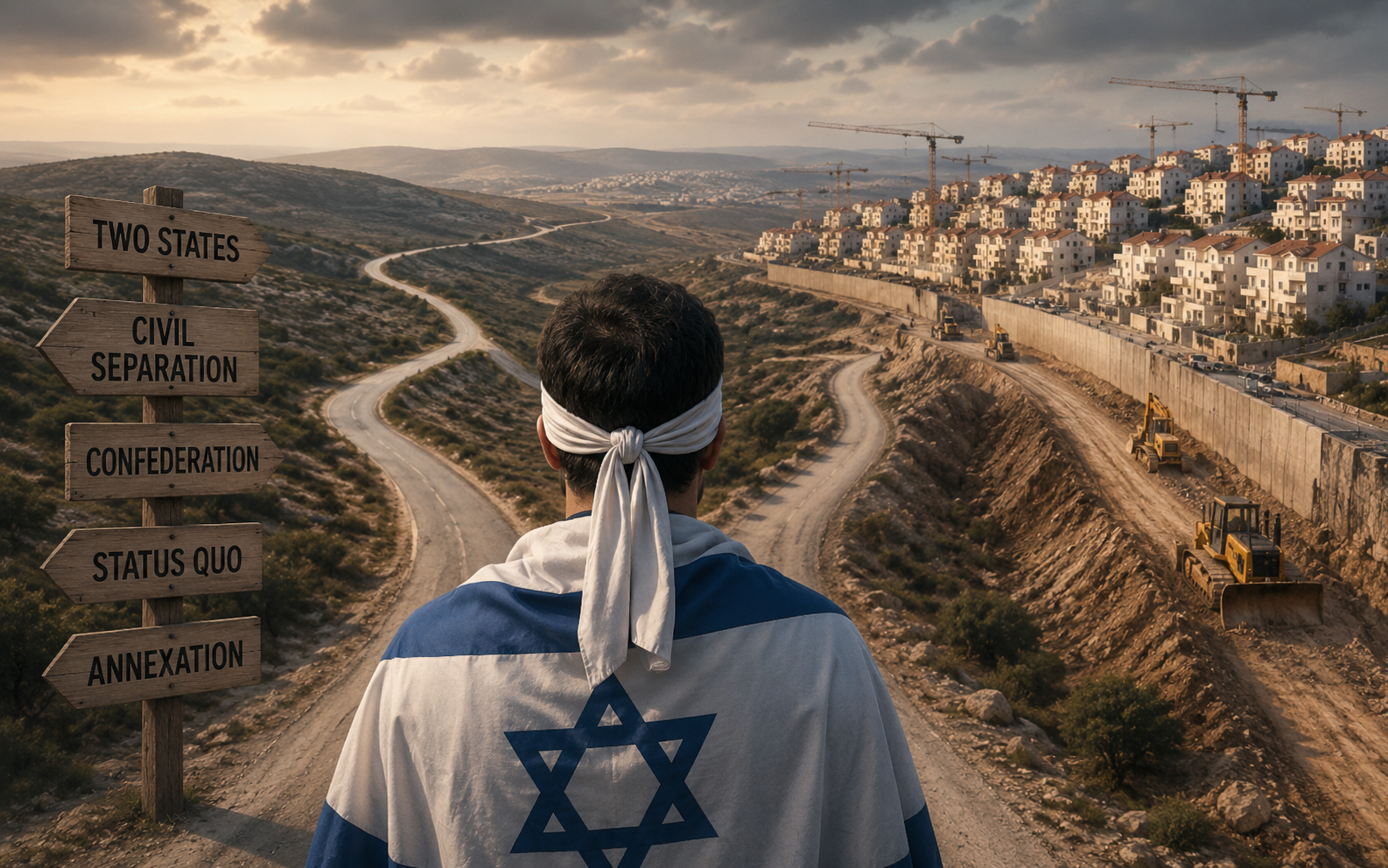
Illustration: AI-generated image created with ChatGPT
Before Israel chooses, it needs to know where each option leads
It worries me when the government appears to ignore warnings from well-regarded Israeli security and policy organizations, and when much of the public is unaware of those warnings.
There has been no vote or referendum asking Israelis whether they want permanent Israeli sovereignty over most of Judea and Samaria, and no government advice on the costs, benefits, impacts and challenges over the next 10 to 25 years of the options currently being considered.
This matters because both Israelis and Palestinians view the future through failed peace efforts, October 7, the Gaza war and years of conflict. Israelis can reasonably look at Gaza and conclude that Palestinian territorial control means danger. Palestinians can look at settlements and conclude that negotiations give Israel more time to take the land. Both perceptions contain important truths. Both can also hide the wider consequences of the policies they encourage.
The decision is already being made
Since October 7, a powerful idea has grown in Israel: greater Israeli control of the West Bank means greater security. This makes intuitive sense. Judea and Samaria also contain places central to Jewish history, as well as the strategically important high ground and the Jordan Valley. October 7 demonstrated what can happen when a hostile armed organization controls territory beside Israel.
However, much of Israel’s real security system has come to be taken for granted. It includes IDF freedom of operation in the West Bank, Palestinian Authority security forces that act against militants, Jordan protecting Israel’s longest border, peace and security cooperation with Egypt, American support, and growing cooperation with Arab states concerned about Iran and regional instability.
Commanders for Israel’s Security (CIS), made up of hundreds of former senior figures from Israel’s security and diplomatic establishments, warned in May that de facto annexation could weaken or collapse the PA and its security services. CIS says those services are valued by the IDF and Shin Bet for preventing attacks and saving Israeli lives. Their collapse could leave Israel policing and administering around three million Palestinians while the IDF is already stretched across several fronts.
CIS also warns of risks to Jordan, Egypt, the Abraham Accords, Saudi normalization and the regional coalition Israel needs against Iran. The Institute for National Security Studies (INSS) similarly argues that annexation offers little security advantage beyond what Israel already has through control of the Jordan Valley, operational freedom and regional security cooperation.
Rather than improving security, INSS and CIS warn that dispersed settlement expansion increases the IDF’s security burden, diverting forces from counterterrorism and preparedness for more serious external threats at a time when the IDF is already under prolonged pressure.
From a security-first perspective, the questions are: a) What are the likely benefits, risks and costs of the government’s current policies? and b) How do they compare with the benefits, risks and costs of the other options now being discussed in Israel?
Administrative annexation is becoming harder to reverse
These questions are urgent because the current government is not waiting for formal annexation. INSS describes a broad change in the West Bank’s legal, property and administrative regime that expands Israeli governance, strengthens settlement control and weakens future political separation. Its April 2026 study describes a “conceptual and practical transformation” toward sovereignty.
In August the government issued a tender for 1,234 housing units east of Jerusalem. The E1 tender closes on October 19, a week before the election. Both supporters and opponents recognize that building there would have major consequences for the territorial continuity of a future Palestinian state.
WHAT DO WE DO?
The CIS, INSS and other former senior Israeli security figures are suggesting variants of ‘civil separation’. This involves reduced day-to-day Israeli-Palestinian friction through greater Palestinian civilian self-government, limits on further Israeli civilian expansion into areas intended for future separation, while Israel retains overriding security responsibility. This can provide breathing space while preserving future options without deciding the final political outcome in advance.
Conduct a strategic reality assessment
In 2020, Dr Shira Efron and Evan Gottesman’s In Search of a Viable Option compared the two-state model with six alternative approaches against common criteria including security, feasibility, political support, costs and Israel’s Jewish and democratic character. While somewhat outdated, it provides a robust model and useful results. It was published in Washington, in English, aimed at policy makers, a couple of weeks before COVID hit.
That work now needs updating for the post-October 7 world. The main families of options include conflict management or the “status quo,” which is increasingly drifting toward de facto annexation; civil or territorial separation; a negotiated two-state solution; confederation or shared sovereignty; annexation; a Jordan-linked option; and Palestinian emigration proposals.
Each should be assessed for Israeli security, military burden, demographics, Jewish self-determination, Palestinian security and dignity, economics, relations with Jordan and Egypt, American support, Arab normalization, implementation risks, spoilers and probability of long-term success. Even options that appear to be non-starters should be included, as some, such as mass emigration, are still presented as realistic.
Palestinians need the same reality test
Palestinians also need to examine what another generation of trying to defeat Israel is realistically likely to achieve, and what it is likely to cost them, in light of the past and the most likely future.
Despite the Gaza war, Israel’s population continues to grow. Its 7.3 million Jewish citizens regard continued Jewish self-determination as essential. It also has a powerful military and strong international relationships. Egypt and Jordan are not preparing another war to remove Israel. The UAE and other Arab states have established relations with it. Saudi Arabia seeks Palestinian statehood within a regional settlement, not Israel’s destruction.
For various reasons, some international campaigns have encouraged the unrealistic expectation that Israel is a temporary colonial project that will eventually disappear. October 7 and the war that followed demonstrated how Hamas was willing to sacrifice its civilian population for PR and Lawfare purposes and how a Palestinian tactical success in Israel can produce devastating Palestinian strategic costs.
There are signs of movement. The August 2026 Palestinian Center for Policy and Survey Research poll found 44 percent viewing negotiations as the most effective route toward Palestinian statehood, while armed struggle had fallen to 27 percent. When offered several political outcomes, 56 percent preferred a two-state solution based on the 1967 borders. This does not mean Palestinian society is ready for a final agreement. It does show that attitudes are not fixed.
Identify the least-worst option
The aim is not to discover a perfect solution. None exists. It is to identify the option with the greatest expected long-term benefit and the lowest unacceptable risks, then strengthen it against its weaknesses.
INSS polling in June 2026 found only 25 percent choosing a two-state solution on its own. Yet 42 percent supported expanding the Abraham Accords within a framework that included a Palestinian state, rising to 61 percent among opposition voters.
A joint Israeli-Palestinian survey found that when the choice was between regional war and regional peace involving two states and Arab-Israeli normalization, 65 percent of Palestinians and 62 percent of Israelis chose peace. The package matters. People can reject a slogan while supporting an outcome that changes their security and regional calculations.
Learn from why Oslo failed
Oslo failed for several interacting reasons. The hardest issues were postponed while settlement growth continued. ‘Spoilers’ on both sides ultimately derailed the process. While there will be spoilers in the future, both sides should have predetermined how they respond, and each should be judged by how effectively it manages them. See below for more.
Fortify the most promising pathway
A future pathway would need a clearly understood destination but conditional implementation. Palestinian authority would expand only as independently verified security and governance benchmarks were achieved. Armed organizations would have to be dismantled, weapons controlled, and Palestinian institutions capable of preventing Hamas, Islamic Jihad or successor groups from deciding Palestinian national policy through violence.
Trust should be earned and not presumed via incentivized conditionality, which must work on both sides. If Palestinians meet agreed benchmarks, Israel must deliver agreed gains. Settlement activity and administrative and other changes that make the agreed destination impossible would have to stop. Palestinian moderates must be able to show that peaceful cooperation produces meaningful results.
Before October 27
Before October 27, Israel should commission an independent strategic comparison, including champions of different models, using its best security, economic, demographic, and regional expertise. The report should not simply be published. The main effort should be communicating its findings to Israeli citizens, as well as to Israel’s regional and international partners. This might include summaries, broadcasts, online discussions, and public forums so that ordinary Israelis understand what each path is likely to mean.
In the meantime, nothing in E1 should be awarded until the above work is done. Bids close eight days before the vote, but the contracts will (or won’t) be signed by whoever forms the next government, and once theyare signed, a political choice has become a contractual obligation.
Making decisions of this magnitude with no vote, no referendum and no proper comparison is not adequate. In Israel’s democracy, an informed public should have the final say.
Selected sources
• Commanders for Israel’s Security, “Security Alert: The Government’s De Facto Annexation Decisions Endangers Israel’s Security”, May 8, 2026.
• INSS, Udi Dekel and Tammy Caner, “A Conceptual Shift in the West Bank: Absolute Security, Decisive Outcome, and the Application of Sovereignty”, April 23, 2026.
• INSS, “The State of Israel’s National Security”, section on halting actions accelerating a one-state reality.
• Israel Policy Forum, Shira Efron and Evan Gottesman, “In Search of a Viable Option”, February 2020.
• Palestinian Center for Policy and Survey Research, “Public Opinion Poll No. 97”, August 12, 2026.
• PCPSR and Tel Aviv University, “The Palestine/Israel Pulse, a Joint Poll”, July 2024.
• The Times of Israel, “Government opens bidding to build 1,200 homes in controversial E1 settlement project”, August 19, 2026.