


Nobody Was Silenced on Ship Street
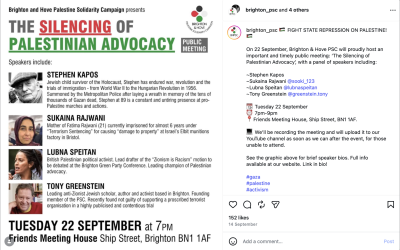
The news broke while I was on my way to Brighton’s Friends Meeting House on Tuesday evening for an event billed “The Silencing of Palestinian Advocacy”. Two men in their thirties had been arrested in Manchester under the Terrorism Act on Sunday, the eve of Yom Kippur, on suspicion of plotting to attack the city’s Jewish community. The Community Security Trust called it “utterly chilling.” Less than a year earlier, on Yom Kippur 2025, Jihad al-Shamie had attacked Heaton Park Hebrew Congregation, and two worshippers, Melvin Cravitz and Adrian Daulby, died.
The timing has a context. Eleven days before the Heaton Park attack, the Labour government recognized the State of Palestine. Two weeks before this latest plot was disrupted, Foreign Secretary Ed Miliband announced sanctions on Israeli settlements in Judea and Samaria, describing them as necessary to “salvage” a two-state solution. Both steps were justified as strengthening the prospect of two states. Both times the Jewish community warned that people who had spent decades trying to kill that prospect would read the steps as a signal that violence pays. No straight causal line runs from Whitehall to a synagogue door. But the sequence is plain to anyone with eyes to see it.
I was uneasy for a more personal reason too. On 5th September 2026 I was not allowed to stay at the launch of the British Chapter of Antifascism International, and I half expected the same here. The organizers, Brighton and Hove Palestine Solidarity Campaign, are a group that stood by a man who assaulted me at the Peace Statue on the seafront, of all places, on 6th December 2025. As it turned out, nothing happened. A couple of people seemed to recognize me, but nobody spoke to me, and the only words I said all evening were an offer of a pen to someone behind me who needed one. The chair told the room that the organizers had “been a bit worried about potential Zionist attacks,” but reassured them that “we’ve got stewards, so we should be fine.” The one Zionist in the room sat quietly and took notes. Then I listened.
The first speaker deserved to be listened to. Stephen Kapos, now 89, is a child survivor of the Holocaust in Budapest. He described wearing the yellow star at the age of seven, and the Arrow Cross militias who marched Jews to the Danube and shot them into the river. He described being hidden in children’s homes run by the Lutheran pastor Gábor Sztehlo, who saved around two thousand Jewish children. He read Miklós Radnóti’s “Fragment”, recovered from the murdered poet’s pocket after his mass grave was exhumed. It was the most affecting part of the evening. Later, though, Kapos spoke about visiting family in Haifa. He said that many of his relatives there who had survived the Holocaust, including a cousin who came back from Auschwitz, were “all, I’m afraid, racists,” and he attributed their fear of Palestinian violence to propaganda that is “completely false.” When a man who survived one attempt to exterminate the Jews treats his cousins’ fear of another attempt as a delusion, it is a measure of how far this politics has travelled.
Sukaina Rajwani spoke next. Her daughter, Fatema Zainab Rajwani, is one of the “Filton Four”, convicted over the August 2024 break-in at Elbit Systems’ factory near Bristol. She described what her daughter did as “dismantling and destroying a shipment of forty killer quadcopter drones.” She said nothing about the stolen prison van driven through the perimeter, or the sledgehammers. Nor did she mention the police officer whose spine was struck from full height by a co-defendant, Samuel Corner, who was convicted of grievous bodily harm. The CPS, she said, had been “in touch with the Israeli embassy.” Then she asked: “Who is really in charge of our judiciary, which is supposed to be independent? Is it Britain or is it Israel?” She said the barrister Rajiv Menon KC was being prosecuted “for defending his clients too well.” In fact he faces contempt proceedings for allegedly defying a judge’s directions in his closing speech. And she said the “terror connection” had been withheld from the jury, as though it were an irregularity.
It is not an irregularity. A finding that an offense has a terrorist connection has been a matter for the sentencing judge since the Counter-Terrorism Act 2008. Parliament widened it in 2021, responding to terrorism that looks less and less like a bomb in a holdall. The same division of labour applies when a judge finds an assault was aggravated by religious hostility: the jury decides the facts, the judge decides whether they meet a statutory test. The Terrorism Act has defined terrorism to include serious damage to property, done to influence government for a political cause, since 2000. A society only functions if some things are certain. Property belongs to its owner. People and their property are protected from attack. Breaking the law brings punishment. The courts apply the laws Parliament passes. Judge and jury each keep to their own roles. The Filton defendants tested every one of those certainties, and so did their advocates in that room.
What Rajwani did not ask was who had put her daughter in that dock. Palestine Action’s own published strategy includes a principle it calls “Sacrifice.” Under it, prison is valued because the sight of activists “willing to sacrifice their liberty for a cause” inspires others to “step up their commitment.” A group that writes this knows the legal consequences better than the twenty-year-olds it recruits. In that room, a young woman’s prison sentence was presented as the system’s crime. It is more honestly described as a sacrifice to a movement that decided democracy was not delivering what it wanted, and a sacrifice that serves the movement as a rallying cry, which is exactly what its strategy intends.
Lubna Speitan followed. She told the room that fifty-six members of her family had been killed, and that her grandmother was expelled from Deir Yassin, following a massacre. Grief on that scale deserves to be heard in silence, and it was. Then she described the motion she has drafted for the Green Party conference, which meets in Brighton from 2nd to 4th October with the motion at the top of the debating priorities. It would declare Zionism to be racism, make the Greens “the first anti-Zionist party,” call for “a single democratic Palestinian state,” affirm “our right to resist by all available means under international law,” and demand that Palestine Action be removed from the list of proscribed organizations.
A motion that can reach the top of a major party’s conference agenda has not been silenced. It is evidence that the party’s structure works as designed, letting members set its course. Members led by people like Speitan are being invited to single out one national movement as uniquely illegitimate, and it happens to be the Jewish one, while Palestinian nationalism is treated as a sacred cause. Speitan also said she opposes “hierarchies of racisms,” apparently without noticing that her motion builds one. She also said that the motion targets the ideology and not the ethnicity or religion of those who hold it. The Jewish Greens, the party’s own recognized Jewish group, have warned it would “uniquely expose” Jewish members all the same.
Her history was no better. Palestinians, she said, were “the people who opened their homes to the Jews when they were persecuted by a racist antisemitic Europe.” Some Arab families in Hebron did hide Jewish neighbors in 1929, and that deserves to be remembered honestly. It does not make a national record of welcome. That record includes the Nebi Musa riots of 1920, the Jaffa riots of 1921, the Hebron massacre itself, and the Arab Revolt of 1936 to 1939. It includes the 1939 White Paper, which capped Jewish immigration as Europe’s gates were closing, and a Grand Mufti who met Hitler in 1941. Her “single democratic state” raises the same question. Gaza has not voted since 2006. The Palestinian Authority’s president is more than two decades into a four-year term. Jews are not blind to the fate of the region’s minorities: Yazidis, Druze, Christians, Kurds, and Muslims of the wrong sect. Nor have they forgotten the promise to send them back “where they came from.” For some that means Europe or America. For others it means Iraq, which emptied itself of almost all its Jews after the Farhud.
The last speaker was Tony Greenstein, a founder of the Brighton PSC, who was acquitted at Kingston Crown Court in August of expressing support for Hamas. He was represented throughout the trial but dismissed his barrister to give the closing speech himself. His explanation was that the judge had “ruled out of order” much of his evidence, and “what she had ruled out, I would rule back in.” “Unlike my barrister,” he said, “I’m not subject to any professional guidelines.” Judges, he told the room, are “as independent as a dog is on a tight leash.” He called Israel “Hitler’s bastard offspring.” He said the Zionist movement “collaborated with the Nazis” and have “no attachment whatsoever” to the land. To his credit, he also warned the room against “conspiracy theories of Israel controlling the US and Britain.” That warning came more than an hour after Rajwani had asked whether Israel controls British judges, and neither he nor anyone else challenged her.
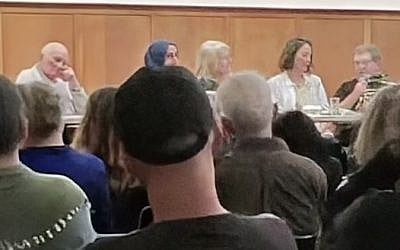
The questions from the floor showed what the evening was really about. A woman from Fight Racism! Fight Imperialism summed up the courtroom strategy: “we win in the court what we win in the streets.” Rajwani added that supporters outside court let “the judge and the judiciary” know “they’re being watched.” One man asked nervously whether he was wrong to be against Netanyahu rather than against Israel. Before any panelist answered, the room’s reaction had answered for him, and he corrected himself: “Should I be anti-Israel? Totally anti-Israel? Okay.” The panel then confirmed it. Rajwani said the “foundation” of Israel was corrupt and “the direction won’t change.” Speitan said Israel “does not have any legal, moral, or ethical right to exist,” must be “dismantled,” and that until then “there’s nothing to negotiate.” When another questioner asked outright whether Israel has a right to exist, Kapos said it was an apartheid state, and “no apartheid state has a right to exist in its present condition.”
That is a rejection of two states, delivered in terms, on the very evening a Labour government’s stated reason for sanctions was to save them. It was said about a country that drained malarial swamps and made a desert bloom with almost no natural resources. It is a country where Arab citizens attend university in growing numbers, where some volunteer to serve in its army, and where Jaffa and Haifa remain mixed cities. In 1869 Mark Twain found the land sitting “in sackcloth and ashes”; in 1854 a New York Daily Tribune dispatch attributed to Karl Marx counted Jews as Jerusalem’s largest community. So much for “no attachment whatsoever.” The panel spoke warmly of how well Jews and Palestinians get along in the diaspora, and they meant Jews who share their politics.
I thought about standing up. I would have said that I am a Zionist, that I wished no one in that room any harm, and that I was looking for a way for us all to live side by side. In the end I stayed seated. The audience was mostly white, mostly British and mostly elderly, and I could not see how anyone there would look at me as anything other than the embodiment of what they had come to oppose. One questioner thanked the panel for the “best parallel” she had heard “between the Holocaust and the Nakba.” After that, a Jew offering them good wishes would not have sounded like an offer to them. It would have sounded like a provocation.
The evening closed with a collection for the Filton defendants, Greenstein’s book at ten pounds, and an invitation to a party celebrating his acquittal. The speakers had a motion topping a national party’s conference agenda, a livestream, stewards on the door and a sense of momentum. They believe history is moving their way, and the Labour government has done little to persuade them otherwise. Both the Prime Minister, Andy Burnham, and his Foreign Secretary say they want two states living in peace. The people in that room were explicit that they want no such thing.
Whatever else was happening in the Friends Meeting House on Tuesday night, nobody there was being silenced.