
Not Alone
Today, I was moved by something I did not see coming.
It started when I took the liberty of sharing a personal picture on my WhatsApp status – something that I generally try to avoid. Almost immediately, I got a number of messages that brought tears to my eyes.
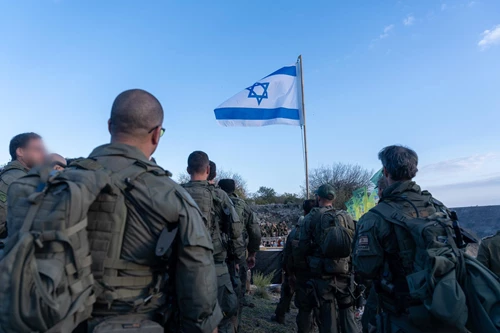
The picture was of my 47-year-old husband, a rabbi and an emergency physician, in an army uniform.
Over the two-and-a-half decades we have been married, I have known him in scrubs, in dress shirts, in sweaters, and in suits. I have seen him run out of the house in the middle of the night in pajamas and a sweatshirt to answer a call from neighbors.
But I had never seen him in an army uniform.
So today, when he returned home in uniform for the first time, I was feeling especially proud, and I posted a picture of him.
My phone started to ping with responses. The ones that made me especially emotional were not from people commenting on my husband. Not from people commenting on the uniform.
They were the ones that came from wives of miluimnikim, soldiers who have spent months on end over the last few years in active duty.
Again and again, women wrote some version of the same thing:
“Welcome to being a miluim wife!”
“Thank you. This makes me feel less alone.”
“It’s really really amazing. Really feels like there is someone out there who cares and is doing something and not just talking about it.”
“This made me so emotional. Means so much to me to see this.”
“So special. My husband also did shlav bet (delayed army service).”
“Thank you. This gave us strength.”
“I really admire people who actively choose to join and take responsibility. Especially in an environment which sometimes make us feel like freiers for paying such prices or alone in taking responsibility.”
The “freier” line hit me hard because beneath that uniquely Israeli word lies an entire emotional universe.
A freier (in Hebrew) is not just someone who is taken advantage of. A freier is someone who looks around and wonders why they are carrying a burden that others are not carrying. A freier is someone who does the right thing and then wonders whether they are foolish for doing so.
Many miluim families have been living with that feeling for a very long time.
They have watched husbands, wives, sons, daughters, fathers, mothers and siblings leave home for weeks and months at a time. They have rearranged work schedules, managed households alone, cared for children, postponed plans, absorbed anxiety, and carried responsibilities that few people around them fully understand.
And all of this has taken place against the backdrop of increasingly painful public conversations about who serves, who does not serve, and who bears responsibility for the collective burden of defending this country. Last night, in our very own yishuv, the home of our neighbor, a supreme court justice, was vandalized over this very issue.
It is impossible not to notice these conversations. It is impossible not to feel the frustration.
And yet these women who wrote to me have continued to forge on.
Not because they are naïve. Not because they are blind to the inequities. But because they believe that some responsibilities remain responsibilities even when they are not distributed equally.
The messages moved me because they reminded me that one of the hardest parts of sacrifice is not the sacrifice itself. It is the loneliness. Human beings can carry extraordinary burdens when they feel part of something larger than themselves. What makes it particularly tough, however, is if you feel you are carrying that burden alone.
Perhaps that is why seeing a middle-aged emergency physician in uniform mattered to these women.
Not because my husband is unique. Quite the opposite. Because he is not unique.
Because behind that photograph stood thousands of men and women who have interrupted their careers, their studies, their family lives, and their routines to answer the call.
And behind each of those soldiers stands a wife, a husband, a parent, a child, or a family carrying the burden with them.
The photograph did not tell them anything they didn’t already know. It simply reminded them that they are part of a much larger story and that they are not alone.
And perhaps most importantly, that they are not “freierim.”
They are citizens who continue to shoulder responsibilities because they believe those responsibilities matter, and because they are proud to do so.
In a period when so much of Israeli society feels fragmented, angry, and divided, I found unexpected comfort in those messages. Because they were not really about my husband.
They were about the deep human need to know that our sacrifices are seen.
And sometimes, all it takes is a photograph to remind people that they are not carrying the burden by themselves.