
Nothing Racist About Ali G
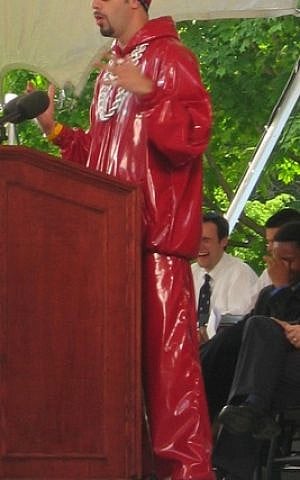
A few days ago, I came across a trailer of the forthcoming Ali G movie. Maybe forthcoming is not the right word, because it looks like the movie, which returns one of Sacha Baron Cohen’s characters to the screen after nearly two and a half decades, might be cancelled. As I type, there are howls from the chattering classes about racism and promoting racist stereotypes about Black people. Some of those howls are taking a tone that I think reveals that the issue is not the supposed racist imagery some people feel the character Ali G exemplifies, but the fact that the role was created and is played by someone with “Cohen” in his name.
Ali Who?
A bit of background for those who are only first hearing of Ali G now. The character Alistair Leslie “Ali G” Graham was created by English comedian Sacha Baron Cohen for his contribution to the Channel 4 show, The 11 O’clock News. Ali G then had his own show, the imaginatively named The Ali G Show. Like his other character developed in those early days of Cohen’s career, Borat, Ali G went on to have his own feature film, Ali G Indahouse, which came out in 2002. It is the sequel, Ali G: Who Iz I? that is causing a furore at the moment.
The back story that Alistair Leslie Graham, or Ali G, to use his street name, is a White English young man from Staines, West London. He is a poseur, who presents himself streetwise in the fashion of London’s urban culture, with its West Indian influence. This is shown in his dress sense, taste in music, consumption of marijuana, and an affected style of speaking, popularly known as “Jafaican” (a portmanteau of “Jamaican” and “fake”) because, while clearly intended to sound like the men of West Indian heritage one sees in music videos and gangster movies, it invariably falls flat. Ali G, and all the other Jafaicans out there, however, are of the view that they are cool in the way they see the men from that background as cool.
Ali G as “Blackface”
The accusation fuelling the calling for the ban of the new Ali G movie is that the character is essentially an outrageous racist depiction of Black men. Any sensible person who has watched the movie and the TV shows can see straight away that Cohen does not depict or intend to depict Black men of any description. Rather, he is poking fun at White youth who seek to imitate the images they see in the media, and imagine these constitute one huge life documentary about Black people. These White youth are not racists. They do not hate Black people. However, because they have not seen other representations of Black men except as braggadocious, sexually promiscuous, aggressive at worst, and fun-loving and idle at best. I think the particular appeal, especially to the young man facing issues of self-esteem etc, is the boldness that many of these Black men present in the media (most rap songs are essentially a boast).
Who believes that Ali G is intended to reinforce racist stereotypes? Well, Newscord, for instance. They have sent out emails to nearly 40,000 cinemas around the world asking them not to screen the movie. They claim that “Black British comedians called the character ‘an alibi for racism’ in 2000,” but do not name any such comedians the average person would have heard of. I think someone’s setting the stage for clout-chasing. And, censorship. I am reminded of Captain Beatty’s words to Guy Montag in Ray Bradbury’s Fahrenheit 451:
“Coloured people don’t like Little Black Sambo. Burn it. White people don’t feel good about Uncle Tom’s Cabin. Burn it. Someone’s written a book on tobacco and cancer of the lungs? The cigarette people are weeping? Bum the book. Serenity, Montag. Peace, Montag. Take your fight outside. Better yet, into the incinerator.”
According to the Hollywood Reporter, Newscord claimed that one cinema chain had said it would not screen the movie, but later retracted. On its X platform, Newscord posted an image of a response by NFBO, in which the Danish chain stated that it did not regard as its task to censor or refuse to screen legally-distributed films.
On their X profile, Newscord ask: “Perhaps a parable will help: if a film was about a non-Jew trying to be a Jew, and performed a number of antisemitic stereotypes because “that’s what they think being a Jew is”, would the joke still be on the character? Or would it be rightly seen as antisemitic because the character inadvertently reinforces the perception of what a Jew is?”
Perhaps Newscord is run by people who are not as exposed to the arts and culture as the rest of us, or they have conveniently forgotten Charles Dickens’ Fagin, or William Shakespeare’s Shylock. Perhaps they are too young to remember famous examples from cinema such as this one:
The obvious irony is that the people demanding that Ali G be suppressed are themselves guilty of the very reductionism they accuse Sacha Baron Cohen of practising. They look at a White Englishman affecting the speech, dress and mannerisms of a caricature of Black British masculinity and conclude that this must be a caricature of Black people. But that is not what the joke is. The joke is about the White man who has consumed those caricatures through popular culture and mistaken them for reality.
How many people actually know a Jamaican man who resembles Ali G’s caricature? For those who do not know any Jamaicans personally, there are enough examples in public life all over the world. Education consultant and Conservative Peer, Lord Sewell (Baron Sewell of Sanderstead). World-record holder<!–TgQPHd|||[]–> and multiple Olympic gold medalist sprinter, Usain Bolt. Marcus Garvey, Pan Africanist. Marlon James, Award-winning novelist. Thomas Lecky and Albert Lockhart, pioneering scientists in the fields of cattle-breeding and glaucoma treatment respectively. Sir Geoff Palmer, another scientist, whose invention, the barley abrasion process, has transformed commercial beer brewing. Robert Ashford, aerospace engineer who contributed to the construction of the Hubble Space Telescope. I could go on and on.
There is an uncomfortable assumption buried in the criticism: that Black people are so easily defined by a handful of stereotypes that merely reproducing those stereotypes—even in order to ridicule the person reproducing them—constitutes an attack upon Black people themselves. That is hardly a liberating view of Black identity. It is, in its own way, profoundly patronising.
Ali G is not Marcus Garvey, Usain Bolt, Marlon James, Lord Sewell, Sir Geoff Palmer or any of the countless other Black men whose lives and achievements bear no resemblance to the character. Nor does Cohen pretend that he is. The entire point is that Ali G is a ridiculous White man pretending to be something he has encountered through the distorting lens of popular culture.
Comedy has always depended upon our ability to understand that distinction. A character can be foolish without the author being foolish; a character can hold an offensive belief without the work endorsing that belief; and a stereotype can be presented in order to expose the absurdity of the person who believes it.
If we lose that distinction, we don’t merely lose Ali G. We lose a fundamental part of how satire works. And once the principle becomes that a work must be judged not by what it is actually saying, but by the worst interpretation someone can place upon an image within it, there will always be another book to burn, another film to ban and another joke to silence.
The answer to bad ideas in art is not always censorship. Sometimes it is simply to watch the bloody thing and understand the joke.