

Now the Applause Makes Sense
Yesterday, I wrote an article angry about the way entertainers use their platforms.
I wrote about filmmakers, actors and musicians who have extraordinary access to millions of people and, instead of using that influence to bring people together, too often seem determined to divide them.
I ended with two lines:
You were given the rare power to unite millions of strangers.
What a terrible waste to use it to divide them.
And then, less than twenty-four hours later, a friend called me with a surprise.
Tickets to see Ishay Ribo in Rishon LeZion.
I could not help but smile at the timing.
Call it coincidence if you want.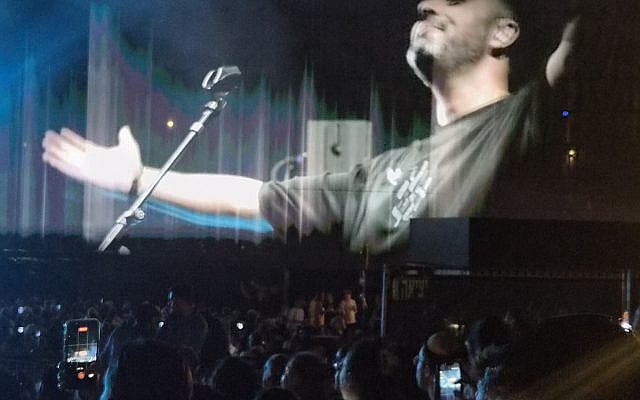
I don’t.
Because after spending an entire article asking what entertainers choose to do with the enormous power of a stage, I suddenly found myself watching an artist show me the answer.
And what a setting in which to see it.
The concert was outdoors, underneath an open sky.
Stars above us.
A beautiful breeze moving through the amphitheater.
Onstage was Ishay Ribo, his band, and the Israeli Philharmonic — rows of musicians, a conductor at the center, strings and percussion and guitars and keyboards all coming together beneath that same night sky.
It was stunning.
But at different moments, I found myself looking away from the stage.
I started watching the people around me.
My brothers and sisters.
Jews from different backgrounds.
Different levels of observance.
Different communities.
Different politics, undoubtedly.
Different lives.
And all around me they were singing.
That is when the tears came.
Because these were not simply catchy lyrics everyone happened to know.
These were words of tefillah.
Words of emunah.
Words of teshuvah.
Words of praise and longing for Hashem.
Song after song, tefillah after tefillah, thousands of voices joined together.
Some people around me surely knew exactly where those words came from.
Others may simply have known them as Ishay Ribo songs.
Maybe some did not even stop to realize that they were praying.
But regardless, there we were.
Hashem’s children, together, singing to Him.
And looking around that amphitheater, underneath the stars, during the Aseret Yemei Teshuvah, I could not help but think:
Hashem must be so proud of us in this moment.
Look at Your children.
Look at us.
For once, not arguing.
Not categorizing one another.
Not deciding who is religious enough, who belongs to which camp, who voted for whom or who is right about the latest fight dividing Israeli society.
Just Jews.
Together.
Singing to You.
As one.
And suddenly the entire point of the article I had written the day before came rushing back to me.
This is what a stage can do.
Yesterday I had written about NAZA and the twenty-four-and-a-half-minute standing ovation Yuval Abraham and Rachel Szor received at the Venice Film Festival.
Twenty-four and a half minutes.
I kept asking:
What exactly were you applauding?
Tonight, I knew exactly what I wanted to applaud.
In fact, I would gladly have given Ishay Ribo twenty-six minutes.
Of course, Israelis being Israelis, I am not sure anyone has the patience to stand there clapping for twenty-six minutes. By then, half the crowd would probably already be calculating how quickly they could get out of the parking lot and beat the traffic home.
But if ever I understood the instinct behind a standing ovation, it was tonight.
Because nobody in that amphitheater had to become the same in order for us to be together.
That distinction matters.
Unity does not require uniformity.
We did not have to vote the same way.
We did not have to dress the same way.
We did not have to daven the same nusach.
We did not have to belong to the same community or agree about everything that divides us the other 364 days of the year.
Our differences did not disappear.
They simply became smaller than what we shared.
And there was something else that struck me.
Even Ribo’s band seemed, in its own way, to reflect the audience in front of him.
Different Jewish backgrounds.
Different musical traditions.
Guitars, piano, bass, drums, percussion and Middle Eastern sounds, all joining together with the Philharmonic to create something larger than any one musician or musical style.
In a way, the stage itself was a miniature version of the crowd.
Different voices.
Different sounds.
Different backgrounds.
One purpose.
And perhaps that is part of Ishay Ribo’s extraordinary ability to reach such a broad spectrum of Jews.
His music does not seem to belong to only one kind of Jew.
It reaches people who are more religious and less religious, Sephardi and Ashkenazi, young and old, people who may hold completely different political opinions.
But what united us that evening was not simply music.
It was Hashem.
Through the words Ishay Ribo chose to sing, thousands of Jews were brought together in tefillah.
That is the difference.
You do not unite people by demanding that they agree with you.
You unite them by reminding them of something greater than their disagreements.
And there, under an open sky in Rishon LeZion, that something was not politics.
It was not ideology.
It was not a slogan.
It was Hashem.
Rosh Hashanah had just passed.
Yom Kippur was only days away.
We were standing in the Aseret Yemei Teshuvah — days meant for examination, return, repair and coming closer to Hashem.
And thousands of Jews were doing exactly that together through music.
Not because anyone had instructed us to demonstrate achdut.
Not because someone had delivered another speech about Jewish unity.
We were simply living it.
We speak about achdut constantly.
We write about it.
We pray for it.
We lecture one another about it.
And sometimes, frankly, we are terrible at it.
Then one man walks onto a stage and, song after song, takes words rooted in our tefillot and our tradition and gives thousands of very different Jews the opportunity to sing them together.
No committee required.
No panel discussion.
No political declaration.
Just music.
Just tefillah.
Just Jews singing to Hashem.
That, to me, is a Kiddush Hashem.
And then came the end.
ברוך שם כבוד מלכותו לעולם ועד ~Baruch Shem Kevod Malchuto Le’olam Va’ed. Blessed is the name of His glorious kingdom for all eternity.
Words that carry particular weight as Yom Kippur approaches. These are words we normally say quietly after the Shema. But on Yom Kippur, we say them aloud.
And there we were, only days before Yom Kippur, thousands of Jews declaring them together.
Under the stars.
Under that enormous open Israeli sky.
The orchestra behind him.
My brothers and sisters all around me.
And all those different voices became one tefillah.
I cannot adequately explain what that sounded like.
Or what it felt like.
But I kept thinking:
This.
This is what I meant.
Yesterday I wrote about performers who take an audience filled with people from different backgrounds and turn it into yet another political battlefield.
Tonight, I watched someone take an audience filled with people from different backgrounds and remind us that there is something infinitely greater than all the things that divide us.
It is not about forcing artists to remain silent.
It is not about pretending people do not have opinions.
It is about understanding the extraordinary gift you have been given when thousands — sometimes millions — of people are willing to listen to you.
What are you going to do with their attention?
What are you going to leave them with?
More anger?
More division?
Another reason to look suspiciously at the person sitting beside them?
Or will you give them something that reminds them of what they share?
Yesterday I wrote about entertainers who, in my view, have forgotten that responsibility.
Tonight, Ishay Ribo reminded me what happens when someone understands it.
And perhaps that is why the timing of those unexpected tickets felt like more than coincidence to me.
I had spent hours thinking and writing about everything that frustrated me about entertainment today — the politics, the preaching, the certainty, the divisiveness.
And then, the very next day, I was handed the counterexample.
Not another argument.
An experience.
Go watch this.
Go stand among thousands of Jews under the stars.
Go listen.
Look around you.
Look at My children.
And see what happens when someone uses his platform differently.
I did.
And I understood.
Twenty-four and a half minutes in Venice left me asking what exactly people were applauding.
Tonight in Rishon LeZion, the applause finally made sense.
I was applauding an artist who had brought thousands of people together.
I was applauding the Israeli Philharmonic, his band and all those different sounds becoming one.
I was applauding Jewish music filling an open-air amphitheater beneath the stars.
I was applauding Jews from different worlds singing tefillah after tefillah together.
I was applauding my brothers and sisters standing together during the Aseret Yemei Teshuvah, praising Hashem with one voice.
I was applauding a Kiddush Hashem.
And I was applauding the possibility that entertainment does not have to make us angrier at one another.
It can remind us that we belong to one another because, ultimately, we belong to Him.
And as the evening ended, just days before Yom Kippur, with thousands of voices declaring together:
ברוך שם כבוד מלכותו לעולם ועד
I thought again about the words with which I had ended the article the day before:
You were given the rare power to unite millions of strangers.
Yesterday I wrote about what a terrible waste it is to use that power to divide them.
Tonight, underneath the stars, with thousands of Hashem’s children united in tefillah, I saw the other possibility.
What an extraordinary gift to use that power to bring them together.