

Numbers Don’t Make Sense
My father and I were deep into our math study session. My younger siblings were long asleep, and I kept shifting my legs on the kitchen chair. The contents of my Hello Kitty pencil case were spread out, and my father’s glass of tea rattled every time I bumped into the base of the table. As I stared at the ice designs on the outside of the kitchen window, I was only vaguely aware of him reading off the math problems with a passion usually reserved for a sonnet. And, amidst it all, every so often we’d be interrupted by a hiss and a bang as the tired radiator remembered to pump heat into our old Tudor house.
“So, what’s the answer?” I asked, pencil in hand, desperate to finish the mimeographed sheet of math homework in front of me.
My father popped up like a spring and grabbed a box of raw pasta from the cabinet. Soon there were small piles of macaroni all over the table. I wasn’t sure how, but this was somehow supposed to explain the fractions problems on the page.
“The answer doesn’t matter, Shiffy, you have to understaaand what is going on.” He stretched out the word “understand” with his Canadian accent, as his finger stabbed the air for emphasis.
My mother, who was in the final stages of wiping down the counter, put down her sponge and stroked my hair. “Loz zi alayn” she said to my father in Yiddish with a half-smile, and I knew that meant that I was going to be released. I wasn’t going to understand or appreciate the beauty of math that night, or thereafter for that matter.
And indeed, my struggle to understand numbers has followed me into my sixth decade.
Working in Holocaust education, I have done exactly what my father forbade and have memorized the essential numerical answers. Six million Jews murdered, 1.5 million of them children, 870,000 gassed in Treblinka, and on and on.
The Babi Yaar numbers are particularly difficult to fathom. According to Nazi records, Nazi Einstazgruppen soldiers and their Ukrainian collaborators murdered 33,771 Jews in just two days. They worked for hours on end, shooting the victims at point-blank range, the bodies piling up in a ravine. The specificity of that number is haunting. The last digit, 1, daring me to imagine who that last person was. And it is such a huge number. Every time I try to calculate a rate of murder per hour, how much blood was perpetrated by each individual average soldier, my head dizzies from this perverse Holocaust math.
And this struggle to understand numbers follows me when I go to Poland. Recently I visited the site of a mass grave in Częstochowa, Poland. Today there are no Jews living in Częstochowa, but before the War, close to thirty thousand Jews called it home. While the city has none of the name-recognition of Warsaw or Krakow, there was a time when its Jews represented 20% of the general population – that is, almost twice the Jewish density of New York City today.
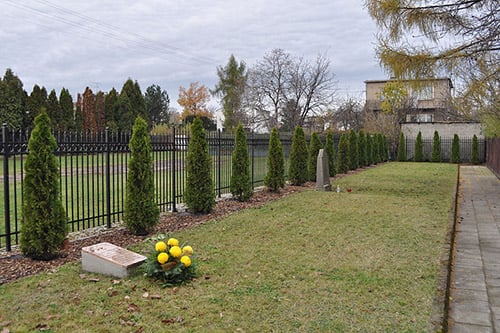
And yet, as we drove through the city streets it was hard to imagine anything ethnic ever taking root. The people and the buildings all seemed washed out, pale and uniform. The driver pulled up next to a windowless factory in a tired industrial area. He pointed to a path that led to a black iron gate and a strip of grass.
Behind the gate were two small concrete monuments containing inscriptions in both Polish and Yiddish: Mass Graves of Jews, the Victims of Nazism, 22nd September 1942 May their memory be honored. The last two thousand of the Częstochowa Jewish community who hid, resisted or were simply too weak to be deported to Treblinka, were murdered on their hometown streets. Their bodies were dumped here on the outskirts.
Two thousand. I stand there by the puny markers in this barely known city and think about what two thousand means. When twelve hundred were massacred in Israel on October 7th, I – and everyone I know – was traumatized. For months, I read bio after bio, trying to grasp all of the sorrow and all of the stories, and yet my mind could not hold them all. The enormity of that 1,200 number was beyond my understanding.
And yet, there I was, standing at a place where two thousand bodies were disposed – even worse – approximately two thousand bodies were disposed because no one even knows precisely how many – and yet it is barely a footnote in collective Jewish memory. How can such a large number mean so little? How can so many dreams and disappointments be buried in one tiny strip of grass on the side of a forgotten factory?
I return to that childhood truth. Numbers don’t make sense.
Numbers don’t make sense in Poland and numbers don’t make sense in New York.
How else to explain the tsunami of pain as I watched just one person slip away before my eyes?
My mother was 74 when she lay barely breathing in Room 308 of Westchester Medical Center. The neurological disease that began in the base of her brain 14 years earlier had wreaked its havoc and it had been years since I had heard her voice or caught the light in her eyes.
In the week that passed from when I got the call from my sister that sent me racing to the airport, I felt like I was living in an alternate reality. My eyes were crusty, my mouth pasty, and there was a permanent chill in my bones. The harsh fluorescent lighting, the sharp smell of Lysol and the incessant background noise seemed like a continual assault on the senses. Living in the hospital, there was little difference between day and night, and sleep, when it came, was on a hard plastic burgundy chair. I kept readjusting my legs trying to get comfortable.
My siblings came in shifts, and when they were there, we couldn’t help but return to our usual banter. The spot-on imitation of an elementary school teacher, the familiar cadence of my father’s one-liners, the predictable slide into well-worn topics. Sitting with my sisters and brother, the background faded and the hospital room felt almost womb-like. I felt known.
But when I was alone staring at my mother’s pale figure, I knew that there was no good position on that hard chair. No explanation from my father was going to help me understand the hugeness of this number one. And no matter how long I waited, my mother was not going to reach over, smooth my hair, and release me with a murmur in Yiddish.