A Call to the Moral Debate the World Refuses to Face — A Black Jewish Voice Speaks for Israel and Global Jewry
NYC Detective’s Observation- Israel Wants to Arrest Firefighter for Water Damage
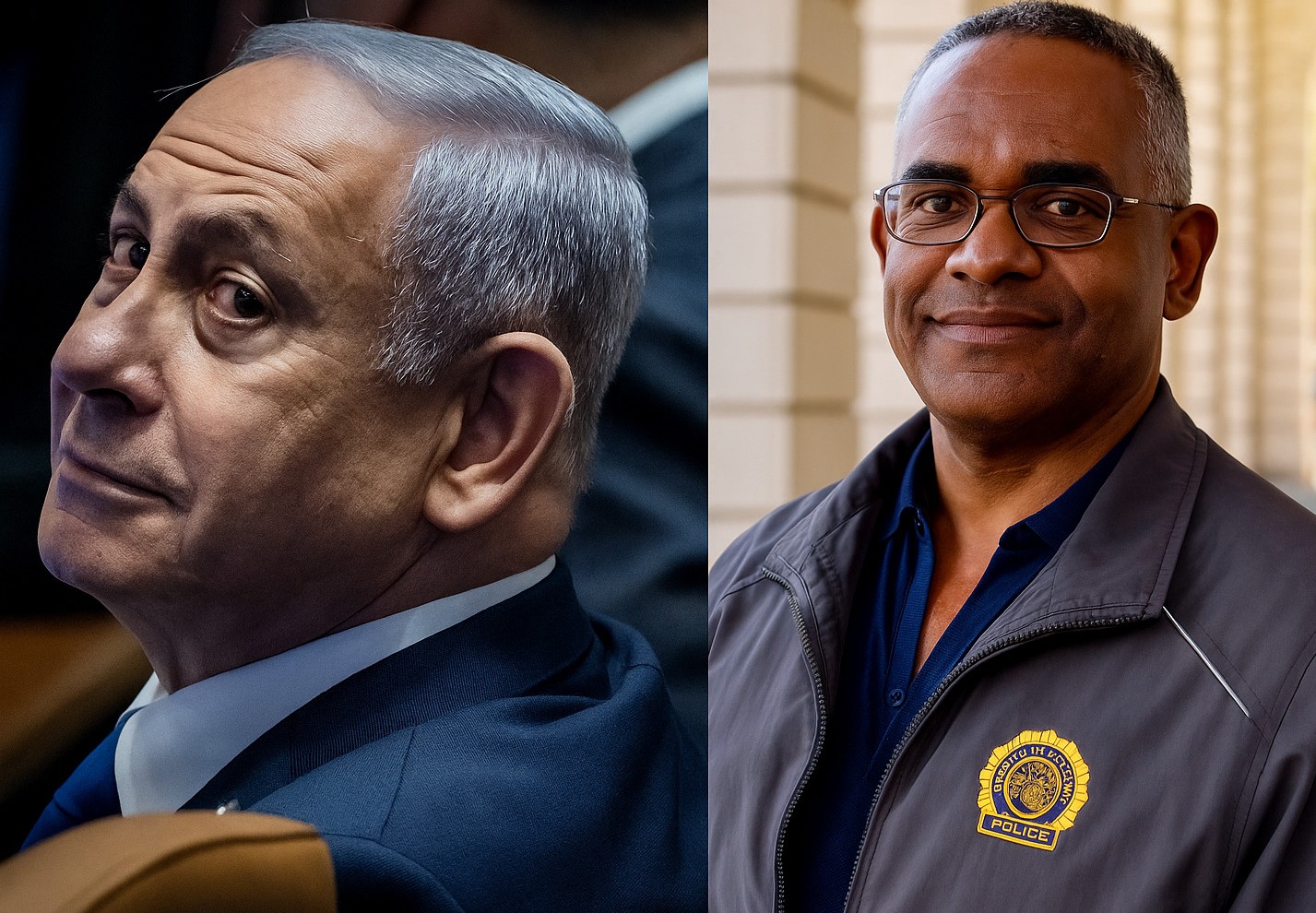
Prime Minister Benjamin Netanyahu in the Knesset on November 10, 2025. (Yonatan Sindel/Flash90) ((Photo credit and commercial-use permission: Betty Seifu Legesse, for the portrait of Officer Shmuel Legesse)
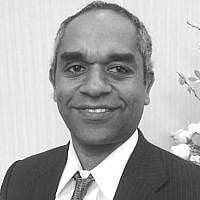
By Dr. Shmuel Legesse
Former NYC Supreme Court Investigator/Detective; Upcoming Author of Moral Diplomacy for a Broken World, inspired by Rabbi Jonathan Sacks
When I was an investigator/detective for the New York City Supreme Court I learned an ugly truth: justice rarely dies in a day. It dies of small things of petty ego, of spectacle, of a thousand tiny staging choices that turn law into theatre. Watching Israel’s endless trial of Prime Minister Benjamin Netanyahu, I feel like I’m watching that slow death with Hebrew subtitles. A nation that forgot October 7 is a nation that forgot why it must be serious about survival.
While Hamas was rehearsing the atrocity, some of our political classes were rehearsing indictments. While Iran funnelled rockets and proxies, we were funding legal panels. While planners abroad sketched maps of kibbutzim to burn, inside our newsrooms we sketched timelines of cigars. We were distracted. That is how catastrophe finds a chink in the armor: not because soldiers are weak, but because the people who should have watched the horizon were watching camera feeds.
I am not pleading for immunity for anyone. I am pleading for priorities. There is a difference between accountability and auto-cannibalism. Democracy requires both law and a functioning emergency room. You cannot indict a nation’s attention and then claim you preserved its life.
Justice has become a selfie. Trials leak more spoilers than a streaming series. Judges become prime-time personalities, witnesses become podcast hosts, and legal strategy becomes a marketing calendar. This is not robust jurisprudence; it is reality TV with a docket. The cases — 1000, 2000, 4000 have become shorthand for a national exhaustion. If these are crimes unique to one man, then every politician on earth is guilty; if they are human behaviors, then the system must be able to distinguish theatrical peccadillo from existential threat.
Meanwhile, our enemies are not watching our debates for jurisprudence; they are watching for weakness. They study the time we waste, the divisions we magnify, the attention we scatter. Leadership in war is not about charisma on the podium; it’s about forging alliances, convincing friends, and forging deterrence. Netanyahu, for all his polarizing personality, still performs the rare feat of convincing President Biden and President Trump in the same week that Israel must be supported. That diplomatic skill is survivorship. When the world’s great powers listen, that is not just politics; it is a matter of national breathing.
And yet we wrestle over cigars while we bury our sons. That is the metaphor: it is like arresting a firefighter for water damage. Imagine putting the person who raced through the blaze in handcuffs because the living room looks wet. That is what happens when a country substitutes spectacle for strategy.
Let us be blunt: October 7 was not a policy failure alone; it was a national failure of attention. Our state apparatus must be both fierce and focused. If our courts become our main theatre, then who watches the borders? Who coordinates with allies? Who thinks through intelligence seams? When legal battles crowd out the cabinet table, the enemy gets the overtime.
This is not an apology for impunity. If prosecutors have clean, provable cases, they must proceed. But the right way to proceed is with a sober sense of context: can the state prosecute and defend itself at once, without losing the war on its watch? If not, then procedures, temporary suspensions, bipartisan oversight, clear rules for how to handle investigations of serving leaders are necessary to preserve both justice and survival.
First, triage the docket. Cases that have collapsed under their own weight should be dismissed; pursuing dead-end prosecutions is national self-harm. Second, audit the auditors: if investigators leaked, coerced, or manipulated testimony, then let the investigators face scrutiny. Justice that isn’t even consistent is not justice. Third, legislate sensible boundaries: criminal probes of a sitting prime minister must follow emergency rules and bipartisan oversight so that an investigation cannot become an instrument of political warfare. Fourth, rebuild trust with a national inquiry into the system itself not a show trial, but a sober examination of how politics, media and law have interwoven into a tangle that weakens us.
And yes, let us ask the wealthy and the moral organizations to stop being spectators. The Jewish world knows how to move mountains when it chooses: rescue missions and international solidarity are not foreign to our history. When states and societies act with moral clarity, miracles are possible. We have seen it. The world has helped Israel before. The question is: where is that voice now?
Rabbi Jonathan Sacks taught that moral leadership begins when power bows to purpose. He reminded us that ethical authority is not softness but the architecture of long-term national survival. Rabbi Sacks died in 2020; his voice is now the quiet mirror we should consult when the din gets loud.
If justice loses compassion, it ceases to be Jewish justice. If leadership loses gratitude, it ceases to be Zionism. If we forget unity, we stop being Israel. The stakes are not rhetorical. Since October 7 and the escalation that followed, lives have been lost and families shattered realities that demand we hold fast to what matters most. Hundreds were killed and scores taken hostage on that day; those facts are the anchor of our collective trauma.
This is not a call for silencing inquiry; it is a demand for proportion. The prosecutor’s office should not hold the nation hostage to a trial schedule while hostages remain unaccounted for and the region heats up. Courts are holy for the dignity of law not for headline warfare. The question is not whether to investigate; the question is how to do so without converting the state into a divided patient. That requires maturity, not melodrama.
So let us stop the virtue signalling and start the triage. End the spectacle, institute procedural guardrails, demand accountability for those who abused investigatory power, and get our national attention back where it belongs: on threats that aim to end us.
Because next October 7 will not wait for another verdict. And while we live in a democracy worth defending, we must make sure it does not die of self-inflicted distraction.
Enough is enough. Let us defend our people, not indict them. Let us fight for Israel’s life not for another chair.
Related Topics
Related Posts