
October 7, Three Years Later: How the Price of War Reached Tehran
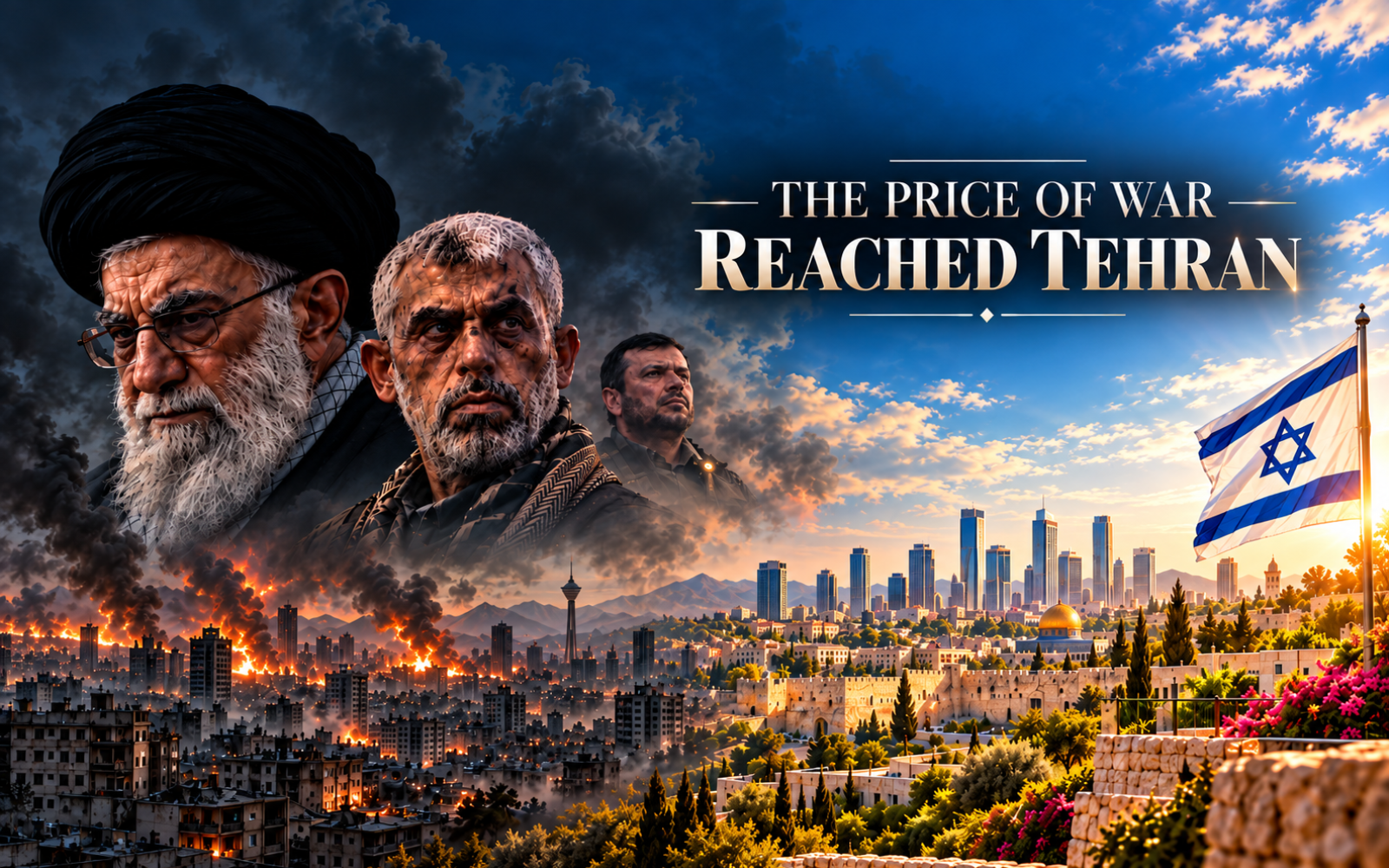
At 6:29 a.m. on October 7, 2023, Hamas opened the deadliest day in Israel’s history. About 1,200 people were killed, more than 5,400 were injured in the immediate terrorist attack, and 251 people were taken hostage into Gaza as thousands of terrorists swept through communities, military bases, roads and a music festival in southern Israel.
The following day, Hezbollah opened another front from Lebanon. Within days, Iran-backed militias operating from Iraq and Syria were attacking American forces. Within weeks, the Houthis were firing missiles and drones from Yemen. Six months later, Iran itself directly attacked Israel.
Three years later, the consequences reach far beyond Gaza. Much of Hamas’s senior leadership is dead, Hassan Nasrallah and much of Hezbollah’s senior military command are gone, senior Houthi officials have been killed, and Iran has lost dozens of senior military and security figures. Its longtime supreme leader, Ali Khamenei, was also killed in 2026.
The war that began along Israel’s Gaza border did not remain there. It travelled through a regional network Iran had spent decades building around Israel and eventually reached Tehran itself.
October 7: The Day Israel’s Defenses Collapsed
October 7 fell on a Saturday and the Jewish holiday of Simchat Torah. Hamas began the terrorist assault with a massive rocket barrage while terrorists simultaneously moved against Israel’s border defenses.
Drones attacked observation positions, while explosives and bulldozers opened passages through the barrier. Terrorists entered on motorcycles, pickup trucks and other vehicles. Some approached by sea, while others crossed using motorized paragliders.
Later Israeli military investigations concluded that more than 5,000 terrorists entered Israel. The Gaza Division was overwhelmed, and for crucial hours a border system built around sophisticated surveillance, technology and rapid military response failed to protect the communities behind it.
The terrorists spread through military bases, roads, kibbutzim and towns. Be’eri, Kfar Aza, Nir Oz, Nahal Oz and Sderot became battlefields, while the Nova music festival became one of the largest massacre sites.
Thousands of young people had gathered at Nova to dance through the night. When the rockets began, the music stopped. Terrorists later reached the festival area and surrounding roads, killing people as they fled, hid in vehicles or sought shelter.
At Be’eri, Kfar Aza and other communities, families barricaded themselves inside safe rooms while terrorists moved through residential areas. Nir Oz suffered one of the most devastating proportional losses, with 47 people killed and 76 taken hostage.
At Sderot, terrorists entered a city rather than a small kibbutz and attacked its police station. Elsewhere, people were killed on roads, at junctions, inside shelters and at military bases. There was not one battlefield demanding reinforcements but many at the same time, helping explain why Israel’s response collapsed.
Israel’s failure was also not simply a lack of intelligence. Later investigations showed that warning signs and information about Hamas’s ambitions existed, but Israeli decision-making had become shaped by an assumption that Hamas was deterred and did not want an all-out war. October 7 destroyed that assumption.
About 1,200 people were ultimately counted among the dead. Israel’s original estimate was higher, but it was revised after forensic identification showed that some remains initially believed to belong to Israeli victims were terrorists.
The dead included civilians, soldiers, police officers and foreign nationals. Citizens of at least 35 countries were killed, injured or abducted, making October 7 an international tragedy as well as an Israeli one.
International investigations later concluded that Hamas-led terrorist groups committed grave crimes, including deliberate attacks against civilians and hostage-taking. A United Nations mission also found reasonable grounds to believe that rape and gang rape occurred at several locations and stronger evidence that some hostages experienced sexual violence while in captivity.
Some individual stories circulated immediately after the terrorist attack that could not later be verified. Those should not be repeated as established fact, but rejecting unreliable claims should never become an excuse for denying documented crimes.
Then there were the 251 hostages. They included children, elderly people, soldiers, festivalgoers, foreign workers and entire families. Some returned during negotiated releases, others were rescued by Israeli forces, while some were killed in captivity and their bodies later recovered.
The final 20 living hostages returned in October 2025. The last hostage still in Gaza was police officer Ran Gvili, who had been killed fighting terrorists on October 7 and whose body was taken into the Strip.
His remains were recovered on January 26, 2026. After 843 days, every October 7 hostage, living or dead, had been returned.
Before moving from the massacre to the wars that followed, one thought belongs above every military calculation: may the memory of those murdered on October 7 be a blessing, and may the families who lost children, parents, partners, relatives and friends continue to find strength.
From Gaza to a Regional War: October 2023–April 2024
The regional expansion happened remarkably quickly. October 7, 2023 was the Gaza front, when Hamas-led terrorists and members of other Palestinian armed groups attacked southern Israel. On October 8, Hezbollah began firing from Lebanon at Israeli military positions, saying it was acting in support of Hamas and Gaza.
By October 17 and 18, Iran-backed armed factions were attacking American forces in Iraq and Syria. On October 19, the U.S. Navy intercepted cruise missiles and drones launched by the Houthis from Yemen that appeared to be heading toward Israel.
On October 31, the Houthis publicly claimed missile and drone attacks against Israel. They later expanded their campaign to commercial shipping in the Red Sea, eventually forcing major shipping companies to divert vessels around Africa.
Then, on April 13, 2024, Iran crossed the most important threshold. After a strike on an Iranian diplomatic compound in Damascus killed senior Revolutionary Guard officers, Tehran launched hundreds of drones and missiles toward Israel in its first major direct attack on Israeli territory.
The United States and several partners helped Israel intercept most of the incoming weapons. Iran attacked Israel directly again with a large ballistic-missile barrage in October 2024.
This chronology requires one important distinction. Lebanon, Iraq, Syria and Yemen did not all formally declare war on Israel as states. Hezbollah operated from Lebanon, Iran-backed armed factions operated from Iraq and Syria, and the Houthis controlled large parts of Yemen.
Strategically, however, the picture was unmistakable. Within six months, a war that had begun in Gaza had produced active fronts or attacks linked to Gaza from Lebanon, Iraq, Syria and Yemen before reaching Iran itself.
The model behind this expansion had taken decades to build. Iran had developed what became known as the Axis of Resistance: a network of allied states and armed groups that gave Tehran strategic reach across the region.
Hezbollah became its strongest non-state ally. Iran supported Palestinian Islamic Jihad and Hamas, cultivated armed groups in Iraq and Syria and built an increasingly close relationship with the Houthis.
The advantage for Iran was clear. Israel and the United States could be pressured from several directions while Iran itself remained geographically removed from much of the fighting. After October 7, much of that network activated.
Israel Strikes at the Leadership of the Axis: 2024–2025
As the fronts expanded, Israel increasingly shifted from containing attacks to targeting the people commanding the organizations behind them.
The process was particularly visible in Hamas. Saleh al-Arouri, one of the organization’s most prominent leaders outside Gaza, was killed in Beirut in January 2024, while deputy military commander Marwan Issa was killed in March.
On July 13, Mohammed Deif, commander of Hamas’s military wing and one of the principal planners of the October 7 terrorist attack, was killed in an Israeli strike. Later that month, Hamas political leader Ismail Haniyeh was assassinated while visiting Tehran.
On October 16, 2024, Israeli troops killed Yahya Sinwar in Rafah. He was widely regarded as the central architect of the October 7 terrorist attack and had become Hamas’s overall leader after Haniyeh’s death.
His brother Mohammed Sinwar subsequently rose to a senior military position in Gaza and was also killed in 2025. Hamas survived, but the organization that had entered October 7 with Sinwar, Deif, Haniyeh, Arouri and Issa was no longer intact.
Hezbollah suffered an even more concentrated collapse of its senior command. The organization had chosen to open the northern front on October 8, 2023, and for months rockets, drones, anti-tank missiles and Israeli strikes crossed the border, forcing tens of thousands of people from their homes on both sides.
Israel then began removing senior commanders. Fuad Shukr, one of Hezbollah’s most important military figures, was killed in Beirut on July 30, 2024, while Ibrahim Aqil and other commanders associated with Hezbollah’s elite Radwan force were killed on September 20.
On September 27, Israel struck Hezbollah’s underground headquarters in Beirut and killed Hassan Nasrallah. He had led Hezbollah for 32 years and had become one of the most powerful figures in Iran’s regional network.
By the time of his death, Israel said it had killed eight of Hezbollah’s nine most senior military commanders. His presumed successor, Hashem Safieddine, was killed in another Israeli strike in early October.
Hezbollah did not disappear, but less than a year after opening the second front, much of the leadership that had built and commanded its military machine was gone.
The consequences also reached Yemen. The Houthis had entered the conflict by firing missiles and drones toward Israel and later attacking international shipping, prompting the United States and Britain to strike Houthi military targets before Israel also began striking Yemen directly.
In August 2025, an Israeli strike in Sanaa killed Ahmed Ghaleb al-Rahwi, prime minister of the Houthi-run government, together with other senior officials. Twelve senior Houthi figures were later buried following the strike.
Their top leader, Abdul-Malik al-Houthi, survived, and the movement retained substantial power. But joining the regional conflict had brought Israeli, American and British military action directly onto Yemeni territory.
The pattern was becoming clear: organizations that had opened new fronts against Israel were discovering that those fronts worked in both directions.
The War Reaches Iran: 2024–2026
Iran had long preferred to confront Israel indirectly. That began changing with its direct attack of April 13, 2024, and the confrontation deepened after its second major missile barrage in October.
The decisive change came on June 13, 2025, when Israel launched a major military campaign against Iran itself. The opening strikes targeted nuclear and missile facilities, air defenses and the senior command of Iran’s military establishment.
Among those killed were Mohammad Bagheri, chief of staff of Iran’s armed forces; Hossein Salami, commander of the Revolutionary Guards; and Amir Ali Hajizadeh, commander of the IRGC Aerospace Force.
An Israeli military assessment after the 12-day conflict said more than 30 senior Iranian security officials and 11 senior nuclear scientists had been killed. The significance went far beyond the individual names: Iran had spent decades creating strategic depth outside its borders, but Israel was now striking the men directing that strategy inside Iran.
To understand how profound that change was, consider Iran’s supreme leadership. Ayatollah Ruhollah Khomeini led the 1979 Islamic Revolution and became the Islamic Republic’s first supreme leader, remaining in power until his death in 1989.
Ayatollah Ali Khamenei succeeded him and ruled for nearly 37 years. During Khamenei’s rule, the Revolutionary Guards expanded enormously, Hezbollah developed into a heavily armed force, Iran built large missile and drone programs and Tehran strengthened its regional network of armed allies.
On February 28, 2026, the United States and Israel launched a new military campaign against Iran, and Ali Khamenei was killed in the opening phase of the war. Other senior Iranian military and security figures were also killed as the fighting continued.
On March 8, Mojtaba Khamenei, Ali Khamenei’s son, was selected as the Islamic Republic’s third supreme leader. Iran’s leadership history could therefore be summarized in three names: Ruhollah Khomeini from 1979 to 1989, Ali Khamenei from 1989 until February 28, 2026, and Mojtaba Khamenei from March 2026.
The first died naturally, the second was killed during war, and the third inherited that war. For decades, Iran’s regional strategy had been designed partly to keep conflict away from Iranian territory, but by 2026 that strategic separation had collapsed.
The Axis had been created to project power outward. The war had travelled back inward.
The Price of the War
None of this produced a cost-free victory for Israel. October 7 itself killed about 1,200 people, while hundreds of members of Israel’s military, police and other security services later died in the wars that followed.
Communities in southern and northern Israel were evacuated. Families spent years waiting for hostages, while Israelis endured rockets, drones and ballistic missiles from several directions.
One uncomfortable question also remains no matter how many enemy commanders Israel kills: how was October 7 allowed to happen? The destruction of Hamas leadership, Hezbollah’s command structure or Iranian military facilities cannot erase the intelligence and military failures that left Israeli communities vulnerable that morning.
Nor can an honest account ignore what happened outside Israel. Gaza suffered catastrophic destruction, with tens of thousands of Palestinians killed, enormous physical damage and mass displacement.
Much of Gaza was destroyed or badly damaged, and most of its population experienced displacement. Even after the 2025 ceasefire, people continued to die.
Lebanese civilians were killed and displaced during the Israel-Hezbollah conflict. Yemen endured repeated military strikes and, by 2026, renewed internal warfare, while Iranian civilians were ultimately caught in a direct war that earlier generations of Iranian strategy had sought to keep outside the country.
There is no contradiction in remembering the people murdered in the October 7 terrorist attack while acknowledging these consequences. Political leaders and armed organizations decide to open fronts, but ordinary people repeatedly discover that they cannot decide where those fronts end.
That may be one of the most important lessons of the three years since October 7.
From 1948 to October 7: The Lesson of Survival
October 7 also belongs to a much older history. On November 29, 1947, the United Nations adopted Resolution 181, recommending the partition of Mandatory Palestine into a Jewish state and an Arab state, with Jerusalem under a special international arrangement.
It was not identical to the modern diplomatic formula usually called the two-state solution, but its central principle was recognizable: separate Jewish and Arab states.
The Jewish leadership accepted the partition proposal. Palestinian Arab leaders and the surrounding Arab states rejected it, considering the arrangement unjust, and fighting between Arab and Jewish forces followed.
Israel declared independence on May 14, 1948. Forces from neighboring Arab countries then entered the war, including armies from Egypt, Transjordan, Syria, Lebanon and Iraq, but they could not eliminate the new Jewish state.
Israel survived and emerged from the war controlling more territory than the original UN partition proposal had allotted to it. Palestinians, meanwhile, suffered mass displacement, dispossession and statelessness, creating a tragedy whose consequences remain unresolved.
That history does not prove that military power can solve the Israeli-Palestinian conflict. More than seven decades of conflict demonstrate the opposite, but it does contain another lesson that should not be ignored: trying to destroy Israel did not destroy Israel.
October 7 offered another brutal reminder. Hamas terrorists succeeded in inflicting the worst massacre in Israel’s history, Hezbollah chose to join the war the following day, the Houthis entered from Yemen, Iran-backed factions operated from Iraq and Syria, and Iran eventually attacked Israel directly.
The regional consequences were enormous, but Israel did not disappear. Anyone who still imagines that another terrorist invasion, another missile barrage or another regional coalition will erase Israel should study both 1948 and the three years after October 7.
Israel is not a temporary military camp waiting to collapse. It is a country of millions of people with a powerful state, a military and deep international connections.
Millions of Jews around the world remain connected to its survival, while millions of Christians and many others support Israel’s right to exist even when they may disagree with particular Israeli governments or policies. Supporting Israel’s existence does not require supporting every Israeli decision, because criticizing an Israeli government and rejecting the destruction of Israel are entirely compatible positions.
Destroying Israel should therefore never be confused with making peace. The Middle East has already paid too high a price for that illusion.
On this third anniversary, October 7 should first be remembered for the people murdered in the terrorist attack, the hostages who were taken and the families whose lives changed forever. Their loss should not become merely another statistic in a regional military history.
Remembrance should also carry a warning. Wars can be started in hours, but their consequences can last for years, cross borders and eventually reach the leaders who believed they could control them.
Israel has faced attempts to destroy it before and remains. Those contemplating another such attempt should remember not only how the October 7 terrorist attack began, but where the war had reached three years later.
October 6, 2026
Tokyo, Japan