

Appeasers Feed Crocodiles, Hoping To Be Eaten Last
October 8 Jew
Your land will be my land, your God my God
We Jews are a stiff-necked people. We did, after all, coin the word “dafka’. So our reaction to the hatred directed against us immediately following the October 7 massacre was entirely predictable. This is my story.
As a teen I was so skeptical of the existence of God that I paid no attention to the meaning of the Jewish holidays, except a few. I knew, for instance, that Rosh Ha’shana was akin to my Gregorian New Year, and that on Yom Kippur I was forbidden to eat (no kippers on Kippur), and that during Sukkot I got to shake a big frond and hang out in a large wooden structure and have a picnic. Pesach was definitely my favorite – the locusts, the dripping blood of the firstborn, the chase, the sea parting – what fun! But as for the rest, with all those weird names like Shemini Atzeret, Lag BaOmer, and Tu Bishvat, I knew little about them and cared less. Oh, and there was another one floating vaguely in my consciousness about some guy who tried to kill us, but we were saved by a beautiful queen, the bad guy was hanged and we ate his ears…
Schul was an opportunity to hang with my friends. Those prayers in incomprehensible Hebrew (which turned out to be maybe Aramaic, and what is that anyway….) were so BORING, I could barely sit through a complete service. I itched and fidgeted at the Saturday morning services until finally released to walk 2 miles to a downtown Greek café where I’d join up with my friends who had also come there from the Orthodox schul. We’d eye the girls, eat minced pie slathered in a thick savory gravy, and blow straw wrappers at each other. Shabbat was fun.
And yet, though ignorant of my religion, I was imbued with Yidishkeit. I lived in a Jewish bubble. My friends were Jewish. We attended the same school and hung out together during break. We’d meet at each other’s houses on weekends and spend lazy summers on the beach, always the same beach, and party together. Every now and then a Christian would enter our group as a boyfriend or girlfriend, but it was rare. I dreamed of that forbidden fruit, the Christian girls – their honeyed lips, blue eyes and blonde hair. Apparently my friends dreamed with me. By the time we hit middle age, around 50% of all Jewish marriages would be interfaith. And in my secular world, that was just fine.
Friday night in my yekke father’s home was a formal affair when the family assembled around the white clothed dinner table. Neatly folded matching embroidered white cloth napkins in silver napkin rings, antique silver Shabbat candlesticks and initialed silver wine goblet were all part of the ritual. Dinner, always fish and fries, was preceded by prayers over the candles, wine and bread, in that strict order. And even at the height of the hot South African summer, I was forced to wear, to honor the sabbath, long trousers, a white shirt, tie and jacket and closed shoes, no sandals. Kippa essential. As to what the prayers meant – who knew?
Though I knew nothing about the meaning of the Jewish holidays, I loved the Jewish food with foreign names that accompanied them: the overladen tables of gehakte herring, knish, kugel, tagelach and kreplach. And who could resist Granny Rose’s cheese blintzes and meat perogen, the dough rolled by her thin irritable blue-veined hands on the small metal kitchen table to delicious perfection. If I could summon one person from the Hereafter (Did she make it to heaven? Is there a heaven?) it would be Granny Rose, to give me just one more bite of her mouthwatering perogen.
Habonim, the Zionist youth movement I joined and became a leader in, was completely secular, with stories of the settlers who drained the swamps, established kibbutzim and fought off the invading Arab armies. No word of King David or Judah Maccabee. We sang Hatikvah at our meetings, not Lecha Dodi.
Israel was founded in 1948 by the remnants of European pogroms and the Holocaust. They brought with them revolutionary communism and socialism, eschewing religion. When I arrived on Aliyah in the 70s, it was still non-religious, just like me. Then, when I eventually left Israel and made my way to the US, I again fit right in with the Jews I found there, and like them, became an integral part of the American fabric. In our eagerness to integrate, we sacrificed our faith at the altar of secular humanism and worshiped at the feet of liberal democracy. We surrendered our will to representative democracy, relying on it for our protection. Under the cloak of this ideology, tolerance was mandatory. Every person equal, every religion identical, except for the actual God they happened to worship. In the West’s cosmopolitan-friendly environment, immigration flourished – they were the same as us, except spoke a different language. We paid no heed to the nuances of each’s culture because we knew, with naïve conviction, that they were all equally good – just a little different. To think, or God forbid, to suggest out loud anything else, would be discriminatory, and suffer the universal opprobrium of racism.
Then came October 7.
My mother was a reserved, gentle soul, with not an ounce of ill will in her tiny frame. So I was surprised at her cynical caution to me one day as we discussed Judaism: “You need never be concerned about losing your Jewish identity. There will always be someone to remind you”.
October 8 proved her right. The vitriolic antisemitism directed at Israel, its victims’ blood not yet cold, and even more profoundly shocking, at world Jewry, shook me to the core. Yet the louder they screamed their hateful reminders of who I am, the more tightly I wrapped myself in Judaism’s embrace, and the fiercer my determination to fight back.
A few months later I invited friends and family to call me by my newly adopted name, Nahum Meron.
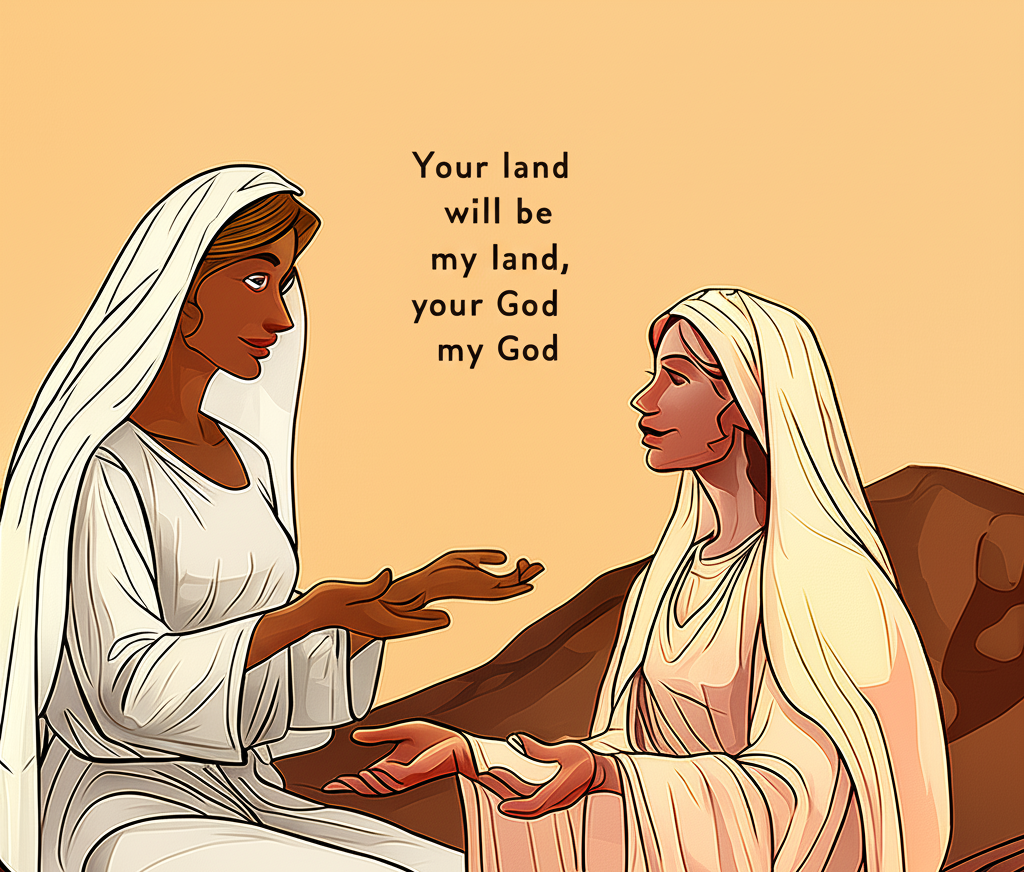
Yesterday was erev Shavuot, one of those mysterious Jewish holidays I knew nothing about. But this year, for the first time in my life, I purposefully picked up a bible. I read the book of Ruth, as we are instructed to do on Shavuot. It tells the story of Ruth, a pagan Moabite (Jordanian) woman who is the first named convert to Judaism in the bible. I was enthralled by the complexity of her situation and her deeply moving devotion to her mother-in-law Naomi, especially her simply stated commitment to her: “whither thou goest, I will go…your people shall be my people, and thy God my God.”
And I wondered if it was divine providence, or mere inexplicable symmetrical coincidence, that the first book of the bible I would ever wittingly read, dealt with the coming to Judaism by Ruth and my return to it.