Advancing Women's Health, One Policy at a Time
Featured Post
Violence is winning
Haredi kids blocked me as I rushed in an ambulance to treat a woman in labor. They endangered her life and violated Jewish law
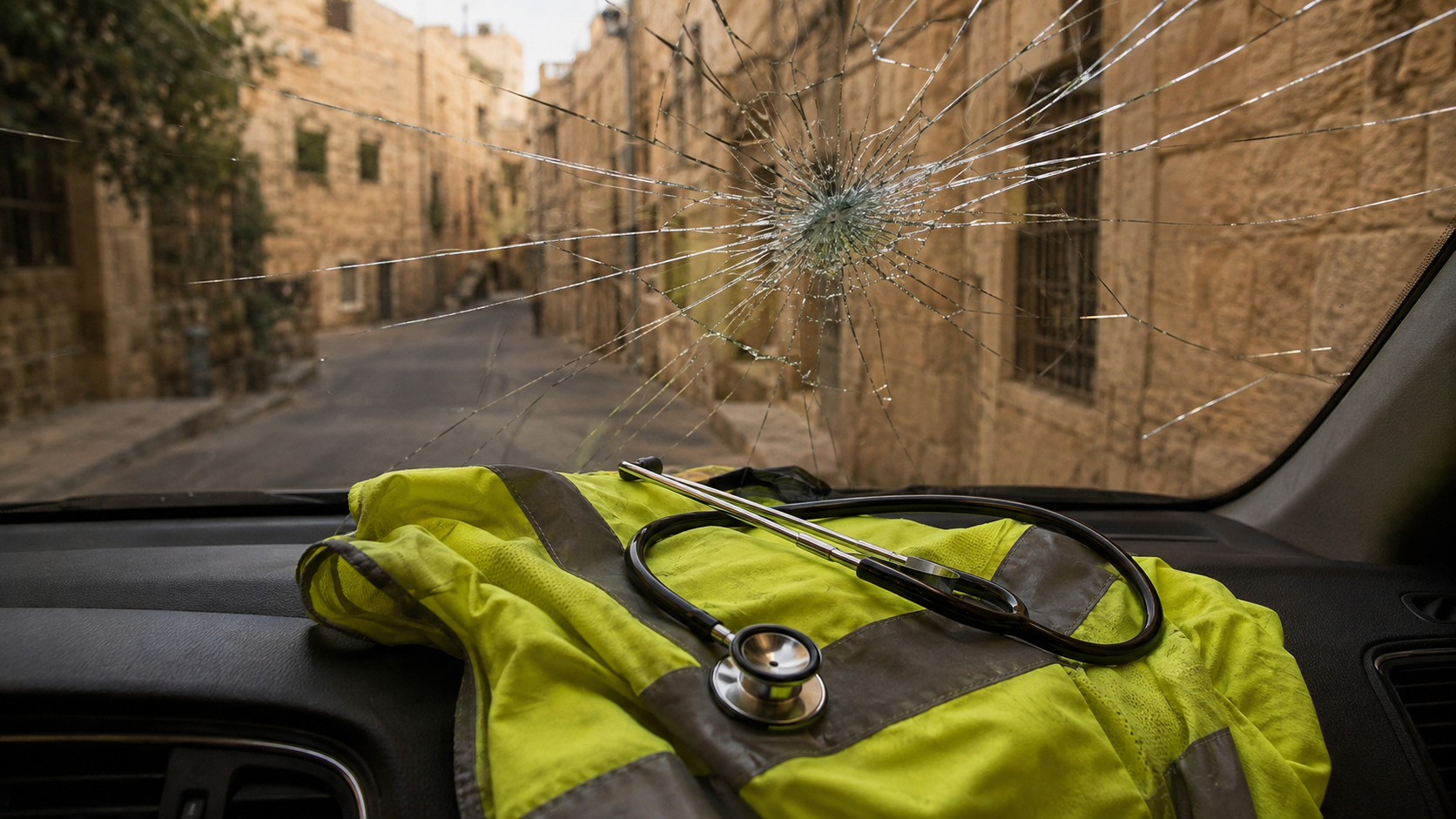
I drove through the tiny alleyways scanning my windshield for cracks as stones, garbage, and curses were hurled at my car. It was Shabbat afternoon and I was navigating through the maze-like streets of an ultra-Orthodox neighborhood surrounded by an enraged mob. Ironically I wasn’t afraid for my own safety. I was afraid for theirs.
The mob was made up of children. Teeny children.
Their tiny bodies formed a human blockade in the street as they screamed, “Shabbos!” They threw rocks and assorted garbage while shaking their tiny fists in indignation.
Six minutes earlier, I had been resting at home when the call came in: Woman giving birth. Seven minutes away.
Every single time I enter these neighborhoods on Shabbat I am greeted by the same mob. I am yelled at, spat at, and things are thrown at my car. Usually, I keep driving.
This afternoon, for some reason, they were particularly enraged, and I was running out of time.
I tried to inch forward. I pointed to my medical vest, held my stethoscope out the window, and called, “פיקוח נפש (Pikuach nefesh)!” A life may be at stake. But the children were too small, too many, and too close. I couldn’t move forward without risking hitting them. I was stuck.
That Shabbat, I was called to treat three people: a Muslim woman who had fallen, an elderly man who was confused, and an ultra-Orthodox woman giving birth.
I reached the first two. I never reached the woman.
When arriving at each scene I didn’t ask which one belonged to my community before beginning to treat them. Medicine doesn’t ask whether someone is religious enough, Jewish enough, politically acceptable, or one of “ours.” It asks where the person is, what is happening, and what must be done.
While I was dealing with my own private mob, that same week Café Basimta announced that it would stop opening on Shabbat after weeks of protests, violence, and intimidation from the ultra-Orthodox community. I know the café is connected to Jews for Jesus and that complicates the story for some. But that still does not make any of the violence that took place there, week after week, into an act of Torah, simply because it was done in the name of Shabbat and religion.
We like to say that violence isn’t the answer. Apparently it is.
The children didn’t convince me that I was wrong to drive on Shabbat. They didn’t need to. They physically stopped my car.
The protesters didn’t convince the café’s owners that opening on Shabbat was wrong. They didn’t need to. They made opening too difficult, frightening, and exhausting to continue.
Upon announcing the closure of the cafe, the ultra-Orthodox community celebrated the announcement: as a “victory for Shabbat.” But what exactly has won?
Has Judaism won when a business closes because its owners are afraid?
Has Shabbat won when a woman giving birth can’t be reached by a midwife?
Has Torah won when 5-year-olds learn to throw stones at another Jew?
Judaism is not binary. It is nuanced and complex, argued over for centuries, across layers of law, commentary, and philosophy. That does not mean it has no rules or absolutes. It has many. Driving on Shabbat is forbidden. Driving to save a life is required.
The nuance here is context.
When it comes to Jewish law the Torah teach us to “live by them.” Jewish law does not exist outside of life; it must be applied within it. Torah has to survive the journey from the page to the real-world context. Yet somehow, these children had learned that driving on Shabbat was forbidden while throwing rocks at the driver was acceptable. If a child is taught how to protect Shabbat but not how to protect the human being in front of them, something essential has been lost between the page and the street.
This is not an isolated incident between a midwife and a birthing woman.
For nearly three years, scenes of violent ultra-Orthodox protests have been splashed across news screens around the world, carried out in the name of religion and the protection of Torah study. We have watched roads burn, stones fly, and blood spill.
The topic may change: Shabbat, a coffee shop, military service. But the tactic remains the same: violence, intimidation, and disruption.
But violence does not become Torah because the person throwing the stone is screaming “Shabbos.” Intimidation does not become holy because it is used to protect Torah study. The moment protecting the Torah requires us to stop seeing the human being in front of us, we are no longer protecting Torah. We are betraying it.
The irony is that context is precisely what the rest of us are repeatedly asked to extend to the Haredi community. We are asked to understand why Shabbat is central to their neighborhoods. Why Torah study is not a hobby but the foundation of their lives. Why military service is experienced by many of them as a threat to the world they have built and are desperate to preserve. I may not agree with every conclusion, but I can listen and try to understand.
But context cannot be a privilege reserved for only one community.
I had context too. Six minutes earlier, I had been sitting at home enjoying shabbat with my family. Then a woman having a baby called MDA and I responded.
If I am asked to understand why an open café on Shabbat feels like a threat to their way of life, then they must understand why using intimidation to close it feels like a threat to ours.
If I am expected to see the yeshiva student behind the draft notice, then they must be willing to see the midwife behind the windshield.
If I am asked to respect the fear that military service may change their children, then they must respect the reality that blocking a medical responder may endanger one of their own.
Understanding cannot travel in only one direction. Neither can responsibility.
We are not only a religion, an ethnicity, or a nationality. We are an am. A nation. A people.
That word must mean more than a shared history or a common name. It must mean that your life places a claim on me, and my life places a claim on you. We are bound together by a brit, a covenant.
A covenant is not permission for one group to decide how everyone else must live. A covenant is a promise that we will carry one another.
Kol Yisrael arevim zeh bazeh. All Jews are responsible for one another.
Arevut is not surveillance. It is not watching another Jew’s coffee cup. It is not checking whether another Jew is driving. It is not forcing another Jew to observe as you do.
Arevut means that I am answerable for you. And you are answerable for me.
It means that when a Muslim woman falls, I go. When an elderly man becomes confused, I go. When a Haredi woman is giving birth, I go.
I do not first ask whether they would come for me. I go because another human being needs me.
I know Haredim who live this kind of arevut every day. They serve, volunteer, rescue, treat, and carry. They are proof that religious devotion is not the problem. The problem is religion emptied of responsibility, context, nuance, and humanity. Torah learning that never makes the journey from the page to the person. Certainty so absolute, that there is no room left for listening, questions, or human dignity.
Those children were not born believing that throwing stones at another Jew was a defense of Judaism. Someone taught them that that’s what religious devotion looks like. Someone taught them to identify outsiders, attack them, and then demand that those same outsiders respect you, accommodate you, and conform to your way of life.
Who is teaching them what they owe those Jews in return?
If my driving on Shabbat is their business, then the choices their community makes that affect the rest of us are our business. If an open café on Shabbat binds us together as one Jewish people, then we remain one Jewish people when the army says it urgently needs more soldiers.
Covenant cannot mean that some of us decide how everyone must live while others are sent to die protecting their right to decide.
Kol Yisrael arevim zeh bazeh.
I will keep going. I will continue to answer calls in every community, at every hour, on every day. Because that is what it means to be a human. That is what it means to be part of an am.
We either carry one another or we throw stones at one another.
We cannot do both.
Related Topics
Related Posts