What's in a Word? Synonyms in the Hebrew Language
Of Miracles and Poles – Neis, Badd, Shapud, Toren
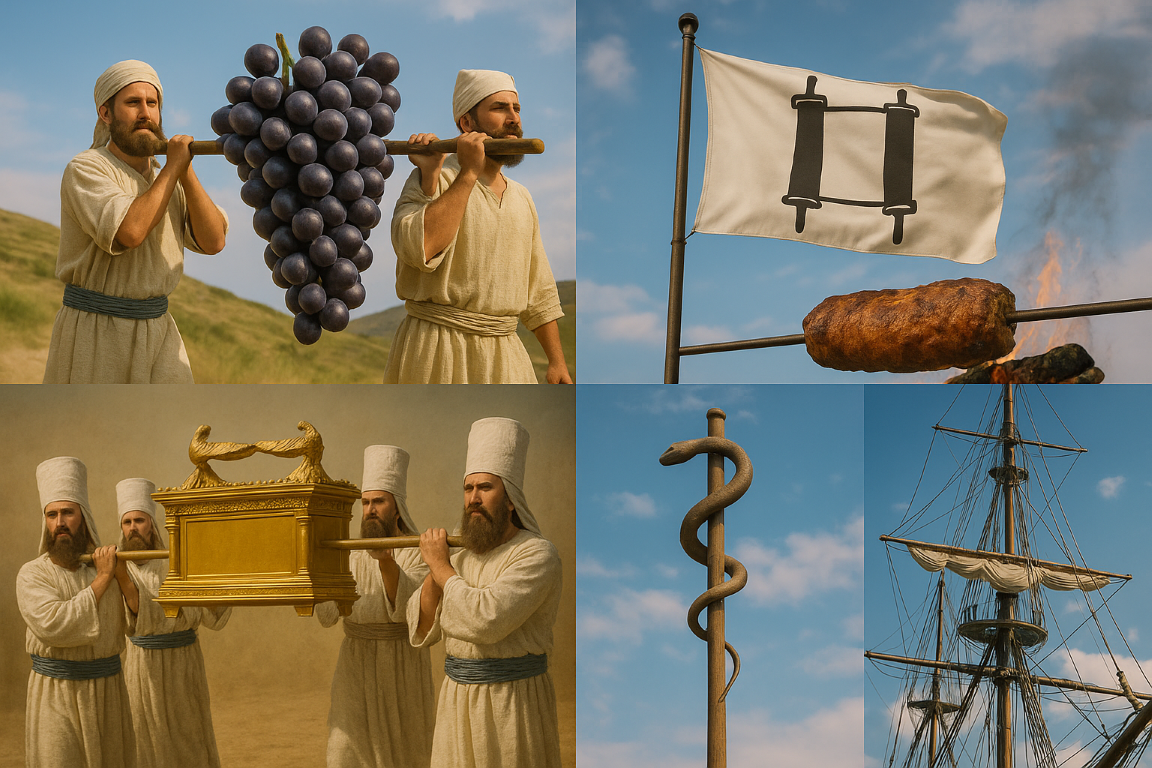
Before the Jews entered the Holy Land, they demanded of Moses to send a group of spies to it scout out that and uncover its weaknesses. In that unfortunate incident, the spies ended up returning to the Jewish People with a bad report of the Promised Land, and the disheartened nation ended up having to stay in the desert for fort years before they would once again have a chance to enter the Holy Land. When describing how the spies checked out the land, the Bible reports: “And they came until Nachal Eshkol, and they cut from there a branch [zemorah] and a single cluster of grapes, and they carried it upon the spit [mot] in twos” (Num. 13:23). This verse uses the word mot to denote a pole used for carrying things. There are several other words in Hebrew that refer to more or less the same concept, including neis, badd, toren, and shapud. In this essay, we will examine all of those possible synonyms by exploring their respective etymologies and trying to hone in on exactly what each term means.
Before we begin, I would like to discuss the interplay between the word mot and zemorah in the verse quoted above. Rabbi Yaakov Tzvi Mecklenburg in HaKtav VeHaKabbalah (there) understood that verse to mean that the spies carried the branch and grape cluster on a mot. However, the Zohar (Shelach 160b) states that the zemorah and the mot were one and the same, using the definite article (“the”) applied to mot to see an allusion to the mot referring to something already mentioned. Instead, the Zohar explains that while said branch was still attached it to the tree was called a zemorah, but once it was detached it was called a mot.
Now we can discuss the word mot more closely. Besides for its appearance in the story of the spies, a mot was also used for carrying the Tabernacle paraphernalia when travelling in the wilderness (Num. 4:10, 4:12). A mot is thus a “pole” used for carrying things, like an oversized cluster of grapes (like in the case of the spies) or the ritual objects of the Tabernacle. These three cases, plus Nah. 1:13, are the only instances of the word mot in the Bible. But, a feminine form of the word, motah (plural: motot) appears another twelve times. Those forms of the word most often appear in reference to the “bar of a yoke” used to control an animal or person (for examples, see Lev. 26:13, Isa. 58:6, and Ezek. 30:18).
What is the shoresh (“etymological root”) of the word mot? For those lexicographers like Ibn Janach and Radak who believe that most Hebrew are rooted in triliteral roots, the answer is pretty clear: MEM-VAV-TET, and that is exactly what they write in their respective Sefer HaShorashim. However, the biliteralists who believe in two-letter roots are divided on this question. The Medieval biliteralist Menachem Ibn Saruk writes in Machberet Menachem that the root of mot is MEM-TET, which he explains also begets Hebrew words like tamut (“slipping/falling/inclining”), mateh (“stick/staff”), matey (“tribe/family”), mitah (“bed”) and the Aramaic word mata (“touching”). On the other, the Enlightenment-era biliteralist Rabbi Shlomo Pappenheim traces mot to TET-HEY, which we will explain below. What this means is that Menachem understood the middle VAV of the word mot to be extraneous to the core root, while Rabbi Pappenheim even understood the initial MEM of mot to be extraneous.
As Rabbi Pappenheim explains it, the core meaning of TET-HEY is the concept of “changing the current situation by inclining/moving in a different direction.” Hence, he sees the word natah (“inclining/turning”) as one of the main tributaries of this root. But since more a change in direction often entails moving downwards (especially because gravity is usually pulling in that direction), words like l’matah (“down/downward”) and matah (“falling/descending/slipping”) also derive from this root. He further connects the word mitah to this idea because one using a bed, one inclines oneself horizontally to lay down. Similarly, a mateh refers to an instrument that one uses to help one walk by leaning (i.e., inclining oneself) on it.
In light of this, it is no surprise that Rabbi Pappenheim explains that the word mot also derives from this root. In his work Cheshek Shlomo, he offers two explanations for how mot fits in, noting that from the simple contextual usage in the Bible, there is no way to decide which of these is more correct: Firstly, a mot refers to an especially thick wooden pole, which typically branches out from the bottom part of a tree (as opposed to the thinner branches at the top of tree). Because of this, mot relates to le’matah. Alternatively, he explains that mot may be related to natah, as it typically comes from a tree branch which is something that juts out to the sides of a tree, as though “turning” in a direction perpendicular to the trunk. In his work Yeriot Shlomo, Rabbi Pappenheim explains that mot is simply an extra strong mateh, so it derives more directly from that word.
Rabbi Shlomo of Urbino writes in his lexicon of Hebrew synonyms called Ohel Moed that the words mot and badd are synonyms. Thus, badd also refers to a “pole” used to carry things. For example, the Torah explicitly stipulates that the Shulchan (Ex. 25:28, 37:14), Gold Altar (Ex. 30:4, 37:27) and Copper altar (Ex. 27:7, 38:7) should have badim by which they can be carried, and the Ark (Ex. 25:13–15, 37:5) was also supposed to have badim.

Hebrew lexicographers trace badd to the root BET-DALET-(DALET), which also gives us words like le’vad (“alone”) and boded (“singular/individual”). A famous inflection of those words is the term hitbodedut, which refers to the act of engaging in isolated self-reflection. How does badd in the sense of “a pole used to carry things” relate to the core meaning of this root?
Rabbi Pappenehim in Yeriot Shlomo explains that because only a high-quality wooden branch would be taken as a badd, so conceptually-speaking once a proper pole has been chosen, it can be viewed as though that is the “only” branch from amognst all the other possible branches that is fit for this purpose. In other words, the chosen badd become singular from amongst its peers (that is, the other branches).
Alternatively, Rabbi Pappenehim writes that badd refers to an especially-thick branch that emerges from the tree near the ground, writing that it is called so because it separates from the tree right at the root, which makes it appear as if it is a tree by itself (that is “alone”). This lower branch is thick and hard, so people often choose to use it for carrying heavy loads, making bars, and crafting the beam of a scale, and hence the term badd refers to a pole used for those purposes. For example, in Mishnaic Hebrew an olive press is called a Beit HaBadd (literally “the House of the Pole”) on account of the use of this type of branch for pressing olives (see Shabbat 1:9, Nedarim 3:2, Bava Metzia 10:4, Bava Batra 1:6, 4:4–5, Shevuot 3:8, Keilim 12:3, 20:3, Taharot 10:1–2, 10:8, and Zavim 4:7).
Another Biblical Hebrew term used in reference to a pole used to carry things is neis (“high pole” or “flagpole”). In the Pentateuch, this word is used when Moses was commanded to prepare a Copper Snake and put up on a neis so that all Jews who were bit by snakes could gaze upon his Copper Snake and be miraculously healed (Num. 21:89). This word appears approximately 20 times in the Bible (according to Even Shoshan’s concordance), and even makes an appearance in the daily prayer liturgy, when we ask Hashem to “sound the Great Shofar to our freedom / and raise the neis to gather in our exiles…” Rabbi Pappenehim actually uses the word mot to define the word neis as “a high mot,” but does not seem to bothered about them being near synonymous.
The different lexicographers have different ways of understanding the etymological basis of the word neis. Machberet Menachem traces neis to the biliteral root NUN-SAMECH, from which also derive words for “fleeing/running away” and “wonder/miracle.” Radak in Sefer HaShorashim traces neis to NUN-SAMECH-SAMECH, explaining that a “flagpole” relates to the concept of “fleeing” because in ancient battle conceptions, when the flagbearer of an army would fall, the entire army would become disheartened and flee. Another closely related root is the triliteral root NUN-SAMECH-HEY, which refers to “testing/training.” For example, when the Bible (Gen. 22:1) introduces the story of the Binding of Isaac, it prefaces that pericope by noting that Hashem meant to “test” (nasah) Abraham. According to Macheberet Menachem, that term actually derives from the monoliteral root SAMECH.
The Midrash Tanchuma (Vayera §43) focuses on the Jewish People’s great merits on account of Abraham’s impeccable choices in the test (nisayon) of the Binding of Isaac by stating that that merit serves as a basis for Jews to “escape” (manos) Gehinnom. In this way, the Midrash links these two roots by offering a thematic connection between them.

When are you going to get yourself a copy?
Rabbi Pappenheim in Cheshek Shlomo actually traces neis back to the biliteral root SIN-ALEPH. The most common word derived from that root is the word nasa (“lifting/carrying”), which indeed Rabbi Pappenheim connects to neis by way of the interchangeability of the letters SIN and SAMECH. He argues that neis in the sense of “miracles” refers to an event or occurrence which has been “lifted up” from the everyday system of nature to reflect something above nature (literally, “supernatural”). Similarly, he writes that neis in the sense of a “tall pole” refers to a sort of branch that has been “lifted” and thus placed above the rest of the pieces of a tree.
Under normal circumstances, the one administering a test (the tester) is trying to figure something out or reveal new information about the one undergoing the test (the tested)….
To read the continuation of this article please visit “Message on a Pole” (June 2024).
Related Topics
Related Posts