
What's in a Word? Synonyms in the Hebrew Language
Of Orchards and Gardens – gan, pardes, bustan
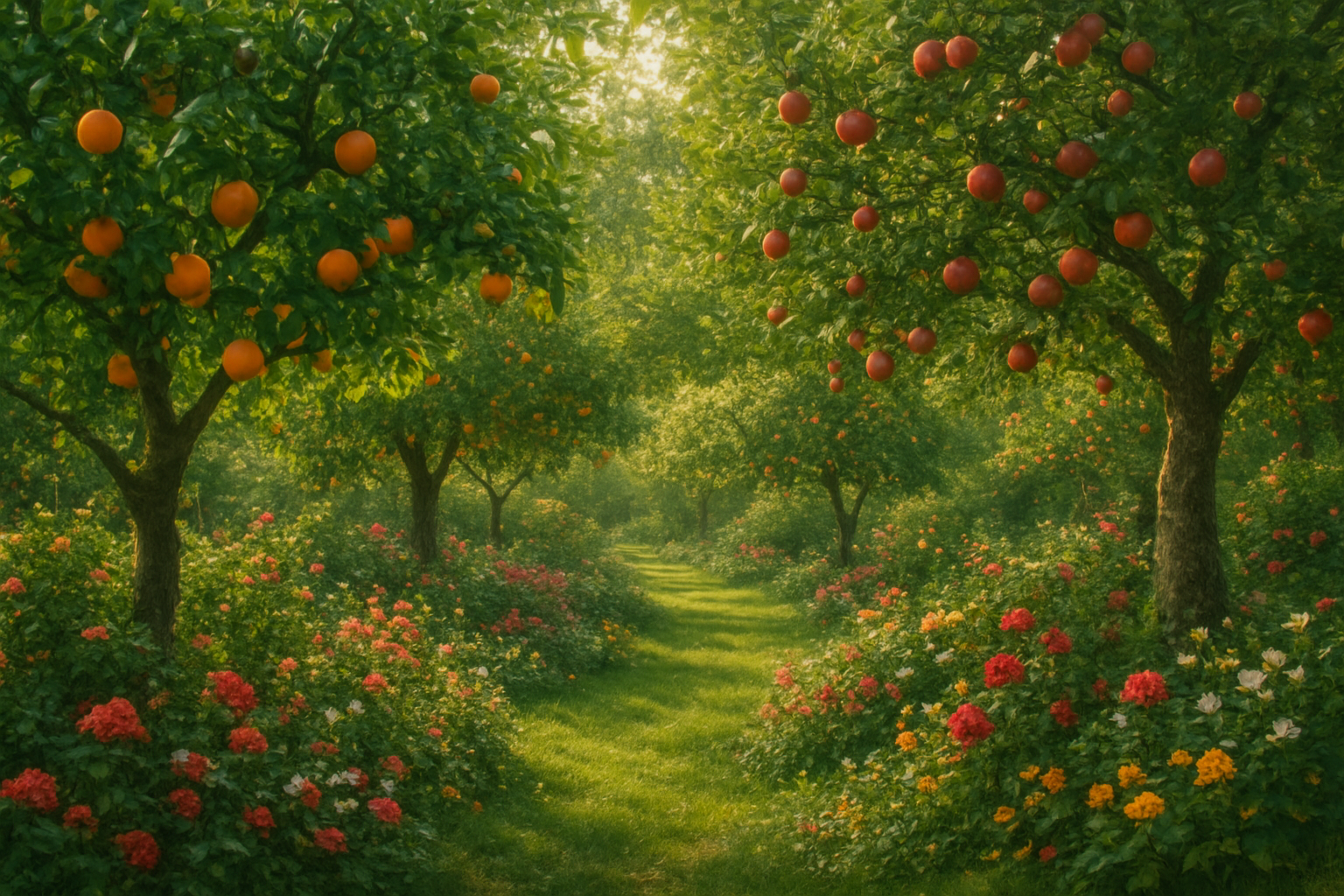
When Hashem created Adam on the very first Rosh HaShannah, He put Adam in a place called Gan Eden (“the Garden of Eden”) to cultivate and guard (Gen. 2:15). On the selfsame day, Adam sinned by eating from the Tree of Knowledge and was booted out from that idyllic utopia. Ever since then, man has strived to perfect himself and the world in a bid to return to that blissfully ideal paradise. In this essay, we focus on the word gan (“garden/park/orchard”) and how it may differ from its ostensible synonyms pardes and bustan. In doing so, we explore the etymologies of the words in question and discuss related cognates that can help us shed light on their core meaning. [For more on the word eden and its apparent synonyms oneg and pinuk, see my earlier essay “Indulging in Pleasure” (June 2019).]
Inflections of the word gan appears 41 times in the Bible (according to Even-Shoshan’s concordance). For example, the Bible refers multiple times to “the Garden of Hashem” (Gen. 13:10, Isa. 51:3, Ezek. 28:13, 31:8-9) and elsewhere refers to “the Garden of the King” (II Kgs. 25:4, Jer. 39:4, 54:7, Neh. 3:15). Cognates of this Hebrew word are also evident in various other Semitic languages, like Aramaic (gena), Akkadian (gannatu), Ugaritic (gn), and Arabic (janna). My cousin Yoninah Chagit Klein pointed out to me that the Arabic name of the West Bank city Jenin is actually a cognate of the Hebrew word gan. It’s no wonder that a 2023 IDF military operation in Jenin was dubbed “Bayit V’Gan” (literally, “house and garden”) — which is incidentally also the name of a prestigious neighborhood in Jerusalem. Scholars have identified the modern-day Jenin as the site of the Biblical Beit HaGan, to whence Ahaziah fled when running away for Jehu (II Kgs. 9:27), and possibly the Canaanite town Gina mentioned in the Amarna letters.
Although gan does not appear in the Mishnah, its cognate ginah appears numerous times in the Mishnah (Kilayim 1:2, Terumot 8:3, 9:5, Maasrot 3:10, 5:8, Shabbat 9:2, Eruvin 2:3, Ketubot 11:4, Bava Metzia 10:4, Bava Batra 1:2, 6:1, 7:2, Eduyot 2:4, Avodah Zarah 4:3, Ohalot 5:7, Uktzin 1:2). In Modern Hebrew, the term gan also refers to a “kindergarten” as a sort of calque from the from word kindergarten, which literally means “children’s garden” (in German).
The classical Hebrew lexicographers see the root of gan as the same thing as the root of the term haganah (“protecting/guarding”), with biliteralists like Menachem Ibn Saruk (920–970) tracing both to the biliteral root GIMMEL-NUN, and triliteralists like Ibn Janach (990–1050) and Radak (1160–1235) tracing both to the triliteral root GIMMEL-NUN-NUN. Anyone who has even some semblance of a green thumb can appreciate the connection in light of the fact that a “garden” is something that one would wish to “guard” and “protect,” so that its flora may flourish and not get destroyed. Rabbi Samson Raphael Hirsch (to Gen. 2:8) even explicitly notes that just like the Hebrew gan relates to the Hebrew haganah, so does the English word garden relate to the English word guard (see below)!
Rabbi Shlomo Pappenheim (1740–1814) also makes this etymology explicit in his work Cheshek Shlomo, when analyzing the two-letter root GIMMEL-NUN. In that work, Rabbi Pappenheim submits that that root’s core meaning is “protecting/guarding,” with the verbs related to haganah like yagen (Isa. 31:5) and migen (Gen. 14:20) referring to the act of “protecting/guarding.” The most obvious tributary of this meaning is the word magen (“shield”), a tool used by fighters for protecting themselves. But our word, gan, is another off-shoot of this idea, because gan denotes a protected patch of land that has been designed as a “garden” for the cultivation of flora and, is thus “protected” by physical barriers (like fences or walls) from the treading feet of intruders who might ruin the garden.
Taking this a step further, Rabbi Pappenheim actually sees two more Hebrew words as tributaries of gan: The word agan (Ex. 24:6, Song of Songs 7:3) refers to a “container,” but Rabbi Pappenheim clarifies that it does not refer to just any container; rather, it refers specifically to the sort of container that one might use for watering a garden. Hence, the very word for this container is derived from the word gan. Additionally, Rabbi Pappenheim argues that the word niggun (“melody”) also derives from gan, because a niggun denotes a harmonious variety of musical sounds that mimics the variety of flora that grow within a garden.
Rabbi Aharon Marcus (1843–1916) adds that just as a “garden” is something precious that is hidden away from people who are denied access, so does a ganav (“thief”) hide himself to engage in his thievery clandestinely. Of course, in Rabbi Pappenheim’s etymological system, the word ganav cannot derive from GIMMEL-LAMMED, because biliteral roots can only be combined with the letters HEY, ALEPH, MEM, NUN, TAV, YOD, or VAV to create a triliteral root. But Rabbi Marcus understood that biliteral root can combine with any letter to form a triliteral root.
In his work Yerios Shlomo, Rabbi Pappenheim takes a different approach altogether to the word gan — tracing it to the monoliteral root GIMMEL. He explains the core meaning of that root as “softening/melting.” There is ample precedent for seeing the letter GIMMEL as an etymological root in its own right in Menachem Ibn Saruk’s Machberet Menachem and in Rashi (to Zeph. 3:18 and Lam. 1:4).
But Rabbi Pappenheim takes this idea a few steps further and offers a whole litany of terms that are derived from this meaning of GIMMEL: nemigah/hitmogeg (“melting” in a physical and metaphorical sense), yagon (“sorrow/sadness” by which one’s heart becomes soft and melts away), niggun (because a musical “tune” or “melody” has the power to soften one’s heart and melt away one’s sorrows), gay (“valley,” because this topographical area has especially soft and absorbent ground, making it particularly fertile), gat (“winepress,” which is used to soften and smash grapes), gigit (the “container” into which grapes are placed after having been pressed in the gat), magen (“shield,” a sort of armor that was often made from a soft piece of animal skin/hide), ge’ah (“high/haughty,” because the growth necessary to achieve such heights stems from one’s amenability or flexibility towards change one’s current state and growing upwards), and gag (“roof,” derived from ga’ah because it is the “highest” part of a building). Finally, Rabbi Pappenheim explains that gan refers also derives from this monoliteral root because a “garden” typically grows in a tract of land wherein the soil is especially soft and conducive to plant growth.
Rabbi Yehudah Aryeh of Carpentras (an 18th century French grammarian and dayan) explains in Ohalei Yehuda that the word gan denotes a place with many trees whose shade can protect one from the sun. Alternatively, he explains that gan relates to the concept of “melting of the heart” in the sense that a garden is an enjoyable setting, such that its relaxing and leisurely aura — along with tis sweet smells — can help cure a person of his ailments. In this sense, a gan is the antidote to one whose heart was hitmogeg.
Interestingly, there are two more words related to gan which does not have an initial GIMMEL: Radak (to Ps. 8:16) explains that the word kanah (spelled with an initial KAF) is a form of the word gan (via the interchangeability of GIMMEL and KAF), even though most other commentators (including Radak himself in Sefer Shorashim) connect this word to the root KAF-(VAV)-NUN (“established/basis”). Likewise, Rabbi Hirsch (to Gen. 6:14) writes that the word ken (spelled with an initial KUF), which means “home/domicile” (often in the context of animals, like in kan tzipor “birdhouse/nest”) also relates to gan (as the letters GIMMEL and KUF are also interchangeable). The way he explains it, a ken is a more intense form of gan, because a gan is closed off by various barriers, while a ken is even more enclosed.
Earlier, we mentioned the notion that the English word garden is etymologically-related to the English word guard, just like in Hebrew gan and haganah share a root. However, this assertion does not pan out according to Modern Linguistics, which sees those two English words as derived from separate roots.
According to linguists, the English word garden derives from the Proto-Indo-European (PIE) root -gher, which originally meant “to enclose,” and eventually begat many related words in all sorts of different languages. In the Germanic languages, this root gave way to the Frankish gard, which in Old English (in the Anglo-Saxon period) became yard. The Frankish gard was also borrowed by Old North French as gardin, which itself was subsequently borrowed by Middle English as garden. Both English words, yard and garden, refer to an area that is enclosed by a fence or barrier. In Latin, the g of -gher turned into an h, to become hort/hortus (“garden”). This gives us such words a horticulture and cohort, the latter of was shortened to court in French and then borrowed into English. So it comes out that the English word courtyard actually uses two words derived from the same PIE root. The English word orchard is also derived from two of these words, as its etymon ortgeard/orceard (in Old English) is ultimately a hybrid of the Vulgate Latin orto (derived from the earlier Latin hortus) and the Old English geard/yard.
In Russian, this PIE root is the forebear of the word grad, which means “group of houses enclosed within a wall or fortification”— in other words a “town” or “city.” As you may have realized, -grad is also a common suffix in Russian place-names like Leningrad and Stalingrad. The Lithuanian town known as Novhardok in Jewish cultural memory is technically named Navаgradak or Novogrudok, which means “New City” (just like Neustadt, Naples, Neapolis, Nablus, Newtown do), again using the -grad element.
On the other hand, the English word guard comes from the PIE root -wer (“to see/watch out”), which became garder in Old French. In this way, guard is more closely related to the English words ward and warden (derived from the proto-Germanic wardon) than to garden. Interestingly, the English word lord is actually a contraction of the Old English words hlaf (“bread, loaf”) and weard (“keeper/guardian”), referring to the lord’s duty in protecting his constituents’ assets. (The phenomenon of the Germanic g becoming a w in Romance languages like French is also seen in the words guarantee and warranty.)
Before we move on to the next word, I wanted to offer another fascinating idea. In one particular passage in Song of Songs, a lover describes his beloved as a gan na’ul, “a closed garden” (Song of Songs 4:12). Based on this verse, rabbinic exegesis abound in expounding on how a woman might resemble a “garden,” with the rabbis even asserting that the word gan actually means “woman” (see Pirkei DeRabbi Eliezer ch. 21, Shir HaShirim Rabbah §4:24). Dr. Alexander Kohut (1842–1894) explains this assertion as wordplay based on the similarity of the Biblical Hebrew word gan to the Greek word gini (gynaíka) which means “woman” (like in the second element of the word androginus, “androgynous”). According to linguists, that Greek word is derived the Proto-Indo-European root gen- which refers to the act of “giving birth.” It is the ultimate etymon of a whole bevy of English words, including: genesis, genus, genealogy, generation, generate, gentile, genetic, genital, gynecology, gender, gene, gonad, pregnant, and more. Kohut also notes that the Latin word hortus which literally means “garden” is also sometimes used euphemistically in reference to female genitalia (as also brought in Lewis and Short’s dictionary on Latin).
-

- Discover the divine depth of Hebrew in *Lashon HaKodesh: History, Holiness, and Hebrew*, where Rabbi Reuven Chaim Klein traces the sacred tongue’s origins, evolution, and spiritual significance. This illuminating work bridges linguistics, theology, and tradition—revealing how language itself becomes a vessel of holiness. https://amzn.to/4q5e0ZD

-
- Discover the divine depth of Hebrew in *Lashon HaKodesh: History, Holiness, and Hebrew*, where Rabbi Reuven Chaim Klein traces the sacred tongue’s origins, evolution, and spiritual significance. This illuminating work bridges linguistics, theology, and tradition—revealing how language itself becomes a vessel of holiness. https://amzn.to/4q5e0ZD
The word pardes appears three times in the Hebrew Bible: Song of Songs 4:13, Ecc. 2:5, and Neh. 2:8. In all these cases, pardes refers to a “garden/orchard,” that is, a closed-off area devoted to growing plants. In one of those passages, King Solomon (under the name Kohelet) boasts of having planted multiples ginot and pardesim (Ecc. 2:5). The fact that he uses two different terms — gan and pardes — suggests that these words are not synonyms, but mean two different things. In this essay, we will also see how various commentators have differentiated between the meanings of gan and pardes, and we will also explore the various etymological theories proposed for understanding the origins of the word pardes. Afterwards, we will visit the term bustan which appears in the Talmud and attempt to better understand its etymology as well.
As our intuition might have guessed it, R. Yosef Kara and Metzudat Tzion (to Ecc. 2:5) explain that gan/ginah refers to a “garden,” where one plants vegetables and flowers; while pardes refers to what we call an “orchard,” that is, a place wherein one plants fruit-beating trees. Interestingly, when the Bible reports that Abraham planted an eshel, this word is typically understood to refer to a singular tree (possibly a tamarisk). Yet, the rabbis understood that Abraham did not just plant one tree, but rather he planted an entire pardes (see Sotah 10a, as well as Targum pseudo-Jonathan and Targum Yerushalmi to Gen. 21:33)!
However, Ibn Ezra (to Ecc. 2:5 and Song of Songs 4:13) takes another approach regarding the difference between gan and pardes. He writes that gan refers to a “garden” wherein multiple species of trees are planted, while pardes refers to a “garden” which consists of only one type of tree. So technically, according to Ibn Ezra, both gan and pardes can be translated as “orchard.” Rabbi Shlomo Aharon Wertheimer (1866–1935) points out that in the Talmud (Bava Metzia 104a, Bava Batra 7a), the default pardes refers specifically to a pomegranate orchard (this also found in Song of Songs 4:13 which refers to a pardes rimmonim), thus implying that the term generally refers to an orchard in which one specific type of tree was planted.
The author of Chotam Tochnit — Rabbi Avraham Bedersi (13th century Provence) — has a very intriguing method for differentiating between apparent synonyms in Hebrew: When a pair of similar-meaning words appear together in the Bible, Bedersi uses the order in which those words appear next to each other to help clarify the difference between them. He posits that the Bible always uses such words in ascending order — from the least intense to the most intense. Therefore, because King Solomon mentioned gan before pardes, he argues that a pardes is more esteemed and honorable than a mere gan. Like Ibn Ezra, he writes that a gan implies a place where all sorts of grasses, plants, and trees are planted — often with intent to benefit commercially from what they yield. On the other hand, a pardes denotes a more exclusive place, where only one specific species is planted (be they roses, pomegranates, or whatnot) and refers to a small area where royalty and nobility would go to enjoy themselves.
Rabbi Wertheimer notes that Rabbi Bedersi’s son, Rabbi Yedeiah HaPenini-Bedersi (1270–1240), echoes his father’s words by writing in the introduction to his work Sefer HaPardes that pardes implies a garden that is smaller than a gan. Rabbi Wertheimer notes that the Talmud (Bava Batra 68a) uses the diminutive term ginunyita (which diminutates gan by doubling its final consonant) to refer to a “small garden,” thus supporting the notion that otherwise the word gan implies a larger area, while pardes is a smaller space.
Contra Ibn Ezra, Rabbi David Luria (1798–1855), his glosses to Pirkei DeRabbi Eliezer, writes that the word pardes refers specifically to an orchard in which multiple species grow. This understanding leads him to find a Hebrew etymology for the word, tracing pardes to the triliteral root PEH-REISH-DALET (pirud, “separation”) in reference to the way that in a pardes, different types of trees planted in their respective rows.
Rabbi Yehudah Aryeh of Carpentras (an 18th century grammarian and dayan) in Ohalei Yehuda offers several different theories as to the etymology of the word pardes. The common denominator among all his theories is that he looks internally to Hebrew to see the source of the word pardes to broadly see pardes as a conglomeration or fusion of multiple Hebrew word/roots. His first theory sees pardes as a portmanteau of pri (“fruit”) and hidus (“dancing”), as the trees of within an “orchard” appear to jump and dance towards the Heavens, for they soar to greater altitudes than vegetables or other low plants that grow in a field/garden. The word hidus that he mentions appears in the Mishnah (Bava Kamma 2:1) that talks about the case of a “dancing” chicken (mihades) that caused damage while moving about. He offers three more theories that ignore the final SAMECH of the pardes and speculate on how the word may derived from a fusion of to pri (“fruit”) and one of the following three words: rar (“flows,” via the interchangeability of the orthographically-similar REISH and DALET), dar (“lives/dwells,” via metathesis that reverses the order of the consonants and REISH and DALET), or hadar (“beautiful”). Finally, he suggests the etymology of pardes as deriving from pri and either dash (“threshing/separating,” via the interchangeability of SAMECH/SIN and SHIN) or datz (like in ditzah, “happiness,” via the interchangeability of SAMECH and TZADI).

The truth is that the word pardes seems to be derived from the quadriliteral root PEH-REISH-DALET-SAMECH. But many prominent Hebrew grammarians like Ibn Ezra (1089–1167) and Rabbi Eliyahu HaBachur (1469–1549) have asserted that Hebrew words that seemingly derive from four-letter roots tend not to actually be native to Hebrew, but rather come in as loanwords from other languages.
Indeed, linguists have long argued that the Biblical Hebrew word pardes is not actually a native Hebrew word, but is, in fact, a loanword that originated in Avestan/Old Persian. As Rabbi Dr. Ernest Klein (1899–1983) clarifies, the original word was pairidaeza (“enclosure”), which was portmanteau of pairi (“around”) and daeza (“wall”). In this way, the etymon of pardes originally referred to a border or edge that extends around a particular area, but eventually it came to refer to whatever luscious grounds were confined within that enclosure. The first element of this Old Persian word is a cognate of the Greek peri (“around”), as both come from the same Indo-European root also found in the prefix of English words like perimeter, pericope, period, and peripheral (which all come from Greek and Latin).
This Old Persian was also borrowed into Greek (as paradeisos) and Latin (as paradisus), and eventually begat the English word paradise. The Greek cognate of pardes entered popular discourse because when the Septuagint translated the Hebrew Bible into Koine Greek, it used the word paradeisos to translate the Hebrew words pardes and gan. Rabbi Jonah Ibn Janach (990–1055) in his Sefer HaShorashim, notes that there is also an Arabic cognate of pardes, probably a reference to the Modern Persian and Modern Arabic word firdaus.
The Talmud (Chagigah 14b) tells the story of four sages who “entered the Pardes,” which Rashi (there) explains as referring to Heaven. This notion in reflected in the Christian idea of Paradise as being in the Heavens. Others have explained the term pardes in this context in more esoteric terms. Rabbi Yitzchak Luria (1534–1572), also known as the Arizal famously understood the word PaRDeS as an acronym for four planes of Torah study, pshat, remez, drush, and sod; while his contemporary, Rabbi Moshe Cordovero (1522–1570), also known as the Ramak, omits remez and puts rayah in its stead, and his contemporary Rabbi Moshe Isserles (1520–1572), also known as Rema, switches our sod for seter. [For Maimonides’ understanding of pardes, see his Laws of Yesodei HaTorah 4:13, Laws of Talmud Torah 1:12, and Guide for the Perplexed (2:30–32).]
The common word for “garden” in Talmudic Aramaic is bustan/bustana. For example, the Talmud uses this word to describe the royal gardens maintained by King David (Shabbat 30b), Achashverosh (Megillah 16a), and the Jewish Exilarch, known as the Reish Galuta (Eruvin 25b). Targum Sheini (to Est. 3:8) also uses the word bustan when relating that Haman complained to Achashverosh about the Jews who “would enter our gardens” on Sukkot and take a Lulav and Etrog for themselves. In some places, Rashi (to Eruvin 25b, Bava Metzia 22a) uses the Biblical Hebrew word pardes to define bustan, while his grandson Rashbam (to Bava Batra 61b) uses the word gan to define bustan.
The Talmudic Aramaic word bustan is clearly a loanword from the Middle Persian word bostan, which also refers to a “botanical garden.” Rabbi Dr. Ernest Klein (no relation) parses the etymology of that Persian term as deriving from bo (“smell/odor/fragrance”) and the Persian suffix -stan (“place of,” a suffix familiar to us through place-names like Pakistan, Kurdistan, Hindustan, Uzbekistan, Afghanistan). It also a cognate of the word bustaan (“garden”) in Arabic. The English word bostanji is an Anglicization of the Turkish term for the imperial guards responsible for protecting the Sultan’s palace in the Ottoman Empire. The name of this type of soldier literally means “gardener,” and is derived from the Persian/Arabic word in question.
The word bustan was also adopted as a personal name in a fascinating, but little-known story. Bustanai (also spelled Bostanai) was a reish geluta of the Jewish community in Babylonia in the seventh century. Legend has it that before he was born, the Persian king sough to annihilate all remnants of the Davidic Dynasty and ended up killing all of King David’s male descendants that were alive. However, unbeknownst to the king, a newlywed wife of a Davidic scion was pregnant when the Persian king killed her husband, and the Davidic line was destined to continue from that son. At some point, the Persian king decided to seek out any possible pregnant daughters-in-law of Davidic males that he killed out so that he can ensure that no survivors will be born.
But then, he had a dream in which he was shown a beautiful garden which he proceeded to destroy. In the dream, an old man chided him for destroying even the young ungrown saplings in the garden — a clear allusion to the unborn scion of David that the Persian king wished to kill. After seeing this dream, Persian king made an about-face and resolved to spare the remaining pregnant daughter-in-law and undertook to support her unborn son. That son was named Bustanai, and his very name alludes to the “garden” that the Persian king saw in his dream. During Bustanai’s lifetime, the Muslims conquered the Persians and took the king’s daughter as captive. Through his cleverness and charm, Bustanai impressed the Muslim Caliph, who actually give him the Persian king’s daughter as a wife. Parts of this story are referenced by Rabbi Hai Gaon (939–1038) in a legal discussion, but for more about the legend of Bustanai, see Seder Olam Zuta, Seder HaDoros (Year 4420), Otzar Yisrael (s.v. Bustanai), and Ben Yehoyada (to Sanhedrin 5a).
I had originally suspected that the word bustan might somehow be etymologically-related to the English word botanical (and its cousin botany/botanist) — after all, both words are used in conjunction with gardens. However, Rabbi Shaul Goldman set the record straight for me. The English term in question ultimately derives from the Latin botanicus and the Greek botanikos, and the earlier Greek word botane (“fodder/pasture/plant”). Meaning, the original Greek etymon seems to have more to do with pasturage than plants/gardens, per se. It seems that botane is more closely related to botamia (“pastures”), boton (“grazing beast”), and boter (“herdsman”), which all relate to animals and what they eat. It has even been suggested that the bo- element of these words is related to bous (in Greek) and bos (in Latin), which means “cow” (thus making botanical a relative of the English word bovine) and has nothing to do with the sweet-smelling bustan.

Related Topics
Related Posts