


Mathematics Teaching Professor, Author
Old Synagogue of Erfurt Germany, the oldest surviving synagogue in the world
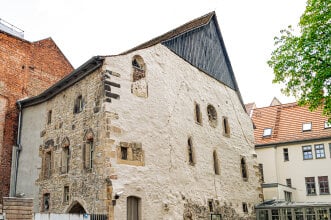
Old Synagogue West Facade (Source: City of Erfurt/Dirk Urban)
The Old Synagogue, in Erfurt, Germany, is widely regarded as the oldest intact synagogue building in Europe, with its earliest sections dating to around 1094 and substantial surviving fabric from the 13th century. After the expulsion and massacre of Erfurt’s Jewish community during the Black Death in 1349, the building was repurposed for secular uses over the centuries, including as a storehouse, restaurant, and ballroom, and its original function was eventually forgotten by the Nazi era, which helped preserve its structure.
Rediscovered and studied again in the late 20th century, it is especially significant for its intact roof of 1350/51 and is often described as the oldest surviving synagogue building of its kind in the world.
I would like to thank the esteemed Dr. Maria Stürzebecher for her guidance and support of this article.
History of the Old Synagogue
In the year 800 CE, Erfurt, Germany, was an emerging Carolingian trading settlement, which was a town established during the Early Middle to control tax, and facilitate international and regional trade. In 805, Charlemagne granted Erfurt market rights, establishing it as an important commercial crossroads where merchants exchanged salt, textiles, agricultural products, and other goods. Over the following centuries, the city grew in wealth and influence, benefiting from its strategic position along major trade routes.
By the late 11th century, Erfurt had become a prosperous trading center within the Holy Roman Empire. Situated along the Via Regia trade route, the city was both economically vibrant and religiously diverse.
It was during this period that a Jewish community emerged and flourished alongside the Christian majority, making Erfurt home to one of the oldest documented Jewish communities in central Germany.
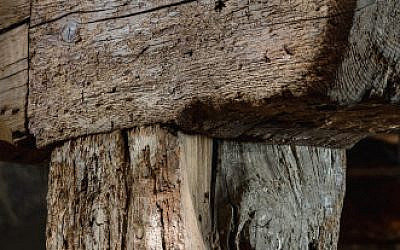
And this begins the story of the Old Synagogue. The story of Jewish Erfurt is closely tied to the Old Synagogue. Architectural evidence shows that the oldest surviving portions of the building date to these times, late 11th century, with timber from the original structure scientifically dated to 1094. These remains represent the earliest physical evidence of Jewish life in the city.
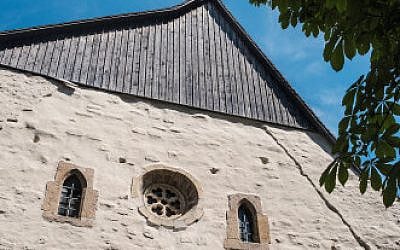
As the community grew, the synagogue was expanded and renovated. Around 1270, a larger and more impressive synagogue was built, incorporating the earlier structure. Its western façade featured five tall lancet windows and a large rose window, while around 1300 additional space was added, likely serving as a women’s prayer area, school, or meeting room for the Jewish court.
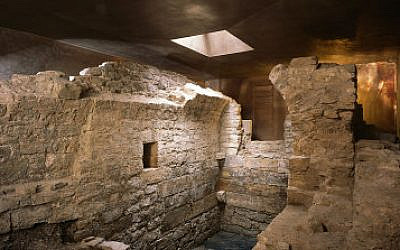
By the 13th century, Erfurt’s Jewish community was thriving through banking, trade, and scholarship. Supporting this flourishing community were essential Jewish institutions, including the synagogue, a cemetery, and a medieval mikveh, which is a Jewish ritual bath used for religious purification. Dating from the 13th century, the Erfurt mikveh is one of the best-preserved examples of its kind in Europe and today serves as a museum.
Nearby, the Stone House, built before 1250, functioned as both a residence and commercial building, reflecting the prosperity and integration of Jewish residents within Erfurt’s urban society.
This period of prosperity came to a tragic end on March 21, 1349, when a plague-related pogrom devastated Erfurt’s Jewish community during the Black Death. Fueled by false accusations that Jews were poisoning wells and spreading the plague, mobs attacked the Jewish quarter. The March 21, 1349 pogrom resulted in the massacre of a large portion of the community, with estimates ranging from 300 to 500 people murdered or burned to death, while the survivors were expelled from the city. The synagogue was severely damaged, confiscated by the city, and converted into a warehouse.
Despite this damage, much of the medieval structure survived. The Old Synagogue, with components dating to the 11th century, is the oldest synagogue in Central Europe preserved up to its roof. Remarkably, much of its original architectural form and design from its period of use between approximately 1100 and 1349 remains intact, providing an extraordinary record of medieval Jewish life in Erfurt.
In the early 1450s. the Italian friar and preacher John of Capistrano visited the Erfurt and the surrounding region, delivering intense anti-Jewish sermons that strongly agitated the local Christian population. Amid rising municipal hostility and religious agitation, Jews were expelled from Erfurt in 1453.
Although Jews were expelled from Erfurt in 1453 and were not permitted to resettle permanently until the early 19th century, the Old Synagogue, Stone House, and medieval mikveh survived. Together, these remarkable monuments preserve the memory of one of medieval Europe’s most important Jewish communities and stand as powerful witnesses to nearly a thousand years of Jewish history in Erfurt.
It was in the 19th century, that in addition to its medieval legacy, Erfurt also saw the re-establishment of a modern Jewish community. A Jewish cemetery was established on Cyriakstraße and later expanded with a New Cemetery due to space limitations.
This community built a Small Synagogue. Later, as the community expanded, in 1884, they then consecrated the Great Synagogue, reflecting renewed growth and confidence. However, this later chapter was violently interrupted when the New Synagogue was destroyed in 1938 during the Nazi pogroms, marking the end of pre-war Jewish life in the city.
Back to the Old Synagogue. From the late 1800s until 1990, the Old Synagogue in Erfurt was extensively repurposed for the preparation, study, and enjoyment of good food, a gastronomic use, and the synagogue was significantly remodeled. A dance hall was installed on the upper floor, while the ground floor contained kitchens and dining rooms. The basement and ground floor even housed two bowling alleys.
To accommodate these changes, the original upper wooden ceiling was removed and replaced by a surrounding gallery. Despite these alterations, much of the richly decorated upper level, including stucco figures and colorful wall paintings, has been largely preserved, reflecting the building’s layered history of adaptation and reuse.
By the late 1900s, the Old Synagogue had lost much of its original architectural clarity due to decades of modification and commercial use. It was used continuously as a restaurant until 1990, and only in the late 1980s did preservation authorities begin to recognize its historical importance. Subsequent investigations in the early 1990s revealed that, despite its altered appearance and structural strain, the medieval core of the building was largely intact and of exceptional historical value. Following difficult negotiations after German reunification, the city of Erfurt purchased the building in 1998 to secure its preservation.
One of the most significant discoveries associated with the site is the Erfurt Treasure, a hoard of medieval Gothic jewelry, coins, and silverware discovered in 1998 in Erfurt, Germany. Believed to have been hidden by a Jewish resident or merchant in 1349 to escape the Black Death–related pogroms, it is considered one of the most important archaeological finds of medieval Jewish material culture in Europe. The treasure was uncovered in the former Jewish quarter and is now displayed in the cellar of the Old Synagogue, where it provides a direct material link to the city’s medieval Jewish community.
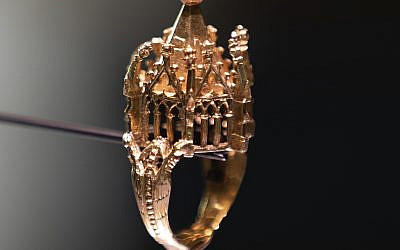
In this hoard, a medieval Jewish wedding ring discovered near the Synagogue further illustrates the religious and cultural life of Erfurt’s Jewish community. Together, these artifacts, combined with the surviving architecture of the Old Synagogue itself, offer a powerful record of continuity, destruction, and rediscovery in the history of Jews in Erfurt.
Between 1999 and 2009, the Old Synagogue in Erfurt underwent a careful and historically sensitive restoration. The guiding principle of this work was to preserve the building’s layered history, reflecting its various uses over time as well as the long history of Erfurt’s Jewish community. Many later additions were removed to reveal the medieval structure and restore its visibility as a synagogue. From as early as 2003, plans developed for a new cultural use of the building, culminating in the creation of a museum dedicated to the history and culture of Erfurt’s medieval Jewish community. The Old Synagogue Museum officially opened on October 27, 2009.
Nowadays, the Old Synagogue stands as one of the few surviving high medieval synagogue buildings in Europe and is regarded as the oldest, largest, and best-preserved of its kind. Its structure clearly reflects its original function as a congregational synagogue, while its location within the medieval city remains fully legible. Alongside the nearby mikveh and Stone House, it forms part of a rare and coherent ensemble of medieval Jewish heritage.
In 2008, the city of Erfurt started to work on the application for UNESCO World Heritage status for this Jewish medieval heritage, with the first step being inclusion on the German Tentative List. In 2023, the Jewish-Medieval Heritage of Erfurt was inscribed to the UNESCO World Heritage List. The transformation of the Old Synagogue into a museum ensures that its history is not only preserved but also made accessible to the public.
Education and Research
Today, the Old Synagogue and the Small Synagogue in Erfurt function as important cultural and educational centers dedicated to Jewish history and heritage. The Old Synagogue houses permanent exhibitions that present the history of the medieval Jewish community, while public guided tours are regularly offered there as well as at the medieval mikveh. Visitor groups can also arrange customized group tours with a variety of thematic options, and the “Jewish Life Erfurt” network provides special educational programs for children, youth groups, daycare centers, and school classes.
The Small Synagogue serves as a scholarly and educational hub, housing a reference library with more than 2,500 books, journals, and DVDs focused on Jewish history and Jewish life in Erfurt and Thuringia. It also plays a central role in research and academic cooperation. An advisory board on Jewish heritage in Erfurt brings together internationally recognized scholars from fields such as art history, archaeology, Jewish studies, Hebrew literature, social history, and architectural history, ensuring interdisciplinary engagement with the city’s medieval Jewish legacy.
Research on Erfurt’s Hebrew manuscripts is conducted through a joint project involving the “Jewish Life Erfurt” network, the Berlin State Library – Prussian Cultural Heritage Foundation, and the Free University of Berlin, with specialist scholars contributing to the study and preservation of these important texts. In addition, the memorial book “Extinguished Lives,” published in 2013, documents 453 Jewish residents of Erfurt who were persecuted between 1933 and 1945 and died violent deaths, preserving their memory for future generations.
Beyond research and education, the institutions also host conferences, lectures, and public events, making them active centers of dialogue and remembrance. Together, the Old Synagogue and Small Synagogue form a living network of history, scholarship, and commemoration that connects Erfurt’s medieval Jewish heritage with its modern cultural memory.
The building’s history reflects the broader story of Erfurt’s Jewish community: its emergence around 1100, its centuries of prosperity, its violent destruction in the pogrom of 1349, and its long absence from the city.
The Old Synagogue today stands as a museum that is a powerful testimony to this legacy of the Jewish community and it serves as a remembrance, tracing the history of the Jewish community in Erfurt, Germany, from the Middle Ages until today.
Contact Information:
Old Synagogue of Erfurt Germany, Waagegasse 8, 99084 Erfurt, Germany
Phone: +49 (0) 361/ 655 16 66
Email: altesynagoge@erfurt.de
Website: juedisches-leben.erfurt.de