
Oman’s Long Dance with Iran
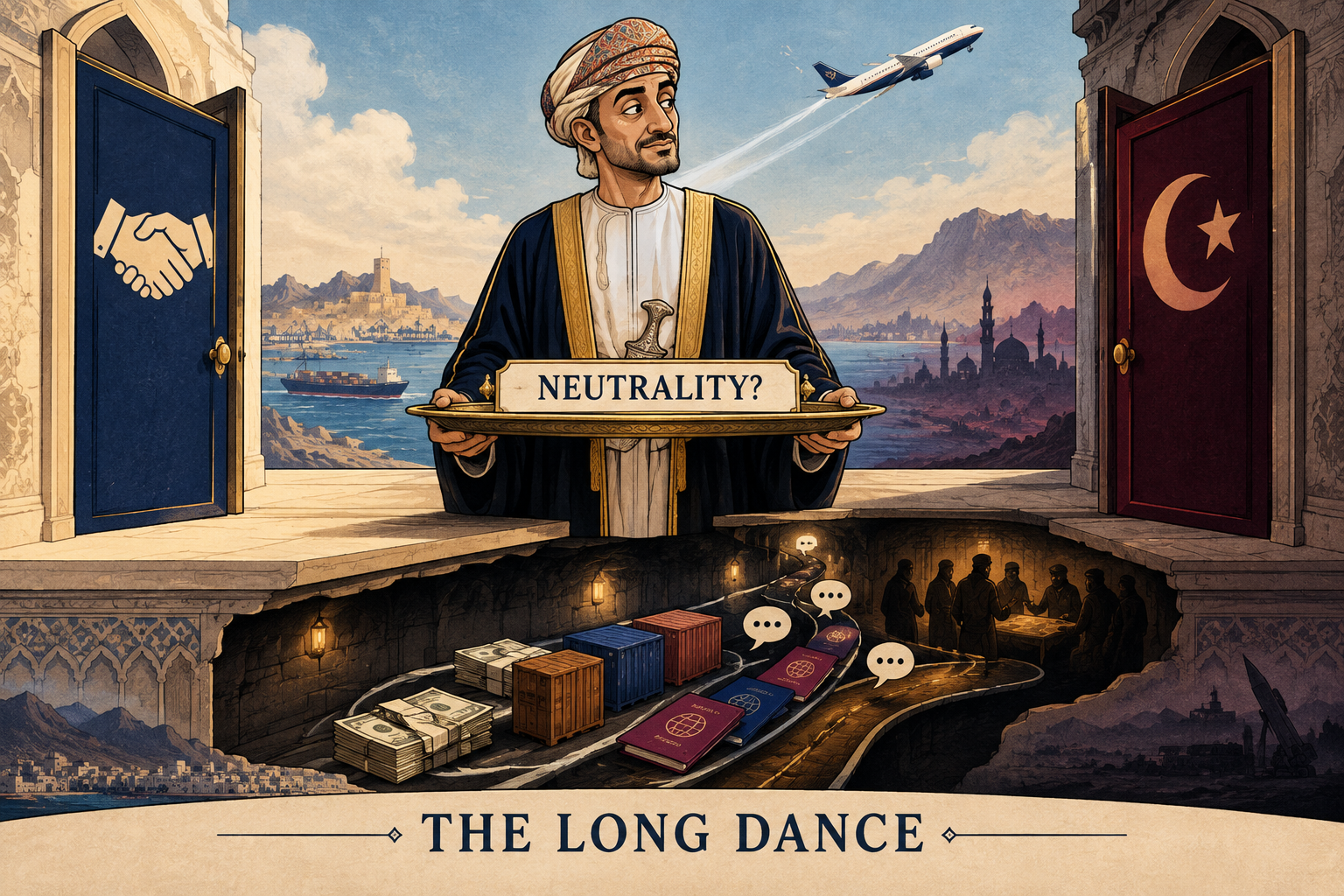
Oman likes to present itself as the grown-up in the room. The Gulf state that speaks to everyone, keeps the channels open, and avoids the theatrical alignments that define so much of regional politics. The reputation has served Muscat well.
Neutrality is not the same as innocence.
For decades Oman has kept an unusually close relationship with the Islamic Republic. It preserved ties with Tehran during the Iran–Iraq war, hosted discreet American–Iranian contacts, and later helped build the diplomatic channel that contributed to the 2015 nuclear deal. Washington has long valued Oman because it can talk to the Islamic Republic of Iran. The same access can also give Tehran cover.
Oman says engagement reduces danger. The regime treats engagement as room to manoeuvre. The difference matters.
Muscat has developed its own formula: Western security cooperation, commercial pragmatism, diplomatic neutrality, and a careful accommodation of Iran. It is neither a formal member of Tehran’s axis of resistance nor a conventional American ally ready to confront Iran at every turn. That ambiguity is deliberate. Oman can host American officials and Iranian representatives in the same diplomatic space. It can claim the role of intermediary while keeping economic and political ties with Tehran. It can allow Iranian-linked activity in an environment that is neither openly hostile nor fully aligned with Washington.
For the regime, that environment is useful.
There is a financial side. Analysts have pointed to Oman as a possible channel for Iranian banking, trade and logistics, including Iranian banks still operating under sanctions and funds moving through Omani institutions. The United States has warned financial institutions in the region about helping Iran evade sanctions. None of this proves the Omani government runs a deliberate evasion scheme. It does explain why the country’s commercial and financial systems deserve scrutiny. An enabler does not need to share the sponsor’s ideology to be useful.
The same pattern shows up in Yemen. The Houthis keep a political presence in Muscat, and Oman has often acted as intermediary between the group and foreign governments. That role can be legitimate. But sanctions reporting and United Nations experts have also identified Oman as a place through which Houthi financial activity, procurement and dual-use goods can move. The issue is not whether every traveller or shipment is controlled by Muscat. The issue is whether Oman has created a relatively open corridor through which Iran and its proxies can move people, money, equipment and instructions with less friction than elsewhere.
Geography turns diplomacy into infrastructure. If IRGC-linked personnel or Houthi operatives face fewer real obstacles when travelling between Iran, Oman and Yemen, then Muscat is no longer just a mediator. It becomes a transit route linking Iran to the wider region. Claims of special permissions need verification. If confirmed, they would matter.
The picture sharpens when Iraq is included. The Islamic Dawa Party is not simply another Iraqi political group. It grew out of Shia Islamist opposition to Baathist rule, supported the Iranian revolution, and kept deep historical ties with Tehran. Its relationship with Iran should not be reduced to crude proxy status. Iraqi politics is more complicated. Yet Dawa shows how Iranian influence works through political institutions as well as armed groups. Tehran does not need every partner to act like the IRGC. It needs political actors who can shape governments, keep access open, normalise Iranian interests and leave formal institutions permeable.
These relationships do not have to form one neat chain. They only need to sit in the same regional system. Oman supplies diplomatic access and a line to Washington. The Houthis supply force around Yemen and the Red Sea. Iraqi political networks supply influence inside a sovereign state. The IRGC supplies money, people, logistics and direction.
Western governments too often examine each piece on its own. Banking is treated as commerce. Houthi access is treated as mediation. Iranian travel is treated as routine. Political links in Iraq are treated as domestic politics. The whole is missed because each part seems to belong to a different file. Tehran’s method relies on exactly that separation.
The method was visible again this week. A Flydubai flight from Dubai to Tel Aviv was forced to divert after one pilot stabbed the other mid-flight. Israeli officials are treating the episode as a possible terror attack. Passengers intervened. The aircraft sent emergency and hijacking signals, dropped thousands of feet, and landed in Saudi Arabia. A second Tel Aviv-bound flight was also diverted. All passengers survived. The incident happened as Jewish communities prepared to mark Simchat Torah, the anniversary of the 7 October massacre. Once again, civilians flying to the only Jewish state faced the risk of being turned into targets.
No public evidence yet links the episode directly to Oman. That is not the central point. The central point is the wider climate in which such attempts become possible. Iran’s regional approach thrives on ambiguity, deniable actors, and commercial or diplomatic routes that do not look like Tehran. When each incident, banking channel, transit route and political relationship is kept in a separate drawer, the system that makes the next attempt easier is left untouched.
Oman is useful to Iran because it does not look like Iran. It is a friendly state, a mediator, a commercial partner and a security contact. That makes it more valuable than an openly aligned ally. The regime can draw benefit from Omani access without needing Omani ideological loyalty.
Muscat may think it is managing Iran through engagement. Iran may think it is managing the region through Muscat. That is the long dance.
The real question for Washington, London and the Gulf states is not whether Oman is “pro-Iranian.” The question is what Oman allows, what it can see, what it can stop, and what it chooses not to stop. If sanctions are being bypassed through Omani banks, that counts. If Houthi procurement moves through Omani commercial networks, that counts. If Iranian or IRGC-linked personnel enjoy easier transit, that counts. If political relationships help Tehran keep influence in Iraq, that counts. And if the broader climate of Iranian-enabled pressure keeps producing attempts against Israel-bound civilians, that counts most of all.
Neutrality cannot become a free pass for strategic blindness. Oman may still act as a mediator. But mediation that leaves Iran’s networks intact can function as enablement under another name. The West should judge Muscat by the practical results of its choices, not by the language of neutrality.
The Islamic Republic has learned to turn ambiguity into power. Oman is one of the places where that ambiguity has been allowed to continue. The Flydubai incident is a reminder of what that power can look like when it reaches the cabin of a civilian aircraft.