
On Bondi Beach, Australia’s Emperor has no more clothes – or excuses
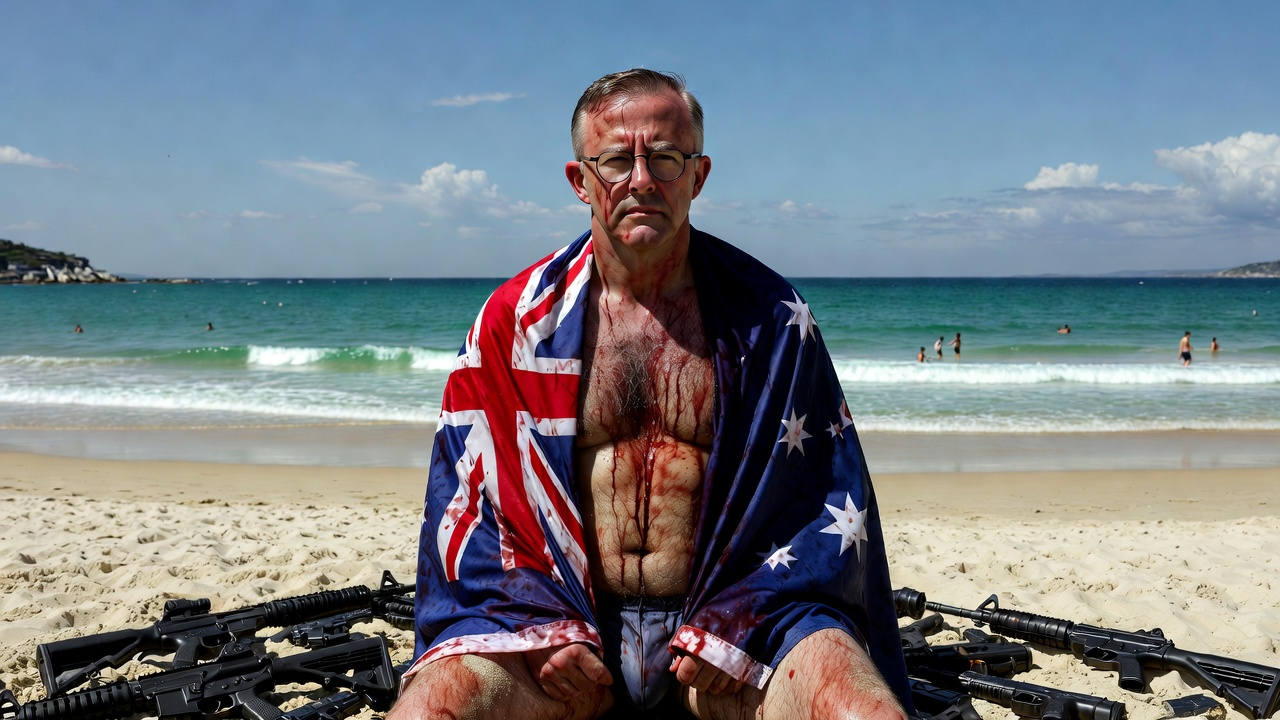
In moments of national trauma – like that of the December 14 Bondi Beach massacre of 15 Jewish Australians – governments reach instinctively for rolls of societal fabric.
Not comfort blankets—those are left to therapists and columnists—but the heavy ceremonial garments of authority: laws, powers, task forces, announcements delivered from lecterns bearing the national crest.
The ritual is familiar enough to feel reassuring. Something terrible has happened; something serious must therefore be done.
In Australia, the aftermath of this latest Islamist-inspired atrocity has produced just such a reflex. Within days, senior ministers, state and federal, were speaking once again of terror, radicalisation, and the need for “stronger tools.”
Australia’s Prime Minister Anthony Albanese however has, up until the past few days, seemed like a ‘Kangaroo caught in a spotlight’, to coin a common Australian phrase.
His low-energy and at times, muddle-headed response to what is an appalling peacetime atrocity does not bode well for the fight against Islamist terror, a fight that’s been going on for at least 46 years, or if some historians are to be taken seriously, 1314 years—since 711 AD to be precise.
And its Australia’s Jews that bear the brunt of this Anglophone myopia.
To quote Chip Le Grand writing in the Sydney Morning Herald, “There is also a deep rift, unmended by the prime minister’s delayed, full-throated commitment to addressing antisemitism four days after the Bondi killings, between Albanese, his government, the Australian Labor Party and Jews who for the past two years asked for them to do more to stop the hate.”
Laws as political costumes
Draft legislation appeared with the speed of light. Surveillance powers were widened. Preventive detention was revisited. The language of emergency – measured, managerial, and faintly martial, has now once again, returned to the air waves.
Of course, there was the ever-present Bogeyman – stricter gun laws, that were dragged out of the basement in order to reassure a jittery public, as if the guns drove themselves to Bondi Beach on Sunday , December 14, 2025, and at exactly 6.47pm local time, shot and killed15 people, all of their own accord.
What was missing, conspicuously, was a sense that anyone had paused to ask themselves whether the tools being sharpened were designed for the right task—or whether the task itself had been properly understood.
In other words, why is there so much emphasis placed on the methods used by Islamist mass killers rather than on the racist and hateful ideology that spurred them to commit their awful crimes in the first place?
The reality is looking increasingly that this is all political gaslighting; Kabuki theatre for the ‘Great Unwashed’, a term popularised for the Australian electorate by former Australian prime minister and friend of Anthony Albanese, Paul Keating.
For example, all Australian states and territories already have on their books a range of laws prohibiting gun ownership by people that are on ASIO watch lists, those who the police suspect may hold various suspicions of being connected to illegal activities and those connected to any number of sanctioned terror and/or hate groups.
For example, to own a gun in the state of NSW, means having to comply with four-times per year visits to a registered shooting range and to provide an address where the guns or guns are stored.
And yet, when it came to the two alleged ISIS-affiliated suspects accused of the Bondi Beach massacre, its unclear if any of these conditions were ever recorded, or enacted, nor for that matter, enforced.
If this is true, then the question is, why?
The answer, as with many Australian official enquiries, will take months, if not years to bubble to the surface.
Feeding the crocodile and hoping to be the last one eaten
For more than two decades, Australia’s — and for that matter, the Western approach to Islamist terrorism has been shaped less by domestic experience than by imported anxieties. In other words, Islamic radicals were unofficially ‘tolerated’ as long as they didn’t cause ‘too much’ of a mess.
This is because multiculturalism is the prevailing dogma of all mainstream political parties in Australia — a rolled-gold set-in-stone political reality since 1980.
However as an intellectual juxtaposition, the architecture of Australia’s counter-terror regime—sprawling, muscular, and legally intricate as it is—owes as much to its genesis in Washington and Westminster as it does to its focus in the Muslim-dominated Sydney suburbs of Lakemba and Bankstown.
Australia’s two most well-known and most respected anti-terror spy agencies ASIO and it’s enforcement wing if you like, ASIS, have largely operated in the shadows, with the vast majority of the public willing to trust their judgment.
In any high-trust society, this is fairly typical and normal.
In Australia’s multicultural society that balances a range of ethnicities with competing and/or over-lapping ideas, this air of impartiality is essential.
However, the recent explosion in antisemitism since October 7, 2023, should have had warning bells and sirens going off across the continent and in the Primes Minster’s office especially.
As former federal treasurer Josh Frydenberg wrote on X, “Anti-Jew intimidation, harassment and violence has metastasised in our country and must not be allowed to go one day longer. The tsunami of hate is not just an attack on Jewish Australians, it’s a threat to every Australian. Prime Minister enough is enough!”
History does not repeat but rather it rhymes
Since the late 1990s, successive Australian governments have passed law after law promising to close gaps, get ahead of threats, and stay “one step in front.” The result is a statute book so dense with terror provisions that even seasoned jurists struggle to map its outer edges.
And yet, whenever violence erupts, the diagnosis remains stubbornly the same: insufficient power, insufficient vigilance, insufficient severity. And of course, insufficient gun laws.
This is what gives the current horrific attack its unsettling déjà vu. Once again, some type of generic nebulous extremism is invoked as both explanation and spectre, despite all and sundry knowing well who and what was behind this.
Once again, the response centres on policing belief rather than understanding behaviour; on expanding authority rather than interrogating efficacy.
Once again, the state behaves as though it were treating a chronic illness with a larger dose of the same medicine that failed to cure it last time.
The definition of national security insanity it seems, is to repeat the same response that has already failed multiple times, over and over again.
Radical violence does not arrive fully formed, nor does it spread evenly through a population. It feeds on grievance, alienation, personal rupture, and ideological simplification.
For those that want to go down the rabbit hole even further, that is the actual definition of woke. In other words, Islamism, like Queer identity or Indigenous supremacy, thrives in spaces where actual or real identity collapses into dogma and meanings of grievance, victimhood, isolation and then, eventual, violence.
These are not conditions that respond neatly to longer sentences or broader surveillance warrants or even tougher gun laws, or the suggested gun ‘buy back schemes’, a perennial favourite with Australia’s bread-and-butter political class.
Not seeing the Islamist forest for the Social Justice Warrior trees
Australia’s counter-terror laws are designed as if ideology itself were a contagious pathogen, best managed through quarantine and force.
They criminalize association, expression, and intent in ways that blur the line between preparation and thought, yet they rarely, if ever, punish the same behaviour.
They rely heavily on intelligence assessments that are necessarily opaque and often unchallengeable. In doing so, they offer the appearance of control while quietly eroding the liberal principles they claim to defend.
Meanwhile the extremists – in particular those associated with the likes of ISIS or Al-Qaeda continue with business as usual, unperturbed by these seemingly ineffectual concepts.
This is not to deny the reality of Islamist extremism, nor to minimize its many and growing number of victims.
It is to note that the state has grown more comfortable misnaming the threat rather than understanding its ecology.
The focus remains overwhelmingly downstream—on disruption, interdiction, and punishment—rather than upstream, where questions of social fragmentation, mental health, online radical ecosystems, along with the impacts of foreign policy entanglements reside.
Anti-terror laws are uniquely attractive to governments because they are difficult to oppose and easy to brand. They promise safety without demanding redistribution, introspection, or long-term investment.
The consequence is a kind of legislative theatre, in which each new law is presented as the garment that will finally clothe the naked truth of vulnerability.
But the public, watching closely, may be beginning to notice the repetition.
The emperor’s wardrobe is extensive; its effect is not.
Identify the disease, don’t just treat its symptoms
If Australia is serious about preventing further deadly Islamist violence, it will have to accept an uncomfortable proposition: that the most important interventions may not look like counter-terrorism at all.
But to treat the disease, as any doctor will tell you, you need to know what it is and how it operates. It needs a definition and a structure. It needs to be known and understood.
There also needs a multitude of treatment options.
One is the hard-edged policing approach. Another is the realisation that Islamism needs to be confronted and thoroughly eliminated.
There are no prizes for second place in this fight for survival.
This is the bitter pill that Prime Minister Anthony Albanese and his government will have to swallow whole.
As Chip le Grand writes, “Labor has a Jewish problem. If this wasn’t clear before Bondi, it is now. It runs much wider than the prime minister’s office and deeper than the normal partisan divide which cleaves nearly every issue in Australian public life.”
Executive Council of Australian Jewry co-chief executive Peter Wertheim, asked to characterise the problem, was clear: “It’s a moral paralysis.”
And so while Australian leaders bicker of what should take precedence in terms of a response to this ‘Problem from Hell’, to borrow a phrase from US journalist and diplomat Samantha Power, one that simply will not go away, no matter how much the political class would wish it to do so, Australia, as a country has now changed forever.
Some say that the famed multiculturalism the country often bragged about has now died, along with the 15 innocent victims on the golden sands of Bondi Beach, with the time of death recorded as 6.47pm, on December 14, 2025.
Others will talk about civilisational wars and the threat of militant Islam.
At the end of the day, 15 lives could have been saved if only Australia’s moribund leftist political class understood that importing foreign wars does not fortify their ideology, but rather weakens the social cohesiveness of the country.
If only.