


On Steroids: Netanyahu Today Sounds Just Like Kahane in 1988
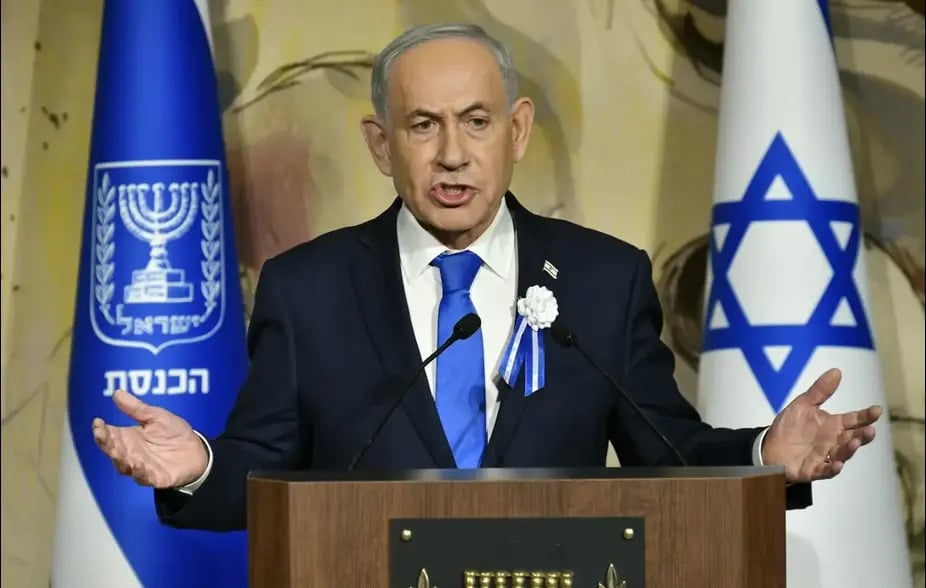
The prime minister’s speech at the swearing-in of the Knesset was almost identical, word for word, to the arguments once made by the now-disqualified Kach movement. The only way to stop the incitement is to form a government in partnership with Ra’am.
In 1988, Likud concluded that there had to be a line. The party announced that it would ask the Central Elections Committee to disqualify Rabbi Meir Kahane’s Kach list, and that it would never cooperate with a racist party or include one in a governing coalition. Prime Minister Yitzhak Shamir called Kahane “a dangerous figure,” while Likud MK Michael Eitan compared his proposed legislation to the Nuremberg Laws. The Elections Committee disqualified the list, the Supreme Court upheld the decision, and one dark chapter in the history of the Knesset came to a close. Or so we thought.
Thirty-eight years later, on the day the 26th Knesset was sworn in, Shamir’s successor stood in the Chagall Hall and delivered a speech that, had it been given in 1988 by a Kach candidate, would have been submitted as evidence to the Central Elections Committee. I listened to it again and again, sentence by sentence, and set it alongside what Kahane said back then. The irony is almost perfect: in that same speech, Netanyahu called for the formation of a national unity government, but the unity he proposed was conditional on excluding Arab representatives from any influence over the formation of the government. Here is the comparison. Judge for yourselves.
Kahane declared that Israel’s Arabs were a “ticking time bomb.” Netanyahu said this week that their representatives were a “Trojan horse,” and that every moderate word they uttered was “taqiyya,” a Muslim term for concealing one’s true intentions as long as the other side is stronger. Kahane wrote that Jews and Arabs could not live together in a Jewish-Zionist state. Netanyahu asked whether there was any difference between the “moderate” Ra’am party and the “extremist” Joint List, then answered his own question: “No, absolutely not.” Both, he claimed, agreed that the State of Israel should be destroyed, differing only over which Palestinian state would rise from its ruins. Kahane once asked from his Knesset office how many Arabs would sit on the Foreign Affairs and Defense Committee and listen to the IDF chief of staff’s classified briefing. Netanyahu asked his fellow MKs whether they would entrust the fate of the country to them.
Wait, the prime minister’s cheerleaders will say, Netanyahu explicitly clarified that he was not talking about Arabs as a whole, adding that “Arabs vote Likud.” True, he did. But Kahane also said, “I don’t hate the Arabs. I love the Jewish people.” He, too, declared before the Supreme Court, “I am not a Nazi and I am not a racist.” And at the 1988 hearing before the Central Elections Committee, Kach’s lawyer argued that the movement’s position toward Arabs was not rooted in racism, but rather in the recognition that the Arab public was hostile to and posed a danger to the Jewish state. That is Netanyahu’s argument this week, almost word for word.
The political mechanism is the same: denying the legitimacy of the Arab vote. Kahane argued that Western democracy and Zionism were fundamentally incompatible, and that he supported democracy for every Jew, but not for Arabs. Netanyahu, in practice, is declaring that the vote of an Arab citizen has no value. Kahane wanted to expel the voters. Netanyahu is content to expel their votes. It is democracy for Jews only, in a more polite form. And it comes at a time when a campaign is being waged against Arab doctors and pharmacists (let’s see how the State of Israel manages without them for even a day), while various organizations and activists are harassing Arabs, Muslims and Christians alike.
I’ve seen this film before. On October 5, 1995, the night the Knesset debated the Oslo II agreement, Netanyahu stood before tens of thousands of people in Zion Square and claimed that the government had “no Zionist majority,” and that the Zionist public had not approved the agreement. The following day, the agreement passed by a vote of 61 to 59, thanks to the votes of Arab MKs. In the eyes of the inciters, those votes simply did not count. An “un-Zionist” government, an “illegitimate” government – and from there, it was a short step to calling the prime minister a “traitor.” A month later, I sat in a small room at Ichilov Hospital and heard Gabi Barbash deliver the terrible news, to me and to the people of Israel.
Netanyahu may not have pulled the trigger, but he was one of the most prominent voices in the camp that turned Rabin’s government into an illegitimate one and branded Rabin himself a traitor. He reaped political gains from the climate of incitement that preceded the assassination. The difference between then and now is that back then he was the leader of the opposition. Today, he is the prime minister. And Netanyahu is not stopping there. Through his emissary, the head of the Shin Bet, he is pursuing a campaign to delegitimize Arab citizens on security grounds. This is Kahanism on steroids. This, it should be said, is a prime minister on whose watch the worst massacre in the country’s history took place, and who continues to evade a state commission of inquiry – a commission that will be established thanks to the votes of Arab citizens of Israel.
And who is this so-called “Trojan horse”? The very same Abbas who said back in 2021 that Israel was founded as a Jewish state and would remain one, a statement that drew criticism from more hardline elements within Israel’s Arab community. The same Abbas with whom Netanyahu himself held negotiations, “in Balfour and outside Balfour,” as Abbas put it, when he needed his votes. When Abbas was useful to Netanyahu, he was a pragmatist. When he might help a government that excludes Netanyahu, he is suddenly a supporter of terrorism.
Meanwhile, who is sitting alongside him in government? In 1988, Likud promised never to include a racist party in a governing coalition. In 2019, Netanyahu himself worked to bring Kahane’s ideological successors into the Knesset. Today, one of them, who was previously convicted of supporting a terrorist organization and inciting racism, sits in his government as a senior minister. Shamir’s Likud worked to disqualify Kahane. Netanyahu’s Likud has brought his successors to the cabinet table and fully embraced their rhetoric, to the point that it is now almost impossible to distinguish between the “statesmanlike” Likud and Otzma Yehudit, the ideological heirs of the Kach terrorist organization.
I am far from naive. There are extremists in Arab society, and there are Arab MKs who made unforgivable statements after October 7. Security is non-negotiable, and any partnership must have clear boundaries. But a country that tells its entire Arab population that their vote is legitimate only as long as it has no influence over the identity of the government cannot survive for long as a Jewish and democratic state. Nor will it withstand the scrutiny of the international community. It will become a pariah abroad and fracture from within, until it ceases to exist. The only way forward is to build a civic partnership in exchange for civic responsibility.
Netanyahu and his partners’ incitement must be stopped, and quickly. In the Knesset, at the negotiating table during government formation, at the ballot box and in the streets, through determined and democratic protest. We have already paid the price of remaining silent in the face of incitement once. We must not pay it again. A government must be formed with Ra’am, even if it could manage without it.