
Using science background to write rationally about Israel, Jews and Academia
On the Political Economy of the Worldwide Pogrom
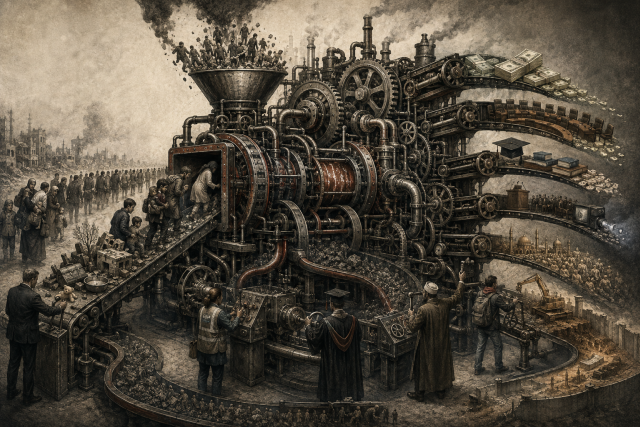
The Extraction Machine In Action
We are witnessing an extraordinary eruption of hostility toward Israel—and toward Jews more generally—global in reach, moralistic in intensity, and difficult to compare with anything the Jewish state has previously encountered. Yet for all the explanations offered, no one seems fully to understand why it is happening or why now.
The prominent British physicist David Deutsch, one of the founders of quantum computation, has described this phenomenon as a “worldwide pogrom. To explain why so much of the world has become hostile to the Jewish state, Deutsch proposed the theory of the “Pattern”—the persistent willingness of societies to regard harming Jews, physically or psychologically, as neither morally repugnant nor forbidden. This pattern has existed for millennia, but we are now living through a period in which it has once again risen to the surface. This is an interesting theory, but it is not very explanatory. In particular, it does not explain where the Pattern comes from or what controls its manifestations.
A number of more specific, mutually complementary ideological approaches have also been proposed. Some point to Soviet-era anti-Zionist propaganda, which recast Jews-as-Zionists as racists, fascists, and colonizers decades before campus activists picked up the same language. Scholar Izabella Tabarovsky has traced this lineage in detail. Others locate the source in the settler-colonialism framework built by anthropologist Patrick Wolfe and applied to Israel by scholars like Rashid Khalidi. A third camp blames Gulf money in Western universities, citing reports like ISGAP’s 2026 findings on Qatari funding. A fourth, developed by writers such as Naya Lekht and Adam Louis-Klein and drawing partly on the work of sociologist David Hirsh, argues that we are witnessing the birth of a genuinely new ideology, which they insist on calling antizionism (without the hyphen), distinct from and no longer reducible to antisemitism. Yet none of these approaches provides satisfactory tools for answering the two central questions: why Palestine, and why now? They identify important components of the phenomenon and place them within their preferred ideological frameworks, but they do not explain why Palestine has acquired such extraordinary moral centrality or why the system surrounding it has become so powerful at this particular historical moment.
A more ambitious answer has recently been proposed by Hussein Aboubakr Mansour, an Egyptian-born social and political theorist. I first encountered Mansour in his Econ Talk conversation with Russ Roberts, “The Political Economy of Palestine”, which led me to Mansour’s essay, “A Metacritique of Palestine: On the Political Economy of a Word-Symbol”.I had never heard of Mansour before, but his argument was an eye-opener—it exposed the naïveté of my own thinking about Israel and Palestine and immediately struck me as a significant analytical contribution. His account of Palestine’s status as the world’s all-encompassing moral issue is simultaneously cynical, philosophically deep, and remarkably concrete. It is profoundly pessimistic about the possibility of resolving the Palestinian problem anytime soon, yet offers a more sober, and, to my mind, more explanatory, view of reality than any of the alternatives considered above.
Thinking about the world’s attitude toward Israel and Palestine within the framework proposed by Mansour, one finds that although all the explanations discussed above capture something real, they nevertheless miss the central point. Each invokes a different ideological framework to explain what is, at its root, an economic rather than an ideological phenomenon. Here, “economic” refers to an economy of value in the broadest sense, in which value takes the form not only of financial gain but also of political power, institutional influence, professional prestige, moral authority, and spiritual meaning. This is not to say that ideological frameworks do not play a role in the system. They underpin it and organize its different channels of participation, but they are not its system-forming principle. This is why multiple, even competing, ideologies can coexist and cooperate fruitfully, even if unwittingly, in contributing to the system’s reproduction.
The central thesis of Mansour’s approach is that “Palestine,” in the current discourse around the Palestinian problem, is not primarily a place or a political cause. Nor are Palestinians treated as real people with their own needs and agency. Instead, all of this collapses into an emergent, self-sustaining system of symbolic, political, and economic extraction. It trades in Palestinian suffering indexed to the presence of Jews. Just as a financial index tracks an underlying asset, the symbolic value of the suffering rises and falls with, and is defined in relation to, the presence of Jews as the counterparty. The two components of this currency are equally important—as the popular saying goes, “no Jews, no news.”
Palestinian suffering at the hands of the Jews is, Mansour argues, a currency freely convertible between different political actors with different announced goals and priorities. This is a game equally well played by Arab governments, European and American NGOs and academics, various humanitarian and human rights organizations, UNRWA, the Palestinian Authority, Hamas and even some players in Israel.
Arab governments, for their part, are interested in maintaining a moderate level of anti-Israel sentiment among their populace as a main source of their legitimacy; NGOs trade Palestinian suffering for hard cash supporting their operations and justifying their existence; academics use this currency to achieve academic prominence, named chairs, invitations to speak, and book sales. UNRWA, the UN agency created to serve Palestinian refugees, extends eligibility for its services to descendants of the original refugees, because the enduring refugee is the raw material on which its own mandate and budget depend. The Palestinian Authority and Hamas both play the same game from opposite ends of the spectrum, each drawing support from multiple, often rival patrons at once—the PA courting whichever combination of Western donors, the UN, and Gulf states will keep it funded and internationally recognized, Hamas doing the same across Iran and Qatar while also benefiting from the larger aid economy operating in Gaza—while each competes with the other for the claim to be the authentic representative of Palestinian resistance or statehood. None of these institutions needs the conflict resolved; each needs it to continue exactly long enough to keep the funding, the mandate, or the legitimacy flowing. As Mansour puts it, the system “doesn’t exploit their suffering: it invents it.” This should not be construed as denying the reality of Palestinian suffering. In Mansour’s usage, “invent” means that the system reproduces the conditions that generate such suffering and then lives off that suffering, rendering its perpetuation indispensable to the system’s continued existence.
The game is so lucrative that its call can become as irresistible as the sirens’ song—even for Jewish and Israeli academics such as Omer Bartov, Raz Segal, Amos Goldberg, and Avi Shlaim, and for Israeli human-rights organizations such as B’Tselem. Within this economy, such figures are assigned the role of the “good Jew.” Whatever the sincerity of their convictions, interventions by dissident Jewish and Israeli scholars carry unusual symbolic value: they confer the authority of internal testimony while generating professional visibility for those who provide it. (See my earlier piece, “Is Omer Bartov the Jewish Thomas Mann?”) Israel’s right participates just as gleefully: Smotrich and Ben-Gvir trade on Israelis’ justified security fears surrounding Palestinian self-determination to advance their own pet project of a Greater Israel. Mansour’s framework gives a more concrete meaning to my own observation that Israelis are caught in a positive feedback loop: the more the world demonizes Israel, the further Israeli public opinion moves to the right, which in turn reinforces the world’s hostility.
Every participant in this game needs the game to go on. As Russ Roberts put it to Mansour on the podcast: an organization built to fight cancer has curing cancer as its stated goal, but actually curing it would also put the organization out of business. This is why Mansour’s conclusions are so pessimistic. The game is immensely profitable for all participants; it is self-organized, and there is no central node in the network of players whose removal could unravel it.
Of course, not everyone advocating for Palestinians is so cynical. Mansour draws a rough distinction between the system’s operators and its participants: cynicism, he notes, increases as you move up the hierarchy, while many who join the cause do so in good faith, precisely because they don’t see the system they’ve joined. Mansour doesn’t fully spell out what this means for the ideological content itself, but the implication follows from his own logic. For the organizers at the top, the settler-colonialism reading, the human-rights reading, the jihadist reading, and the rest are not real justifications—they are recruitment technology. An aphorism often attributed to Eric Hoffer diagnoses this arc: “Every great cause begins as a movement, becomes a business, and eventually degenerates into a racket.” A regime, an NGO, or a movement doesn’t need its foot soldiers to understand the extraction taking place, because the ideological tropes do that work for it—each one supplies genuine moral conviction to whichever audience is most susceptible to it. The settler-colonialism framework mobilizes the university left, the human-rights framework mobilizes the liberal donor class, the jihadist framework mobilizes the pious—and each participant marches, protests, or donates believing they are pursuing justice, unaware they are also fuel for a machine whose actual operators are indifferent to which story got them there. This is what makes Palestinian suffering so convertible as currency: every ideological camp presents the same conflict through its own fully coherent, self-serving narrative, pursuing the same interest even while often claiming opposing goals. Mansour argues that these different narratives do not compete with one another. They are all independent parts of the same structure, which is what makes it indestructible—discrediting any one of them doesn’t weaken the whole.
However, for this structure to work, the game needs a fervor that would bring the foot soldiers out onto the streets, demanding and demonstrating. Mansour wasn’t the first to note the religious nature of the anti-Israel sentiment exhibited by the masses, but he offers a deep explanation for this phenomenon, one that also answers the question: why the Jews? Why is it Israel, out of every possible object of grievance available to a Marxist, an Islamist, or a human-rights activist, that keeps drawing the focus?
An important point Mansour makes is that this fervor, too, is part of the structure. Institutional and political actors do not create from nothing the spiritual need that animates it, but neither do they merely redirect a fully formed sentiment. They provide the ideological substance—the narratives, symbols, rituals, and objects of guilt—through which that pre-existing need acquires political form. The masses respond with such fervor because they are already predisposed to receive these narratives and feel a need for what they offer.
Mansour calls the source of this predisposition a “wound”: a spiritual void left in people’s lives by our current post-Christian and post-Islamic societies—a need for meaning, moral innocence, and redemption that inherited religious frameworks can no longer adequately satisfy. Whether that loss comes from Christianity simply waning or from Islam being infused with a modern civilizational resentment that displaces its older self-understanding, the effect is structurally the same: a need for an explanation of suffering and a path toward redemption. The wound is a spiritual vacancy, and it demands to be filled. Palestinian suffering, interpreted through the inherited presumption of Jewish culpability, provides a ready-made answer to that need.
Mansour’s answer to the eternal question: “Why the Jews?” rests largely on the fact that Jews have already occupied a persistently negative role in classical Christian and Islamic theology. In both traditions, they were represented as having rejected divine revelation: Christianity added the accusation of deicide, while Islamic polemic accused Jews of concealing or distorting scripture. Mansour argues that, even as Christianity in Europe approaches extinction (Europe remains full of Christian artifacts but increasingly empty of Christians) and as Islam, despite the visible and increasingly hostile rhetoric coming from prominent clerics and its continued numerical growth, is emptied of its original content and infused with a distinctly modern civilizational resentment, the inherited figure of the guilty Jew survives in social consciousness. The nature of the guilt changes—the figure of the crucified Jesus in European minds is replaced by that of a Palestinian child, and the Sanhedrin by the State of Israel. Likewise, modern Muslim resentment differs from older Islamic hostility toward Jews: whereas the latter reflected the contempt of a dominant civilization for a subordinated minority, the former arises from the humiliating reversal of that relationship—the rise of a technologically advanced and militarily successful Jewish state on territory formerly under Muslim rule. This resentment is further sharpened by the Islamic world’s more general developmental lag behind the West.
This idea is not entirely new. Mansour’s account of Jews inheriting the historically prepared role of culprit largely rhymes with David Deutsch’s idea of the “pattern”: the recurring availability of Jews as legitimate objects of hostility once an age has found the appropriate moral justification. What Mansour adds is an account of the mechanism through which this pattern operates in contemporary discourse. His concept of the wound explains the demand for a redemptive drama, while his economy of value explains how Palestinian suffering, once attributed to Jewish culpability, is converted into moral authority, political power, institutional influence, spiritual meaning and, yes, hard currency. Deutsch identifies the recurring pattern; Mansour describes the system that invests it with fervor and value and gives it the capacity to reproduce itself.
The strength of any theoretical framework lies in its explanatory and, ideally, predictive power. By that standard, Mansour’s framework is remarkably successful. One would hardly expect a theory in the social or political sciences to possess the precision of quantum mechanics, but his conception of Palestine as a system of extraction explains more than any competing account I have encountered.
For instance, it provides a ready explanation for a fact that puzzles many: why, when it comes to Israel, does the radical left repeatedly find itself aligned with the radical right and Islamist movements? Within Mansour’s framework, the answer is, as Sherlock Holmes would undoubtedly say, elementary: ideological differences do not matter so long as they allow all participants to play the game and derive value from it. Moreover, these participants do not really compete for the resources being extracted; they assist one another in the extraction process.
Even more remarkably, the framework offers a plausible explanation for the visceral anti-Israel reaction that began immediately after October 7, even before the IDF launched its military campaign in Gaza—a reaction that bewildered many observers and generated numerous conspiracy theories. Mansour’s theory points toward a more natural explanation: what we witnessed was the spontaneous response of an extraction system to a shock that threatened the conditions sustaining it.
The system depends upon the continuation of the conflict. It is interested neither in alleviating Palestinian suffering nor in Israel’s actual destruction. Hamas’s barbarity threatened to overturn the established equilibrium in one direction or another. It might have provoked Israel into permanently transforming Gaza, destroying Hamas, and dismantling the political arrangement upon which the existing economy of victimhood depended. The system therefore entered self-preservation mode in the only way it knew: by intensifying the demonization of Israel and mobilizing mass pressure against an unequivocal Israeli victory.
No conspiracy, central command, or advance warning from Hamas was required. The system’s participants responded independently but convergently because they occupied positions shaped by the same incentives, narratives, and moral reflexes. The result looked coordinated because the system reacted almost like a single-celled organism recoiling from a probe.
The pogrom Deutsch named will not end any time soon, because the system that sustains it depends upon its continuation. Yet it is unlikely to prove fatal to Israel, because a system built to extract value from Israel’s endless demonization has no interest in Israel’s disappearance—only in its perpetual guilt. What a relief.
The Palestinians remain the system’s indispensable losers. Their suffering supplies the moral and material currency from which nearly every other participant extracts value, while the system rewards them for remaining in the role of eternal victim. One cannot help feeling sympathy for the plight of Palestinians whose pain is being exploited in such a ruthless manner. Ultimately, however, only a force emerging from within Palestinian society can decisively pull the rug out from under this game—one that reclaims Palestinian agency and rejects the political economy of victimhood.
Related Topics
Related Posts