Working to protect people and our shared planet.
On Tisha B’Av, Dayenu Offers Jewish Wisdom to Help Us Face a Climate Crisis
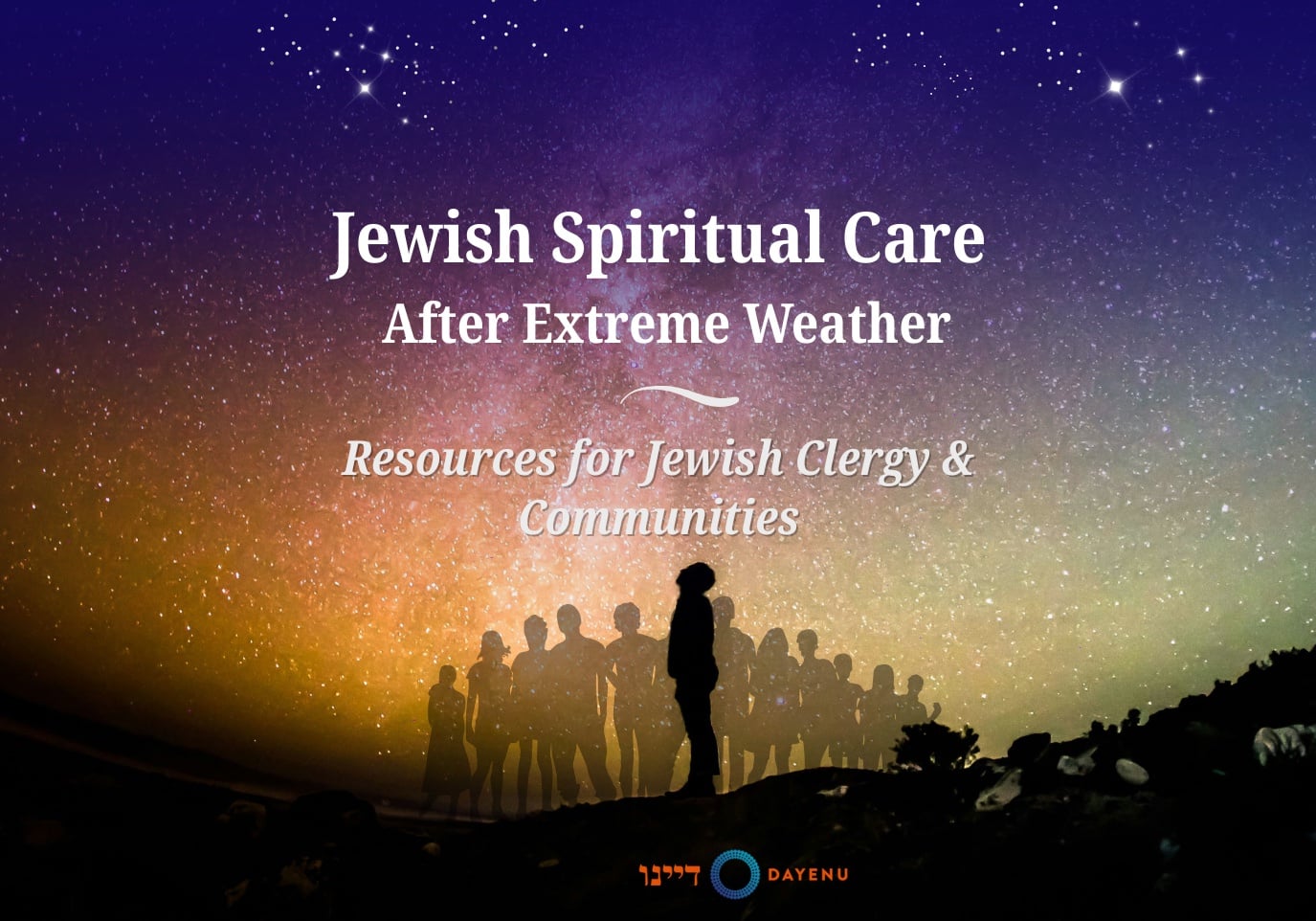
Dayenu creates new spiritual guide for climate crisis. Image courtesy of Dayenu.
This summer, the climate crisis is not an abstract problem somewhere far away. It is showing up in our neighborhoods, our communities and our lives.
Across the United States, Americans are confronting dangerous heat, destructive wildfires, smoke-filled skies, intense storms and flooding. Sadly, communities are experiencing disasters that leave behind more than damaged homes and disrupted lives. They leave grief, anxiety, fear and a profound sense of uncertainty about what comes next.
For many of us, the question is no longer whether climate-related disasters will affect the people and places we love. It is how we will respond when they do—and how we will care for one another long after the headlines disappear.
That is why I am grateful for a new set of resources from Dayenu: A Jewish Call to Climate Action, released this week in advance of Tisha B’Av.
Tisha B’Av, literally the ninth day of the Hebrew month of Av, is traditionally a day of fasting and mourning, commemorating the destruction of the First and Second Temples in Jerusalem and other tragedies throughout Jewish history. It is a day when Jews confront loss and grief, but also remember that even after destruction, communities can rebuild, renew and imagine a better future.
That makes this moment especially meaningful.
Dayenu’s new resources, Jewish Spiritual Care After Extreme Weather, recognize something that is sometimes overlooked in the aftermath of disasters: recovery is not only physical. It is also emotional, communal and spiritual.
In the immediate aftermath of a hurricane, flood, wildfire or heat emergency, we understandably focus on the essentials: Is everyone safe? Who needs shelter? Where can people find food, transportation and medical care? How do we reconnect families and begin rebuilding?
Those needs are urgent and visible.
But what happens when the news cameras leave?
People may still be grieving the loss of a home or a community. They may be frightened by the next storm or heatwave. They may feel anger, abandonment or helplessness. Children may be struggling to understand what happened. Older adults and people with disabilities may face particular challenges in recovering and rebuilding.
As Rabbi Laura Bellows, Dayenu’s Director of Spiritual Activism & Education, explains, disasters can leave people “devastated—not just physically, but emotionally and spiritually.” Survivors may move through “waves of shock, abandonment, anger, or fear.”
These are spiritual and emotional needs, too.
Dayenu has responded with three new guides designed to help Jewish communities meet that moment:
Spiritual Care Guide: For Clergy & Communal Leaders — offering clergy and communal leaders Jewish spiritual sustenance, Torah and ritual frameworks to support communities following climate-related disasters.
Jewish Spiritual Care After Floods & Storms — a resource for individuals seeking Jewish spiritual support after experiencing floods and storms.
Jewish Spiritual Care After Heatwaves & Fires — a resource for individuals seeking spiritual support after heatwaves and fires.
These guides are not substitutes for emergency preparedness or disaster response. They address something different: the long road of healing, reflection and community care that begins after the immediate crisis has passed.
I believe that is an important contribution.
As Jews, we have a long history of surviving displacement, destruction and upheaval. Our tradition gives us language for mourning, rituals for remembering and a deep understanding that rebuilding is both possible and necessary.
We also have a tradition of action.
The Jewish concept of tikkun olam—the responsibility to help repair the world—calls us not only to comfort people after disaster, but also to work to prevent suffering where we can. We cannot control every storm or wildfire. But we can reduce the pollution that is driving dangerous climate trends, strengthen our communities and make sure that the people most vulnerable to extreme weather are not left behind.
This is where Dayenu’s broader work is so important.
Dayenu is building a multi-generational movement of American Jews confronting the climate crisis through what it calls “spiritual audacity and bold political action.” Its work combines Jewish wisdom and spiritual resources with grassroots organizing, climate advocacy and efforts to build political power for systemic solutions. Dayenu organizes through local Dayenu Circles and works with Jewish and non-Jewish partners to connect the moral and spiritual voice of the American Jewish community to the larger movement for climate action.
I particularly appreciate Dayenu’s central message: Dayenu—enough.
Enough with accepting fossil fuels and pollution that harms our health.
Enough with treating extreme weather as someone else’s problem.
Enough with allowing the people who have contributed the least to the climate crisis to bear some of its greatest burdens.
But “Dayenu” carries another message, too: we have enough.
We have enough knowledge to act. We have enough technology to transition to cleaner energy. We have enough creativity to build more resilient communities. We have enough people who care deeply about their children, grandchildren and neighbors.
And we have the wisdom of our traditions to help us navigate a frightening time.
As we mark Tisha B’Av, I hope we can hold both grief and hope together. We should mourn what has been lost—to disasters, to pollution and to our failure to act quickly enough. But mourning cannot be the end of the story.
The Jewish story teaches us that destruction can be followed by rebuilding. That grief can lead to responsibility. That remembering can inspire action.
The climate crisis demands that same combination of honesty and hope.
We need to care for people after disasters. We need to prepare our communities before the next one. And we need to act boldly enough to reduce the scale of the crisis itself.
Dayenu’s new spiritual care guides give our communities tools for the first part of that work. The broader Dayenu movement challenges us to take on the second and third.
On this Tisha B’Av, perhaps the question for all of us is not simply how we mourn what has been destroyed.
It is what we will do to help build what comes next.
Related Topics
Related Posts