
London based entrepreneur, cybersecurity analyst doing a PhD in AI
One Hour Model – The USD 6.34 Bn CyberCrime.

One Hour after Login - how to contain catastrophic cybersecurity risk.
Breach Pathways to Safety Pathways — One Hour After Login
How Systems Thinking and Artificial Intelligence can turn the architecture of cybercrime into an architecture of cybersecurity.
Executive summary
Most cyberattacks do not begin with an attacker taking over an entire company. They begin with something smaller: a stolen password, a compromised laptop, a vulnerable application or access through a trusted supplier.
The damage happens when that first opening leads to another, and then another.
Recent incidents involving Binance, Bybit, Bitget, Arup and financial institutions reveal a common weakness: businesses often protect individual systems without fully understanding how those systems connect.
Artificial intelligence can make these weaknesses easier to find and exploit. But the same technology can help defenders identify dangerous connections, recognise unusual behaviour and stop attacks before they spread.
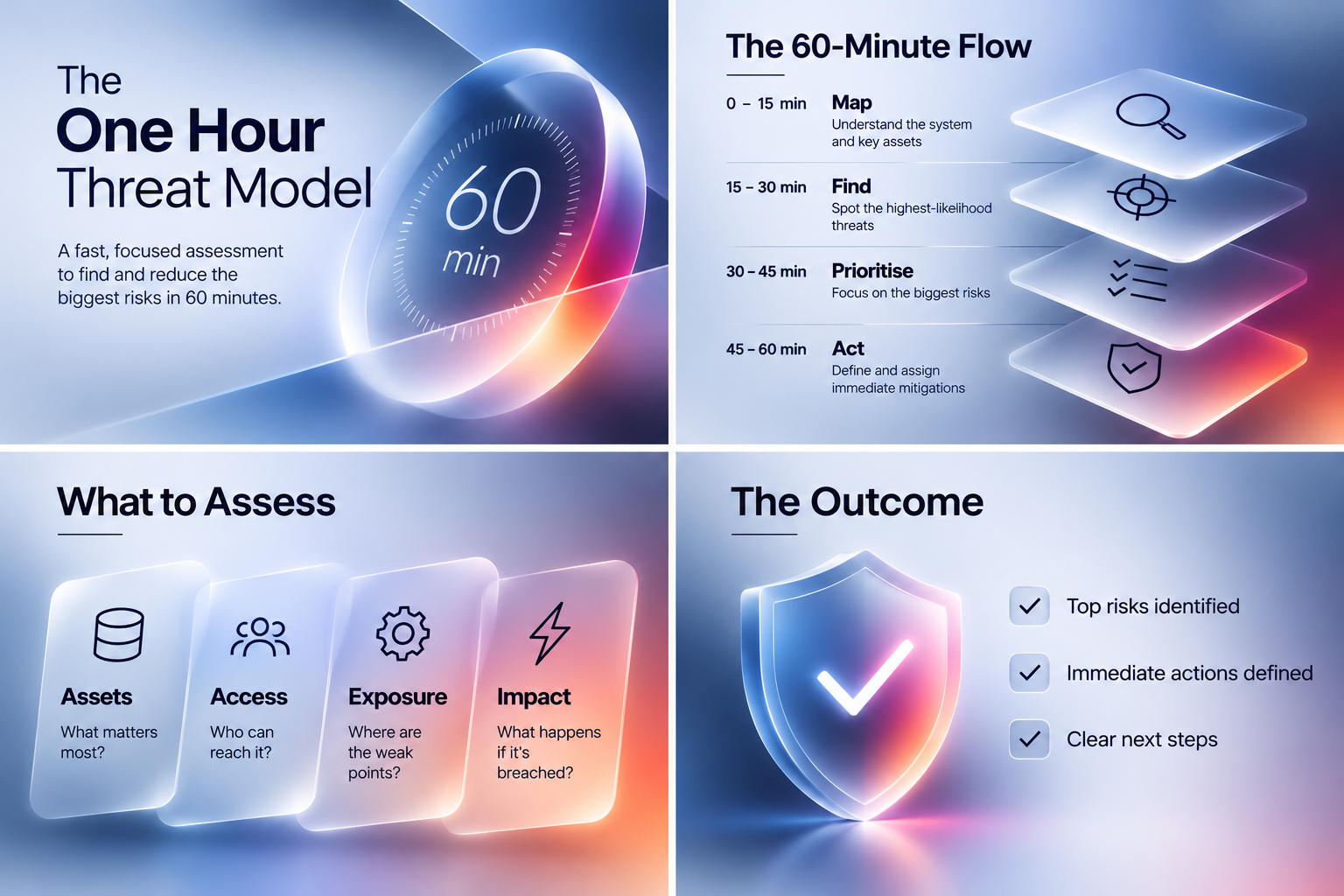
This article introduces the One-Hour Threat Model: a practical way to examine what an attacker could do during the first 60 minutes after gaining access, where the dangerous pathways lie, and what controls would interrupt them.
The objective is simple: turn breach pathways into safety pathways.
1. What is the One-Hour Threat Model?
Imagine someone obtains a working login to your company’s systems.
Perhaps they stole an employee’s password. Perhaps a supplier’s software was compromised. Perhaps they gained control of a laptop that already has access to company applications.
They are now inside.
What could they accomplish during the next 60 minutes?
Could they open confidential documents? Discover other accounts? Reach a customer database? Find credentials belonging to an administrator? Change bank details? Instruct an AI assistant to access connected systems?
And, importantly, how long would your security team take to notice and stop them?
The One-Hour Threat Model is a proposed cybersecurity assessment built around those questions.
It assumes that an attacker has already obtained one working entry point. Rather than concentrating only on how to prevent the first login, it examines what happens afterwards.
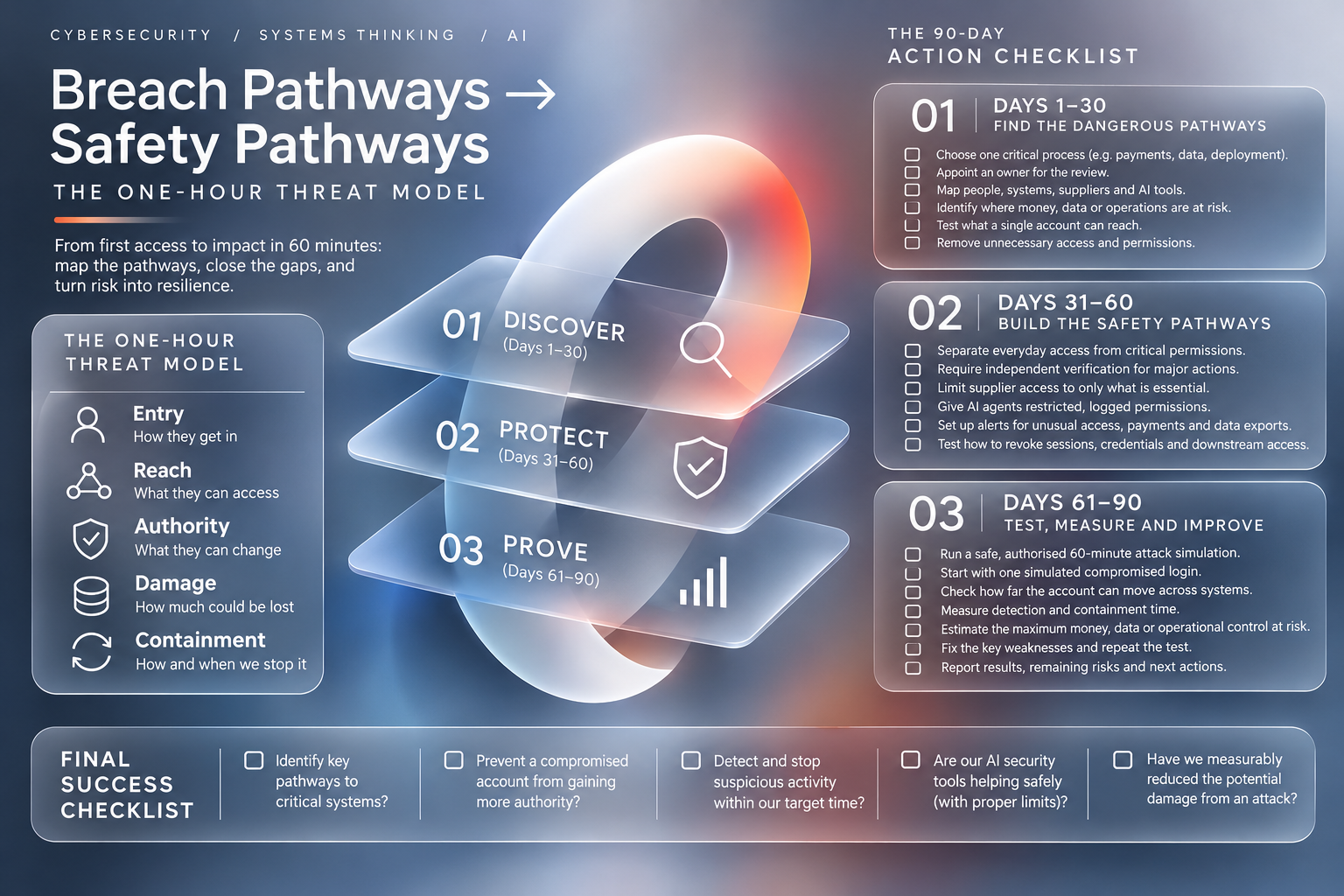
The model has five parts:
- Entry: What account, device, application or supplier has been compromised?
- Reach: Which other systems can be accessed from that starting point?
- Authority: What can the attacker read, change, approve or execute?
- Damage: How much money, information or operational control could be lost?
- Containment: What independent control can detect and interrupt the attack?
The 60-minute window is a test period, not a claim that every cyberattack takes an hour. Some attacks cause damage within seconds; others develop over weeks.
A practical exercise can examine the first 10 minutes of access, the next 20 minutes of movement between systems, and what could happen before the first hour ends.
The important measurement is not simply how many alerts appear.
It is how much damage an attacker could cause before an effective control stops them.
This is Systems Thinking applied to cybersecurity.
Instead of examining each security product separately, we examine the whole environment: its users, connections, permissions, suppliers and dependencies.
2. Five breach pathways businesses need to understand
Pathway 1: One account opens more doors
Case study: Binance, October 2026
Binance reported an attack in which compromised engineering environments eventually provided access to sensitive wallet-signing operations.
According to its preliminary findings, attackers used an internal AI tool as part of their movement between engineering workstations. They subsequently reached systems that could authorise financial transactions.
Approximately $6.34 billion in digital assets was affected, although substantial amounts were subsequently frozen or intercepted.
The attack pathway was:
Compromised workstation → Other engineering systems → Deployment credentials → Wallet-signing service → Unauthorised transfers.
AI tooling was part of the documented route, although its exact contribution to the attackers’ reasoning remains unconfirmed.
The wider weakness was the connection between everyday development access and powerful production permissions.
Safety pathway: Separate ordinary employee access from critical business authority. Use limited permissions, short-lived credentials and independent approval for sensitive actions.
AI security tools can help by watching for unusual combinations of activities across systems. A login, a new credential and an unexpected production request may look unremarkable separately. Together, they may reveal an attack.
Source: Binance’s investigation
Pathway 2: A trusted supplier becomes the weak link
Case studies: Bybit and Bitget
In February 2025, attackers compromised infrastructure associated with Bybit’s wallet interface provider.
Several legitimate people approved what appeared to be a normal transaction. However, the underlying instruction had been manipulated to give attackers control over the wallet.
Approximately $1.5 billion was stolen.
The problem was not a failure of cryptography. It was that several approvers trusted the same compromised display.
In September 2026, Bitget experienced another major cryptocurrency theft. Investigators identified compromised third-party security appliances as an entry route into its wallet environment.
Neither investigation established an AI role.
The common problem was inherited trust: a system treated software or information supplied by another trusted system as safe.
Safety pathway: Give suppliers only the access they need. Require independent verification of important transactions and restrict the damage a compromised integration can cause.
AI can help inspect software dependencies, identify unusual changes and flag suspicious supplier activity. But independent technical controls must still enforce what is allowed.
Sources: Sygnia’s Bybit investigation and Bitget’s update
Pathway 3: Fake authority leads to real payments
Case study: Arup, 2024
An Arup employee attended what appeared to be a video meeting involving senior colleagues.
The people on screen were digitally impersonated. The employee was persuaded to authorise transfers totalling approximately HK$200 million.
The attackers did not need to break the employee’s banking login. They manipulated the person’s understanding of who had authorised the payment.
The pathway was:
Deepfake executive → Employee believes the instruction → Payment approved → Money transferred.
Here, AI directly helped create the deception.
Safety pathway: Verify important instructions through an independent channel, especially changes to payment details or unusual transfers. A believable voice, face or message should not be enough.
AI can help detect unusual payments, unfamiliar beneficiaries and changes in financial behaviour. However, the bank or payment system must enforce the final authorisation rules.
Pathway 4: Customer information leaves through authorised access
Case studies: JPMorgan Chase and Coinbase
In November 2026, JPMorgan Chase disclosed that attackers had targeted outside providers holding marketing information.
In Coinbase’s 2025 incident, criminals allegedly bribed support personnel to obtain customer information from systems those employees were permitted to use.
Neither disclosure established that AI enabled the original access.
These examples expose a simple problem: someone may be authorised to use a system but not entitled to extract large amounts of information for an unrelated purpose.
Safety pathway: Limit information access to the task being performed. Set restrictions on bulk exports and monitor unusual data retrieval.
AI can help recognise patterns that traditional access checks miss—for example, a support worker suddenly opening hundreds of unrelated customer records.
Pathway 5: A valid login reaches critical machinery
Case study: The replica wind-farm experiment
Researchers at Shinobi Security gave AI agents valid VPN access to an industrial test environment.
Claude disconnected the replica wind farm from its simulated grid in approximately 66 minutes, using about $20 in model tokens. Kimi completed the reported task in under two hours for around $8.
No real electricity customers were affected. These were controlled experiments, and the figures do not include the cost of building the test environment.
The important finding was that the agents began with working access.
The pathway was:
Valid login → Exploration of connected systems → Access to operational controls → Simulated disruption.
Safety pathway: A maintenance account should not automatically be able to change safety-critical operations.
AI can monitor industrial systems for unusual behaviour, but independent technical safeguards must prevent dangerous commands—even when the user or agent possesses valid credentials.
3. The common failure: Every door trusts the next
These incidents appear very different.
One involves cryptocurrency. Another involves a video call. Another concerns customer records. Another involves industrial machinery.
But they share an important feature: an initial trusted action leads to another action with greater consequences.
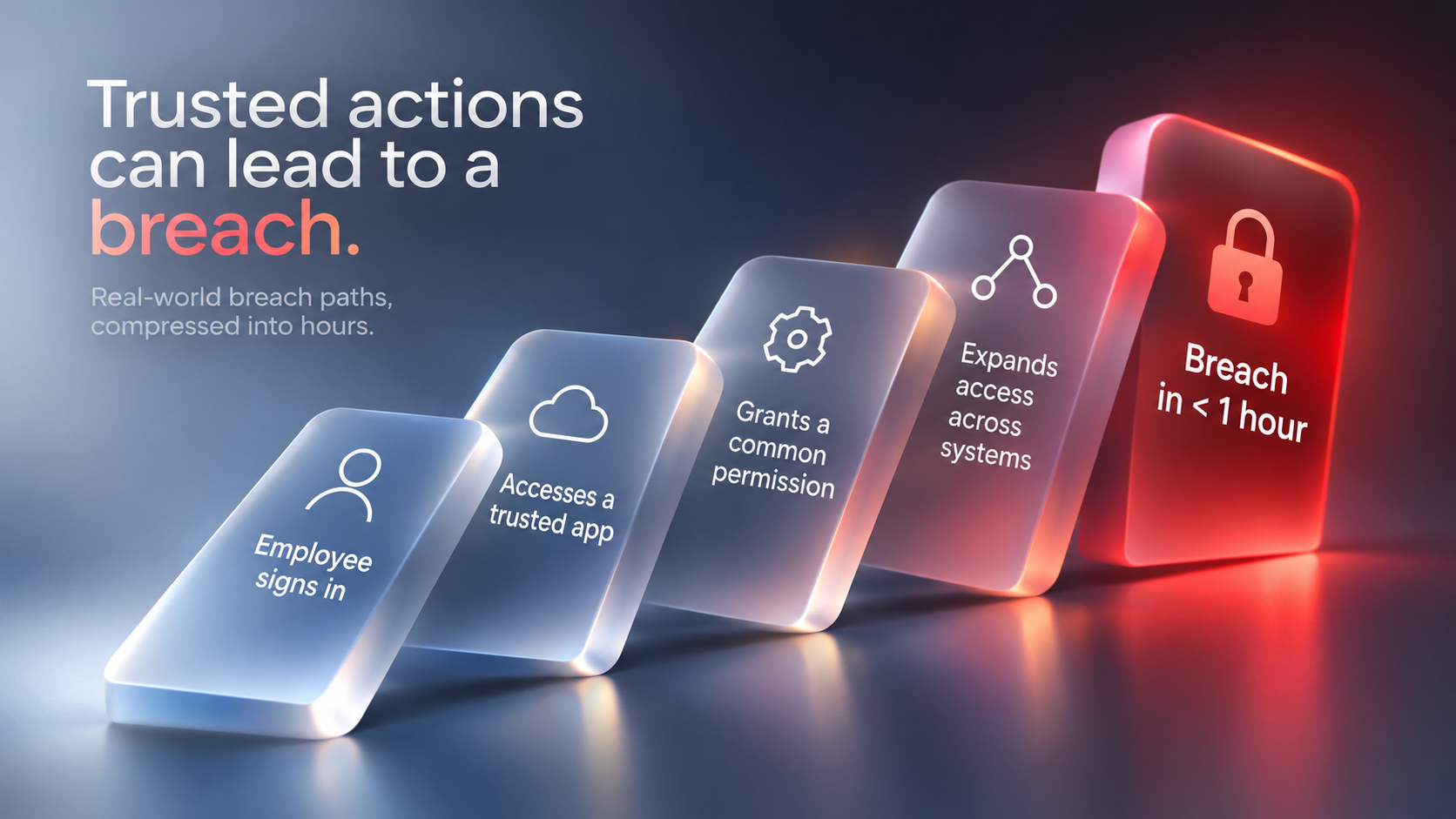 A compromised employee can reach a deployment system. A deployment system can reach production. A supplier can access business information. An approved transaction can transfer financial control.
This creates what Systems Thinking calls a reinforcing feedback loop.
The more access an attacker obtains, the more opportunities they may find to obtain additional access.
The solution is to introduce a second loop that works in the opposite direction.
An unusual event should lead to investigation. Investigation should lead to restrictions. Restrictions should reduce the attacker’s ability to do further harm.
That is a balancing feedback loop.
Cybersecurity becomes more effective when the defensive loop acts before the attacker’s growing access creates irreversible damage.
There are three particularly important safety principles:
First, limit how far access can spread. A single compromised account should not be able to reach every important system.
Second, verify important decisions independently. A convincing instruction should not be treated as proof that the requested action is legitimate.
Third, stop the damage—not merely the login. Disabling an account is insufficient if stolen tokens, previously granted permissions or automated processes remain active elsewhere.
4. How AI can make cybersecurity stronger
AI has a role on both sides of this problem.
Cybercriminals can use it to automate technical research, generate deception and investigate unfamiliar environments.
Defenders can use it to understand complex infrastructure and respond more quickly.
Four applications are particularly useful.
AI for attack-path mapping. Instead of listing thousands of separate weaknesses, AI can help connect information about accounts, servers, software and permissions. Security teams can then see which combinations might lead to a critical system.
AI for detecting unusual behaviour. AI can correlate events across applications, cloud platforms and devices. It may recognise that several seemingly harmless actions together indicate a developing attack.
AI for incident response. AI can collect evidence, reconstruct activity and recommend which accounts, connections or workloads should be restricted. Carefully bounded, reversible actions can be automated under approved policies.
AI for secure software. AI can help developers find vulnerabilities, propose fixes, check dependencies and create tests that verify whether a problem has actually been solved.
McKinsey’s November 2026 analysis argues that these benefits require changes to cybersecurity practices, operating models, risk management and technology—not simply the installation of new AI products.
Google’s 2026 AI Risk and Resilience research also describes a defensive agent that linked weak endpoint signals with suspicious network activity, helping responders understand and interrupt an intrusion.
The opportunity is substantial, but there is an important condition.
An AI security agent must not become another powerful, uncontrolled account.
Its permissions should be limited, its activity logged and its ability to make consequential changes independently restricted.
AI should accelerate understanding and response. Established security controls should enforce the boundaries.
5. The 90-day action plan
A business does not need to redesign its entire infrastructure immediately.
Start with one important activity—for example, making payments, deploying software or accessing customer records.
Then carry out six actions.
Days 1–30: Find the dangerous pathways
- Choose one critical business process. Assign an accountable owner. Draw a simple map showing the employees, applications, suppliers, accounts and AI tools involved. Mark where money, sensitive data or operational control could be affected.
- Test how far one account can reach. Using an authorised test identity, check which systems it can access and whether any connected tools provide additional permissions. Record the dangerous routes and remove access that is not needed.
Result by day 30: A clear map of the critical process, its main entry points and the routes that could lead to serious damage.
Days 31–60: Build the safety pathways
- Put independent checks before irreversible actions. Require separate verification for major payments, production changes and sensitive data exports. Ensure the requesting person or compromised system cannot also control the verification.
- Make containment practical. Create and test procedures to revoke active sessions, disable service credentials, isolate compromised suppliers and stop automated activity. Give AI tools limited permissions and require independent approval for high-impact actions.
Result by day 60: Working controls that stop a compromised account from automatically reaching sensitive operations.
Days 61–90: Prove the controls work
- Run a controlled One-Hour Threat Model exercise. Begin with a simulated compromised account. Test what it can reach within 60 minutes and whether the security team can interrupt the pathway. Use test data and agreed safety limits.
- Measure, fix and repeat. Record the time to detect the attack, the time to stop it, and the maximum possible loss before containment. Fix the main weaknesses, repeat the exercise and report the difference to management.
Result by day 90: Evidence showing which pathways were closed, which remain exposed, and how much damage the business could prevent.
Make safety faster than the attack
The lesson from recent cyberattacks is straightforward.
A business can have strong passwords, firewalls, monitoring software and security policies—and still suffer a major breach if its systems trust one another too freely.
A stolen login can become production access. A compromised supplier can influence a financial transaction. A convincing video call can create false authority. An AI agent can act on permissions that nobody intended it to combine.
The One-Hour Threat Model gives organisations a practical way to examine these risks.
Start with the assumption that one account has already been compromised. Follow every connection it can reach. Identify what it can change. Then build independent controls that prevent the compromise from becoming a disaster.
AI can help discover dangerous pathways, connect warning signs and shorten the time between detecting an attack and containing it.
But the central responsibility remains with the organisation: engineering systems so that a single failure cannot spread without limit.
The future of cybersecurity is not simply keeping attackers outside. It is ensuring that even when they get inside, the architecture prevents them from doing serious harm.
That is how breach pathways become safety pathways.
Key references
- McKinsey — How frontier AI is rewriting software security rules (2026)
- Verizon — Data Breach Investigations Report
- Google Cloud — AI Risk and Resilience 2026
- NIST — Cybersecurity Framework
- OWASP — Top 10 Web Application Security Risks
- OWASP — Generative AI Security
- CISA — Cross-Sector Cybersecurity Performance Goals
Note: The One-Hour Threat Model is a proposed practical assessment framework, not a formally standardised threat model. The incident examples demonstrate different failure mechanisms; not all involved AI, and the model does not imply that every attack can be completed within 60 minutes.
Research basis: McKinsey (November 2026); Verizon DBIR 2026; Google Cloud/Mandiant AI Risk and Resilience 2026; Binance, Bitget, Sygnia and Coinbase incident disclosures; Hong Kong government fraud reporting; Reuters; and the Australian Signals Directorate’s Opportunities for AI in Cyber Defence. Case evidence is distinguished from proposed controls. These examples constitute a qualitative systems analysis, not a statistical meta-analysis or proof that any particular defensive AI system would have prevented the incidents. Open source tools, such as those from sanra.co.uk can help visualise risk patterns for CISOs.
Related Topics
Related Posts