
London based entrepreneur, cybersecurity analyst doing a PhD in AI
One Idea Tafsir No.2 – Screen Time Report.
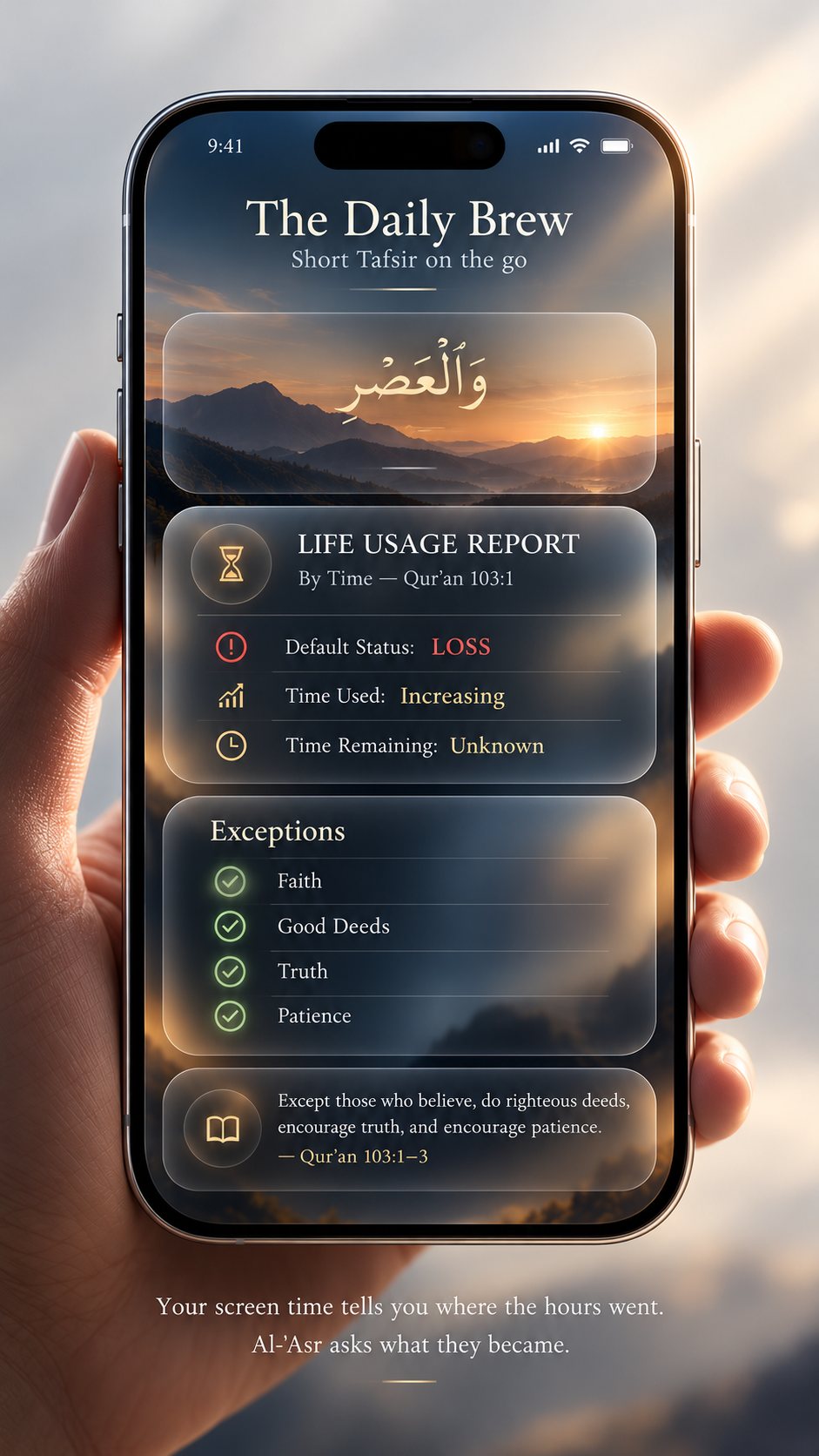
Go to https://quran.com for verses and Tafsir. Images for illustration only. For lexical analysis and Ontology of the Quranic Arabic visit https://corpus.quran.com.
Your Screen Time Report
Sūrat al-ʿAṣr through one contemporary notification
The Daily Brew — Short Tafsīr on the Go · No. 2
Every Sunday, my phone tells me something slightly uncomfortable:
Your screen time was up 17% this week.
Seven hours here.
Forty minutes there.
Messages. News. Work. Videos. Maps. Email. Social media.
I am not preaching to anyone, I am the same :).
The strange thing is that none of those moments felt especially expensive while I was spending them. Five minutes feels like nothing. Until five minutes becomes an hour. An hour becomes a day. Days become years.
Now imagine a different notification appearing on your phone:
LIFE USAGE REPORT
Time already used: Increasing
Time remaining: Undisclosed
Default status: LOSS
And then, underneath it:
Four exceptions apply.
That may be one contemporary way of approaching one of the shortest—and perhaps most comprehensive—chapters of the Qur’an: Sūrat al-ʿAṣr.
Only three verses. Yet it contains something remarkably close to a complete life audit.
The notification: time is running out.
وَٱلْعَصْرِ
By time! (Quran 103:1)
Allah begins with an oath. That alone should make us pause.
He does not swear here by wealth, influence, possessions, or human success. He swears by time—the one resource that every human being possesses and every human being loses.
You can replace money.
You can rebuild a career.
You can buy another phone.
You cannot retrieve yesterday afternoon.
Once time is spent, it is gone.
And unlike your bank account, life does not show you the remaining balance.
That is what makes al-ʿAṣr so unsettling. We are used to measuring everything—salary, calories, followers, views, steps, output, and even sleep quality. But the one measurement that governs the rest remains hidden: how much time is left.
Your phone may tell you how many hours you used this week.
It cannot tell you how many weeks remain.
Your account is already decreasing
Then comes the diagnosis:
إِنَّ ٱلْإِنسَـٰنَ لَفِى خُسْرٍ
Surely humanity is in ˹grave˺ loss, (Quran 103:2)
The language is severe. Not might be in loss. Not some people are in loss.
Mankind is in loss.
That means the default human condition is not neutral. It is not “doing fine unless proven otherwise.” It is decline—capital being spent continuously.
Think about your phone battery.
You can use it productively.
You can waste it.
You can leave applications draining it unnoticed in the background.
But either way, the percentage falls.
Human life is like that.
The Qur’an is not merely saying that some people misuse time. It is saying something deeper: time itself is being consumed, and if it is not transformed into something of lasting value, the human being is losing by default.
Your life is not standing still while you decide what to do with it. It is being spent while you decide.
That is why this sūrah hits so hard. The question is not whether you are spending your life.
You are. Whether you like it or not, time is being spent. The clock is ticking.
The question is:
What are you purchasing with it?
The Prophet ﷺ gave us another “usage warning”
The Prophet ﷺ said:
“There are two blessings that many people are deceived into losing: health and free time.” (Sahih Bukhari, 6412).
That is extraordinary language.
A blessing can be in your hands and still be lost through poor use. You can possess time and still be in loss. You can possess health and still be in loss. You can possess education, money, opportunity, intelligence, and access—and still be in loss.
Because resources are not the same as wise use of resources.
In modern language: having the device is not the same thing as using it well.
Which takes us to the final verse of the sūrah.
The four exceptions
Allah does not leave mankind inside the red warning box. He gives four exceptions:
إِلَّا ٱلَّذِينَ ءَامَنُوا۟ وَعَمِلُوا۟ ٱلصَّـٰلِحَـٰتِ وَتَوَاصَوْا۟ بِٱلْحَقِّ وَتَوَاصَوْا۟ بِٱلصَّبْرِ
except those who have faith, do good, and urge each other to the truth, and urge each other to perseverance. (Quran 103:3)
Let’s break down the operative words here.
Except – so the default position is loss, as we said before.
Those – so there is a smaller subgroup now being delineated.
Faith – So the precursor to action is belief.
Good – Goodness is defined throughout the Quran and Sunnah – Taking care of Orphans, elderly, parents, neighbours, honesty in business etc.
Truth – Society here can be seen as almost like “blockchain” – you don’t let the “checksum” happen on falsehood. This is again why “bot farms” and ” state propaganda” is so dangerous.
Patience – When you become the “subgroup” – you are going to “feel the heat”. It won’t be a walk in the park always. That doesn’t mean we should think life is miserable, but generally the greater good is not always in the interests of those who may have concentrated power, wealth, status or influence.
Here, I also by no means identify the “subgroup” as small. It may be the entire humanity may become that “subgroup” one day, In sha Allah.
These are not four random virtues. They form a complete structure.
1. Faith — Īmān
First comes belief.
Before asking what you achieved, the Qur’an asks what you believe about reality itself. Who created you? Why are you here? To whom are you returning?
Faith gives direction to everything else.
Without a destination, speed is not necessarily progress. A person may have a full calendar, a strong work ethic, and impressive productivity—and still be travelling quickly in the wrong direction.
Īmān answers the biggest question first: What is all this for?
2. Righteous deeds — ʿAmal ṣāliḥ
Then belief must become action.
This is where the metaphor becomes especially useful. Your phone does not measure what you intended to do. It measures what actually consumed the battery.
Likewise, Islam is not only about admirable inner sentiments. Belief must enter the calendar.
Prayer takes time.
Charity takes action.
Helping your parents takes action.
Raising children takes action.
Learning takes effort.
Repentance changes behaviour.
Faith that never becomes action remains abstract. Al-ʿAṣr insists that a profitable life is not built merely on ideas, but on embodied obedience.
3. Truth — al-Ḥaqq
Then the sūrah moves beyond the individual:
Wa tawāṣaw bil-ḥaqq
And they encourage one another to truth
It is not enough to try to survive spiritually alone.
Human beings forget. We drift. We rationalise. We tell ourselves convenient stories. We normalise what should trouble us and neglect what should matter to us.
So believers need a community of mutual reminder.
Truth in Islam is not a private mood. It is something people help one another remain faithful to. Sometimes the most valuable friend is not the one who constantly affirms you, but the one who gently returns you to what is right.
A healthy Muslim life includes being reminded—and reminding others.
4. Patience — Ṣabr
Finally:
Wa tawāṣaw bil-ṣabr
And they encourage one another to patience
Because truth is not always easy to live.
Prayer requires consistency.
Marriage requires patience.
Parenthood requires patience.
Illness requires patience.
Avoiding temptation requires patience.
Remaining truthful when truth is costly requires patience.
Patience here is not passive resignation. It is moral endurance. It is staying on course when obedience becomes difficult and when immediate reward is not visible.
Taken together, the four conditions form a powerful sequence:
Know what is true.
Live according to it.
Help others remain with it.
Continue when doing so becomes difficult.
That is how time stops becoming mere depletion and starts becoming investment.
The notification you cannot swipe away
Our phones let us dismiss almost anything.
Swipe left.
Clear notification.
Remind me tomorrow.
Not now.
But time has no “remind me later” button.
That may be one reason this sūrah has had such a deep effect on Muslims throughout the centuries. It is so short that you could overlook it. Yet it contains the summary of an entire human life: a vanishing resource, a default condition of loss, and four conditions of rescue.
Modern life gives us detailed reports on things that matter less than we think:
steps walked, emails answered, calories burned, followers gained, storage used, weekly screen time.
But Sūrat al-ʿAṣr gives us the report that matters more:
Your time.
And there is no top-up.
So the next time your phone tells you:
Your weekly screen time is ready…
Remember, you spent some time you can never recover and the reorient ourselves based on Surah Al-Asr.
Note on method, sources, and limits
This piece is not scholarly tafsīr and is not intended to replace study of the Qur’an, Arabic, the Sunnah, or the explanations of qualified scholars. I am not a scholar. The Daily Brew is a short reflective series that takes one established idea from a sūrah and places it beside a contemporary image—in this case, a smartphone usage notification—to make the meaning vivid for a modern reader.
The method remains:
Qur’an → Prophetic Sunnah → reports from the Companions → classical tafsīr → contemporary reflection.
So the phone, battery, notification, and usage-report language are illustration, not tafsīr.
Principal references behind this piece :-
- Sūrat al-ʿAṣr (103:1–3) — Arabic, translation and study tools on Quran.com. Sūrat al-ʿAṣr — Quran.com Quran.com
- Tafsīr Ibn Kathīr on Sūrat al-ʿAṣr — includes the statement attributed to Imām al-Shāfiʿī: “If the people were to ponder on this Surah, it would be sufficient for them,” as well as Ibn Kathīr’s explanation of khusr, righteous deeds, truth and patience. Tafsīr Ibn Kathīr — Sūrat al-ʿAṣr Tafseer
- Reports concerning Ibn ʿAbbās and the meaning of al-ʿaṣr — al-Thaʿālibī reports from Ibn ʿAbbās that al-ʿaṣr means al-dahr—the passing age/time—and gives earlier source references. Al-Thaʿālibī on Sūrat al-ʿAṣr Safha
Al-Qurṭubī also attributes the interpretation al-dahr to Ibn ʿAbbās and others. Al-Qurṭubī on 103:1 Quran KSU - Ṣaḥīḥ al-Bukhārī 6412 — health and free time — narrated by Ibn ʿAbbās: “There are two blessings that many people are deceived into losing: health and free time.” Ṣaḥīḥ al-Bukhārī 6412 — Sunnah.com
Important qualification:-
As with the previous instalment, reports attributed to Ibn ʿAbbās in later compilations should not automatically be treated as equally strong in attribution. Wherever possible, such material should be cross-checked through established early tafsīr works and major transmission sources.
In short: this article does not claim to exhaust the meanings of Sūrat al-ʿAṣr. It simply takes one thread—time as diminishing capital—and presents it in a contemporary form to encourage readers to return to the sūrah itself with greater seriousness and curiosity.
Related Posts