London based entrepreneur, cybersecurity analyst doing a PhD in AI
One Idea Tafsir No.20 – Knowing not believing.
Carl Jung along with Sigmund Freud is one of the pioneering figures in Psychology. This excerpt is from his famous BBC interview.
One Idea Tafsīr No. 20 | So Know
The Daily Brew – Short Tafsir On the Go
Sūrat Muḥammad (47:19) · Carl Jung, certainty and the prayer that follows
In 1959, the BBC interviewer John Freeman put a question to the Swiss psychiatrist Carl Jung. As a child, Jung had believed in God. Did he still believe in God now?
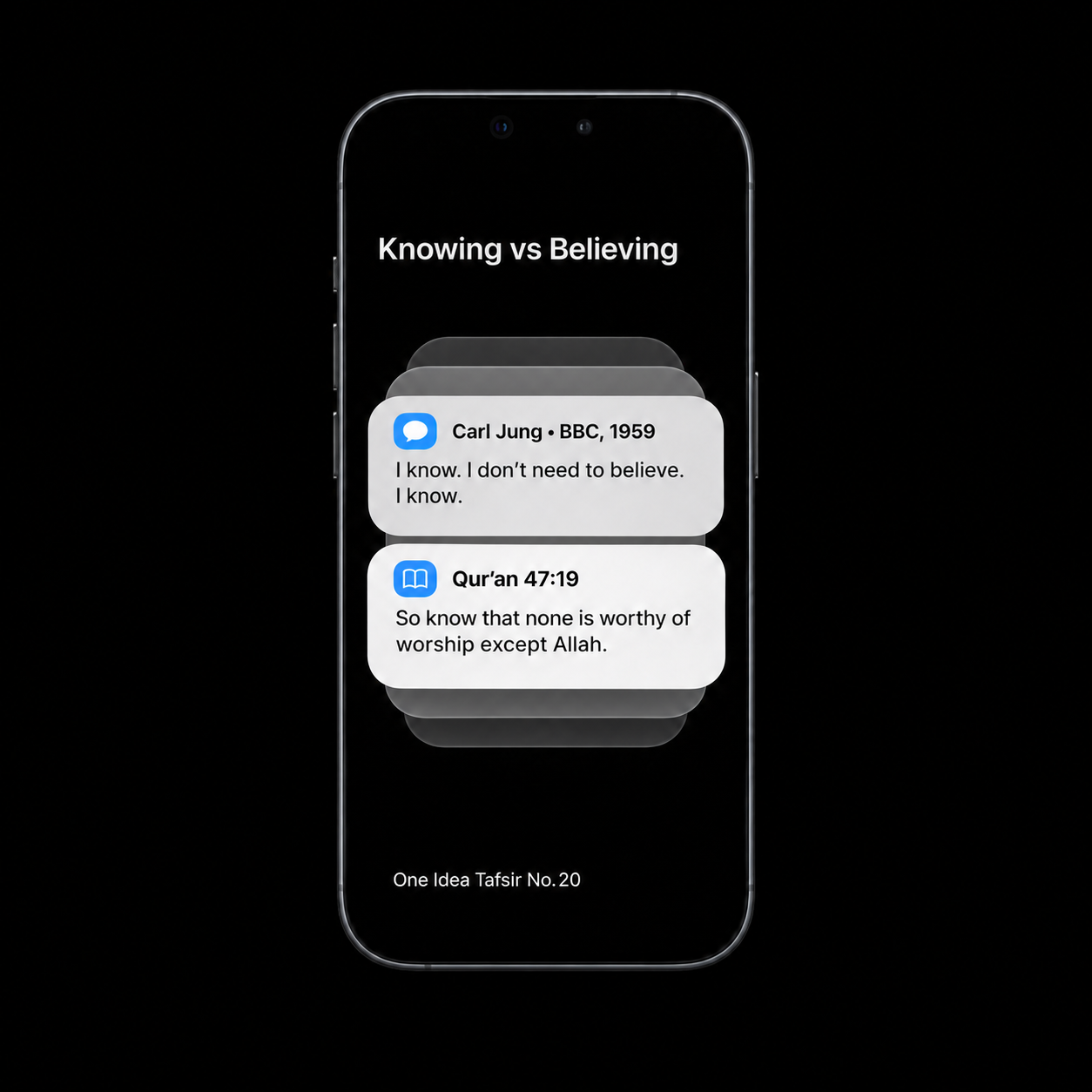
There was a pause. Then Jung gave the answer for which the interview is remembered. “I know. I don’t need to believe. I know.” [1]
 At eighty-four, Jung had spent much of his working life listening to people describe things that had taken them by surprise. One of them was a scientist, raised Catholic, who had ceased to practise and showed little interest in religion. In his 1937 Terry Lectures at Yale, Jung discussed a series of more than four hundred of this man’s dreams. By Jung’s own count, only two dealt openly with religion. Yet he counted images arranged in fours at least seventy-one times. What caught his attention was a pattern the dreamer himself had scarcely noticed. [7]
Then came an image the man could hardly forget. He saw what he called a world clock, with one circle standing upright and another lying horizontally, each moving to its own rhythm. Try sketching that from the description and you might produce a curious piece of machinery. The man who saw it felt an extraordinary harmony, and Jung recorded that he felt considerably better afterwards. Jung recognised parallels with older religious images of an ordered cosmos. The circles belonged to the patient’s account. Reading them as a religious symbol was Jung’s interpretation. [7]
The psychologist William James had noticed something similar in the first-person testimonies he gathered for The Varieties of Religious Experience (1902). People sometimes spoke of an experience as if they had learned something, even when they could scarcely put it into words. James called this its noetic quality. He also noticed how often people described the experience as something that happened to them, beyond their choosing. Jung drew on Rudolf Otto’s word numinous for this quality of being overtaken by something one experiences as sacred. For the person it happens to, “I believe” can sound oddly tentative afterwards. [7, 8]
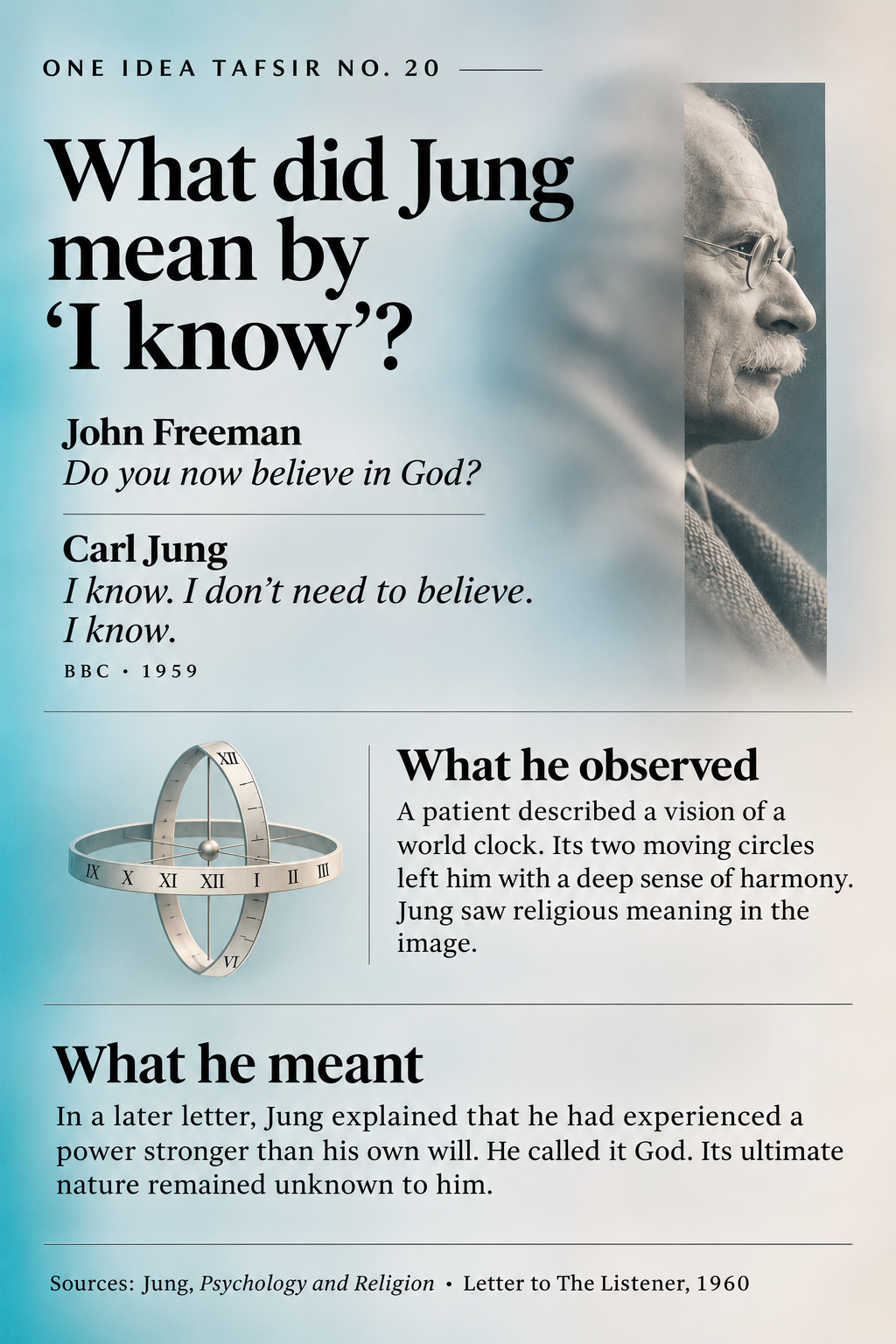 That gives the pause in the interview some history. Behind it lay a clinician’s case notes, parallels he had traced across centuries, the testimony of other observers and, as he later explained, experiences of his own. What could be overwhelming was the encounter itself. In his letter to The Listener, Jung said he used the name God for a reality whose power over him he knew from experience and whose nature remained unknown to him. A Muslim reader can take that testimony seriously and still ask the question it leaves open. What, precisely, are we being asked to know about Allah? [2, 7, 8]
The opening words of Qur’an 47:19 give that question an answer.
فَٱعْلَمْ أَنَّهُۥ لَآ إِلَـٰهَ إِلَّا ٱللَّهُ وَٱسْتَغْفِرْ لِذَنۢبِكَ وَلِلْمُؤْمِنِينَ وَٱلْمُؤْمِنَـٰتِ ۗ وَٱللَّهُ يَعْلَمُ مُتَقَلَّبَكُمْ وَمَثْوَىٰكُمْ ١٩
So, know ˹well, O Prophet,˺ that there is no god ˹worthy of worship˺ except Allah. And seek forgiveness for your shortcomings and for ˹the sins of˺ the believing men and women. For Allah ˹fully˺ knows your movements and places of rest ˹O people˺. (Quran 47:19)
What are we commanded to know?
Two familiar verses come close to the phrase “Know, He is Allah.” In Sūrat al-Ikhlāṣ, the opening word is qul, meaning “say”. What follows is huwa Allāhu aḥad — “He is Allah, One.” Here in Sūrat Muḥammad, the word is faʿlam, meaning “so know”. What follows tells us who has the sole right to our worship. A person can acknowledge a Creator and still have to ask a deeply personal question. When I bow my head in worship, to whom do I bow? [3, 4]
Consider how Allah addresses Mūsā (Moses), peace be upon him. In Sūrat Ṭā Hā, Allah identifies Himself, declares that He alone is worthy of worship, and commands Mūsā to worship Him and establish prayer in His remembrance. The next time you stand for prayer, think of that moment. The One you face in worship has made Himself known, and He has told you how to remember Him. [5]
Who knows whom?
A final detail is easy to miss in English. The word near the beginning, faʿlam (“so know”), and the verb near the end, yaʿlam (“He knows”), come from the same Arabic root. At the opening, the Prophet ﷺ is addressed in the singular. By the close, Allah speaks of where all of you go about and where you come to rest. The verse begins with what we are called to know about Allah. It ends with what Allah already knows about us. [3]
Sources
- BBC, Face to Face, John Freeman interviews C. G. Jung, broadcast 22 October 1959. Full interview, Association of Jungian Analysts · Short clip shared by the reader.
- C. G. Jung, letter to The Listener clarifying the broadcast.
- Qur’an 47:19, Arabic and English.
- Qur’an 112:1–4, Sūrat al-Ikhlāṣ.
- Qur’an 20:14, Allah’s address to Mūsā.
- Ṣaḥīḥ al-Bukhārī 6307, narrated by Abū Hurayrah.
- C. G. Jung, Psychology and Religion, Terry Lectures delivered at Yale in 1937, first published in 1938. See lectures I and III on the dream series, the world clock and Jung’s use of Rudolf Otto’s term. Full text.
- William James, The Varieties of Religious Experience (1902), lectures XVI and XVII, “Mysticism”. Full text.
Related Topics
Related Posts