
London based entrepreneur, cybersecurity analyst doing a PhD in AI
One Idea Tafsir No. 22 – Organisational Change.
Consultation is standard corporate practice but is also part of prophetic guidance from the Quran and the Sunnah of Prophet Muhammad (peace be upon him).
One Idea Tafsīr No. 22 — Why Consult?
Shūrā, psychological safety and the people who live with a decision
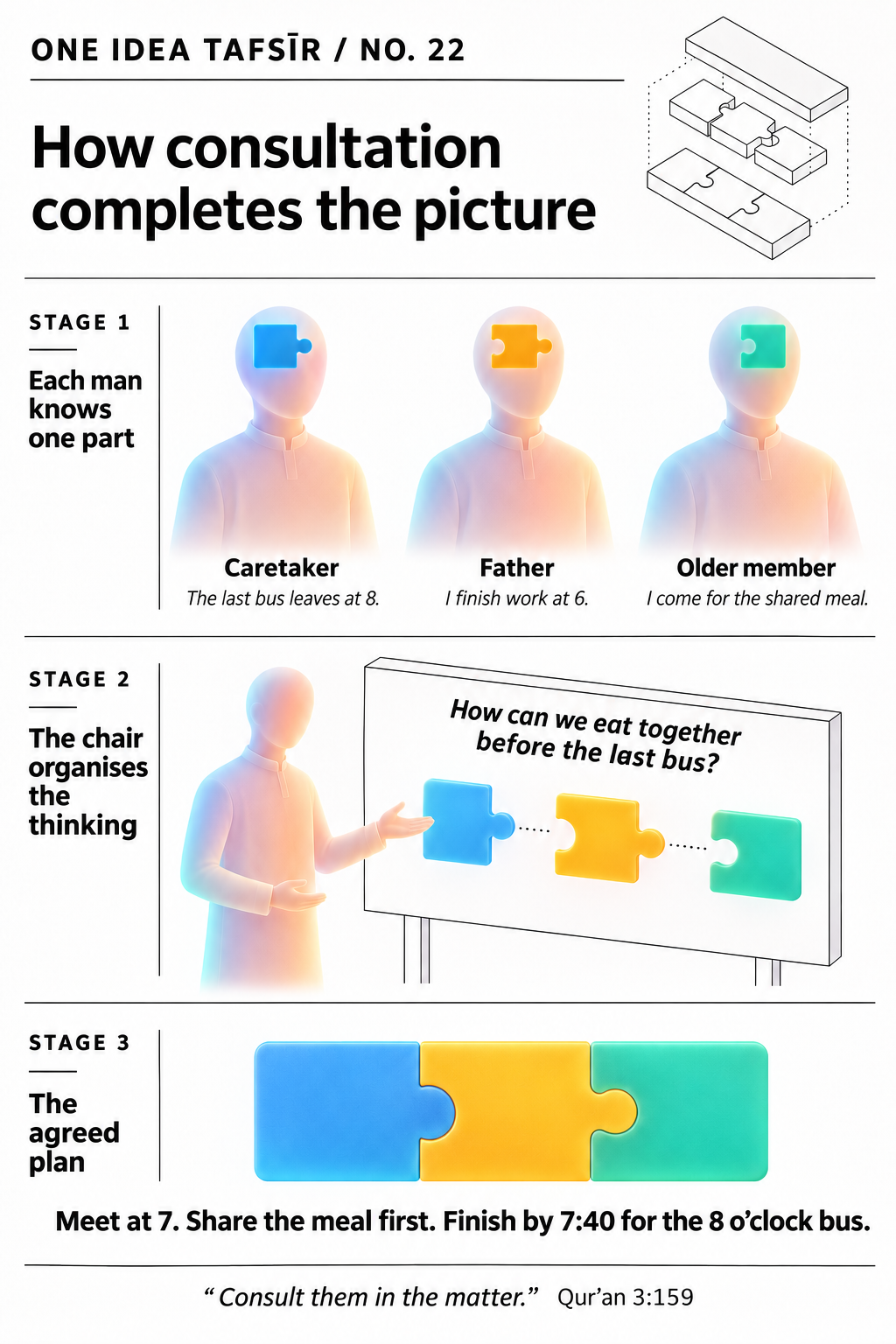
Imagine a community centre choosing an evening for its weekly gathering or a business making a critical decision. Around the table, Thursday at seven suits everyone. For a business it could be a stipulated meeting time. The caretaker, or the manager who is putting away the chairs or organising the meeting, knows something the committee does not. The last bus home leaves at eight. He knows because every Thursday he waits at the stop with two of the older members. Or the manager knows one of the people scheduled to be at the meeting has to do a school run or has an obligation or a doctor’s appointment they can’t get out of or had planned to take their kids out a long time ago.

It is easy to call this an overlooked detail. To the two people at the bus stop, it is the difference between belonging to the gathering and hearing about it afterwards. The chair could be intelligent, experienced and sincerely concerned for both of them. How would she or he know to ask about a bus she or he has never needed to catch?
A command given after a setback
فَبِمَا رَحْمَةٍ مِّنَ ٱللَّهِ لِنتَ لَهُمْ ۖ وَلَوْ كُنتَ فَظًّا غَلِيظَ ٱلْقَلْبِ لَٱنفَضُّوا۟ مِنْ حَوْلِكَ ۖ فَٱعْفُ عَنْهُمْ وَٱسْتَغْفِرْ لَهُمْ وَشَاوِرْهُمْ فِى ٱلْأَمْرِ ۖ فَإِذَا عَزَمْتَ فَتَوَكَّلْ عَلَى ٱللَّهِ ۚ إِنَّ ٱللَّهَ يُحِبُّ ٱلْمُتَوَكِّلِينَ ١٥٩
It is out of Allah’s mercy that you ˹O Prophet˺ have been lenient with them. Had you been cruel or hard-hearted, they would have certainly abandoned you. So pardon them, ask Allah’s forgiveness for them, and consult with them in ˹conducting˺ matters. Once you make a decision, put your trust in Allah. Surely Allah loves those who trust in Him. (Quran 3:159)
The word worth pausing over is “them.” In the verses concerning Uḥud, the Qur’an has already spoken plainly about faltering, disagreement and disobedience. The same passage speaks of Allah’s pardon. A few verses later, Allah reminds the Prophet ﷺ of the mercy through which he was gentle with those around him. Harshness, the verse says, would have caused them to disperse. He is instructed to pardon them, seek forgiveness for them and consult them. [1]. The islamic term for consultation is Shura, and you can find 3 reference videos from scholars in the references below.
Many of us can imagine asking people for advice after they have done something well. It is harder to imagine asking for their judgment after a decision has gone badly and our own confidence in them has been shaken. Yet a community that has lived through a failure now knows things it could never have learnt in advance. If everyone who was there loses the standing to speak, who is left to explain what happened?
In his commentary, Ibn Kathīr observes that the Prophet ﷺ sought his Companions’ counsel in important affairs. He connects this practice both to the effect it had on their hearts and to their willingness to carry out a decision in which they had participated. There is a moral claim here that goes beyond the practical benefit. The verse tells the Prophet ﷺ to seek Allah’s forgiveness for these people. Their good matters even before anyone asks what information they might contribute. [1]
What a quiet meeting conceals
Organisational psychologists use psychological safety for a shared belief that people can take interpersonal risks in a team. One such risk is telling the person who approved a change that it is creating a problem. The caretaker has to decide whether to interrupt people who appear to have reached agreement. He may be quite certain of the timetable and still hesitate. The risk lies in correcting the chair in front of others. If she or he asks, “Who will find it hard to get home at that hour?”, she/he makes her/his knowledge relevant and gives them a natural moment to speak.
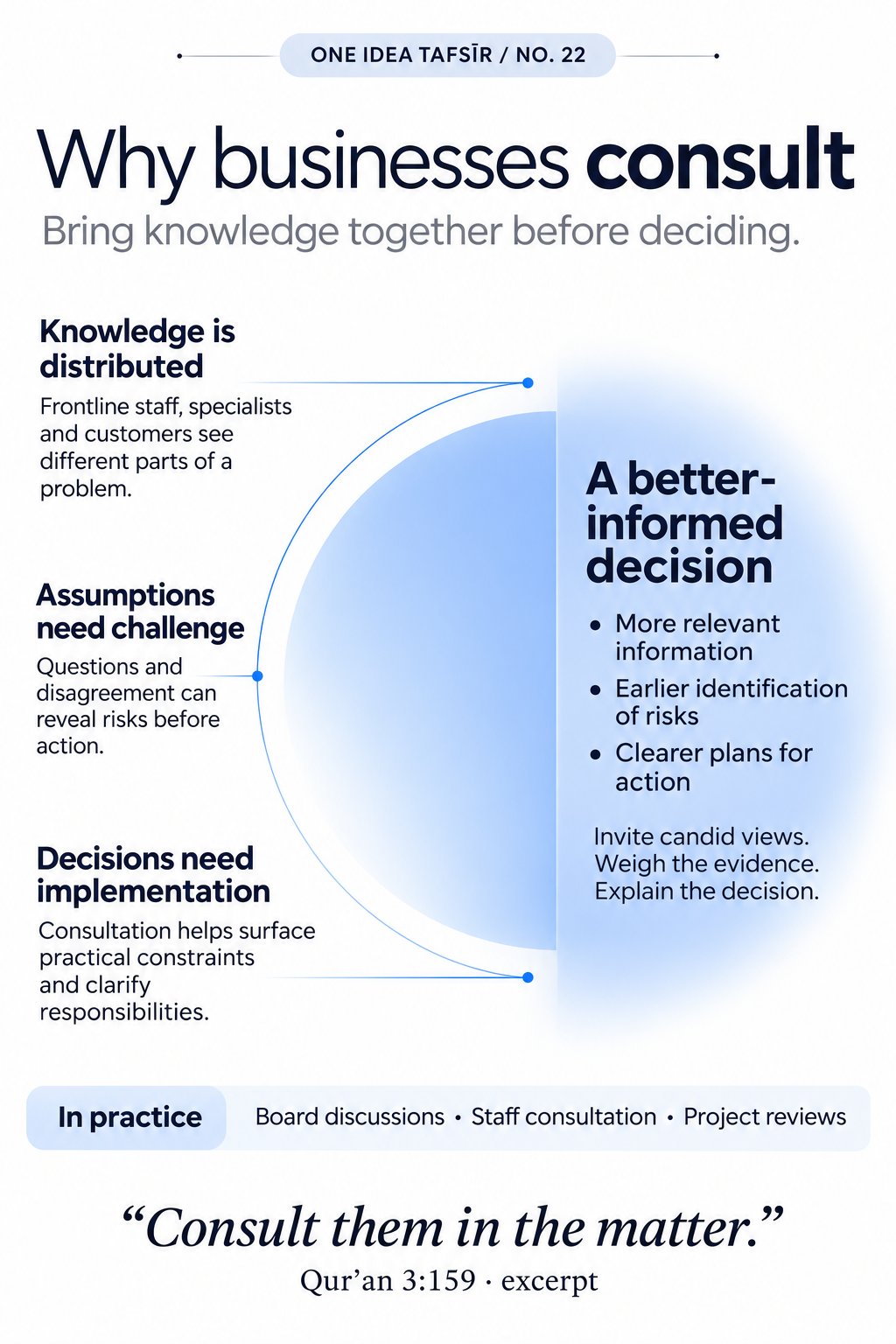
Ingrid Nembhard and Amy Edmondson studied staff in 23 neonatal intensive care units engaged in quality improvement. Professional status mattered. So did the behaviour of leaders who invited contributions and showed that they valued them. Staff who experienced greater psychological safety also reported greater engagement in improvement work. These were survey findings. They establish an association and leave open how much improvement any particular leadership intervention would produce. They nevertheless give a manager good reason to ask whose knowledge a hierarchy makes difficult to hear. [2]
A 2024 paper in Health Care Management Review examines what happens after somebody speaks. The authors describe how an idea from the frontline can pass through colleagues, supervisors and senior decision-makers before anybody can put it into practice. At each point, someone needs the authority, time or persistence to carry it further. This helps explain a familiar disappointment. A manager can listen sincerely, thank the speaker and return to a full diary. A month later the same fault remains, and the person who first reported it has learnt something about the likely value of reporting the next one. [3]
The advice that changed what people saw
An incident at al-Ḥudaybiyyah gives us a different way to think about leading change. After the treaty had been concluded, the Prophet ﷺ instructed his Companions to sacrifice their animals and shave their heads. He repeated the instruction three times. Nobody rose. He went to his wife Umm Salamah رضي الله عنها and told her what had happened. She advised him to go out, offer his own sacrifice and have his head shaved. He took her advice. When the Companions (r.a.) saw him, they rose and followed. [4]
It is worth noticing who understood what the moment required. Umm Salamah (r.a.) offered a judgment that altered what the Prophet ﷺ did next. They did not have to hear the same instruction a fourth time. They could see, in the action of the person (s.a.w.s) leading them, what accepting the decision meant. The narration records their conduct. Their individual thoughts remain their own. [4]
What a chair can do with an answer
Suppose the caretaker speaks. The chair thanks him, and someone suggests starting an hour earlier. Then a parent explains that he finishes work at six. Consultation has revealed a real disagreement about timing among people who agree entirely about the purpose of the gathering. Both have given the committee something valuable. Each has made it harder to choose a convenient hour by quietly passing the inconvenience to somebody else.
The chair might ask the two older members which part of the evening they most want to attend. Perhaps it is the shared meal, usually served last. Moving it to the beginning could let them eat with their neighbours before catching the bus, while people coming from work could still join the discussion. They might have a better suggestion of their own. The important detail is who gets asked while the decision is still open.
Now return to the end of the verse. After consultation comes resolve, followed by trust in Allah.
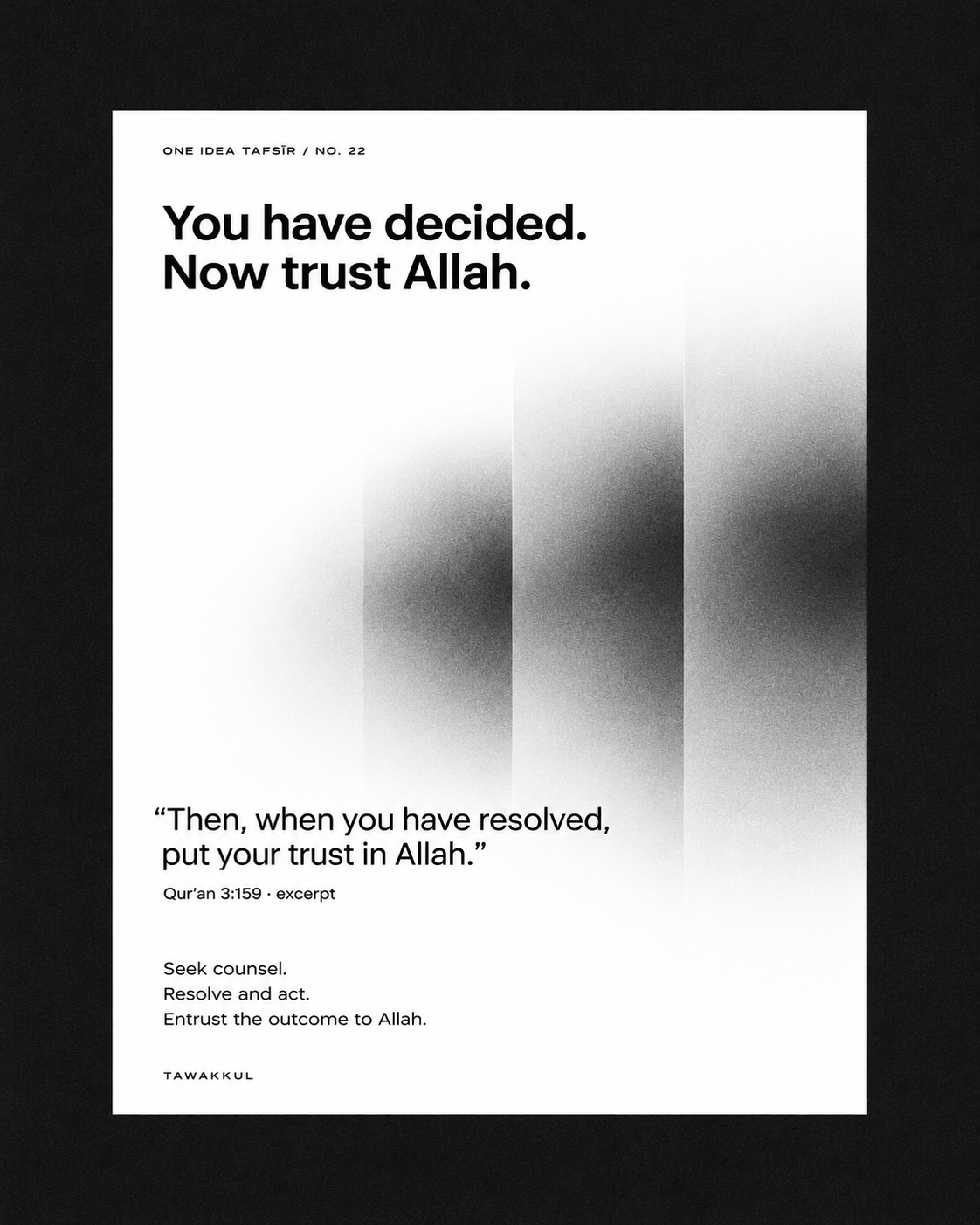
Listening can reveal competing needs and leave the choice difficult. The person entrusted with the decision still has to make it. For a believer, tawakkul belongs here, at the point where consultation has been given and received and the decision taken. [1]
Imagine the chair at the bus stop a week later. He has one more question for the two members. “Did you manage to stay for the part you came for?” Their answer will tell her something that even a unanimous vote in the committee room could never have settled.
Author’s note :- I am not a scholar. This is a personal reflection informed by classical Sunni tafsīr and organisational psychology which is my MSc from Birkbeck, University of London. The community centre is an illustrative example. Allah knows best. Any questions around gender, pronouns, identity, he/she/they/them, traditional gender roles, separation between sexes are not part of the scope of this tafsir which only deals with the concept of consultation. The author is not interested in any controversy around this topic, either making controversial views or discussing them in comments. If the author deems it fit to discuss this topic, a further article will elucidate this topic, and I will address it at that point. No particular order has been chosen here, and the author follows guidelines to the best of his knowledge from traditional registered Imams and scholars who have deep knowledge of the religion. This series does not deal with topical political or societal topics which are heavily debated, instead focusing on elucidating the Quranic worldview through a blend of academic views and current ideas. Please do not misread or misconstrue and if you do, your misunderstanding is your responsibility, not mine.
References
[1] Sūrat Āl ʿImrān 3:152 and 3:159 with Tafsīr Ibn Kathīr.
[2] Ingrid M. Nembhard and Amy C. Edmondson (2006). Making it safe: The effects of leader inclusiveness and professional status on psychological safety and improvement efforts in health care teams. Journal of Organizational Behavior.
[3] Voice is not enough: A multilevel model of how frontline voice can reach implementation. Health Care Management Review (2024).
[4] Ṣaḥīḥ al-Bukhārī 2731–2732, the account of al-Ḥudaybiyyah and Umm Salamah’s counsel.
[5] Islamic Short on Shura – https://youtube.com/shorts/XVzBzKCeLeU?si=xICetUz25xHXvx-o
[6] Jeff Bezos on why he speaks last in meetings – https://www.youtube.com/shorts/6xRWFDscAc0
[7] Islamic Short on Shura and Decision making – https://youtube.com/shorts/thLz64QlVdo?si=uRR5DdMF_Gp3f6Up
[8] Islamic Short on how to do Shura and actively participating – https://www.youtube.com/watch?v=Z8BReullXfQ
Related Topics
Related Posts