London based entrepreneur, cybersecurity analyst doing a PhD in AI
One Idea Tafsir No.8 – The Ancient Mariner
Daily Brew — One Idea Tafsīr on the Go
No. 8 — The Albatross, the Raven and Cain’s Intelligent Stone
Sūrat al-Māʾidah (5:27–32): The Art of Burying Responsibility
Preamble — A Personal Note
Perhaps the first human technology was not the wheel.
Perhaps it was the grave.
Before armies, corporations, governments, financial institutions and artificial intelligence, there was a dead brother and a living brother who did not know what to do with him.
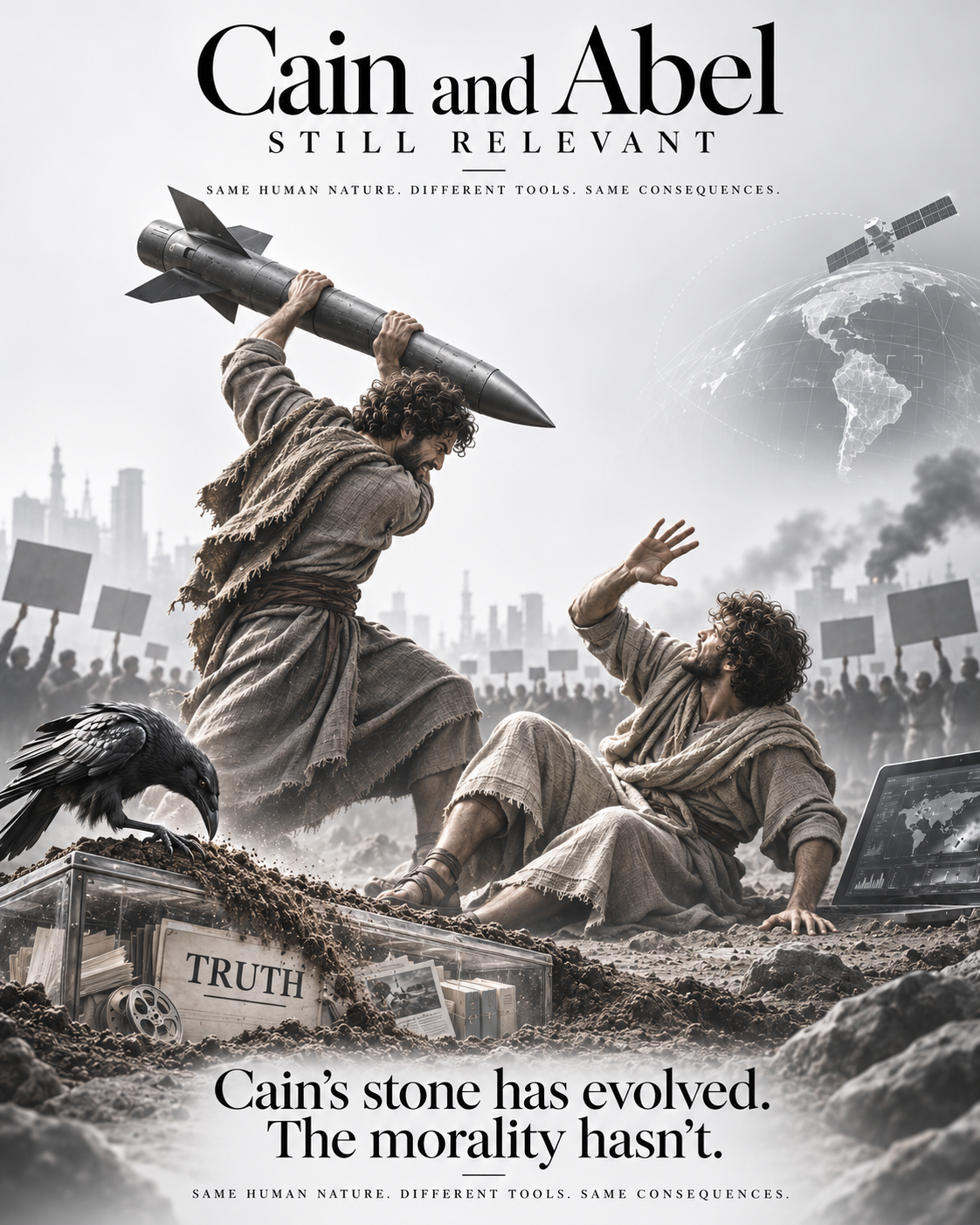
Then Allah sent a raven.
Thousands of years later, we have become considerably more sophisticated.
We have invented drones, hypersonic missiles, satellites, intelligent machines and extraordinary methods of storing, retrieving—and sometimes concealing—information.
But have we become any better at taking responsibility for what we do?
In this edition of Daily Brew, I want to bring together three stories: the Qur’anic account of Cain and Abel, Samuel Taylor Coleridge’s The Rime of the Ancient Mariner, and the extraordinary evolution of modern warfare.
One idea: our technology has evolved enormously. Our ability to justify wrongdoing remains disturbingly familiar.
1. The Qur’an: The First Murder
Sūrat al-Māʾidah tells us about two sons of Adam, traditionally identified as Qābīl (Cain) and Hābīl (Abel).
Both offer sacrifices. One is accepted. The other is not.
Cain responds with a threat.
Qur’an 5:27 — The Threat
۞ وَٱتْلُ عَلَيْهِمْ نَبَأَ ٱبْنَىْ ءَادَمَ بِٱلْحَقِّ إِذْ قَرَّبَا قُرْبَانًا فَتُقُبِّلَ مِنْ أَحَدِهِمَا وَلَمْ يُتَقَبَّلْ مِنَ ٱلْـَٔاخَرِ قَالَ لَأَقْتُلَنَّكَ ۖ قَالَ إِنَّمَا يَتَقَبَّلُ ٱللَّهُ مِنَ ٱلْمُتَّقِينَ ٢٧
Relate to them in truth ˹O Prophet˺ the story of Adam’s two sons—how each offered a sacrifice: one’s offering was accepted while the other’s was not, so he threatened ˹his brother˺, “I will kill you!” His brother replied, “Allah only accepts ˹the offering˺ of the sincerely devout.
Notice something.
Abel did not cause the rejection of Cain’s offering.
Yet Cain directed his anger towards Abel.
Envy becomes resentment. Resentment becomes hatred.
Then the Qur’an describes something even more remarkable.
Qur’an 5:30 — The Inner Decision
فَطَوَّعَتْ لَهُۥ نَفْسُهُۥ قَتْلَ أَخِيهِ فَقَتَلَهُۥ فَأَصْبَحَ مِنَ ٱلْخَـٰسِرِينَ ٣٠
Still, the other convinced himself to kill his own brother, so he killed him—becoming a loser.
His own nafs (self or loosely translated as ego) made the act acceptable to him.
Ibn Kathīr explains that Cain’s inner self encouraged the murder and made it seem reasonable.
That is a frighteningly familiar description of human wrongdoing.
Greed becomes ambition.
Deception becomes communication.
Corruption becomes facilitation.
Cruelty becomes necessity.
And killing becomes an operation.
Before the hand commits the wrong, the mind often constructs the justification.
2. Coleridge: The Albatross Around the Neck
In 1798, Samuel Taylor Coleridge published The Rime of the Ancient Mariner.
A sailor encounters an albatross while his ship struggles through icy waters. The bird is welcomed, and its arrival accompanies improving conditions.
Then, without an adequate explanation, the Mariner kills it.
“I shot the Albatross.”
Four words.
One apparently senseless act.
The ship’s fortunes deteriorate. The sailors suffer, and the dead albatross is hung around the Mariner’s neck.
It becomes the physical representation of his transgression.
Eventually, the Mariner recognises beauty in the sea creatures around him, blesses them spontaneously and experiences a spiritual turning point.
The albatross falls from his neck.
Yet the consequences do not simply disappear. He continues to tell his story, compelled by the memory of what happened.
An act can take seconds. Its moral consequences can last a lifetime.
3. The Raven: What Happens Afterwards?
Now return to Cain.
He has murdered his brother.
And then something extraordinary happens.
Qur’an 5:31 — The Raven
فَبَعَثَ ٱللَّهُ غُرَابًا يَبْحَثُ فِى ٱلْأَرْضِ لِيُرِيَهُۥ كَيْفَ يُوَٰرِى سَوْءَةَ أَخِيهِ ۚ قَالَ يَـٰوَيْلَتَىٰٓ أَعَجَزْتُ أَنْ أَكُونَ مِثْلَ هَـٰذَا ٱلْغُرَابِ فَأُوَٰرِىَ سَوْءَةَ أَخِى ۖ فَأَصْبَحَ مِنَ ٱلنَّـٰدِمِينَ ٣١
Then Allah sent a crow digging ˹a grave˺ in the ground ˹for a dead crow˺, in order to show him how to bury the corpse of his brother. He cried, “Alas! Have I ˹even˺ failed to be like this crow and bury the corpse of my brother?” So he became regretful.
Rendering of meaning: Allah sends a raven scratching in the earth, showing Cain how to cover his brother’s body. Cain laments that he could not even do what the raven had demonstrated, and becomes regretful.
Think about that.
A human being has taken his brother’s life.
Yet a bird must teach him how to bury him.
The Qur’an describes burial, not a modern criminal cover-up. But the image invites a further reflection.
There are two ways to bury Abel.
The first is physical: conceal the body beneath the earth.
The second is moral: conceal who was responsible.
The second burial may be considerably more dangerous.
4. Cain’s Stone Has Become Intelligent
Later exegetical traditions describe Cain killing Abel with a stone. Neither the Qur’an nor Genesis specifies the weapon.
Nevertheless, the image is powerful.
The first stone required a human hand.
Today, that stone can fly thousands of kilometres, use satellite navigation, identify objects through machine vision and deliver extraordinary destructive force.
Drones, hypersonic weapons, robotic systems and artificial intelligence have transformed warfare.
Some systems can also protect life: robots can evacuate wounded soldiers, and satellite imagery can help document destruction.
But precision and morality are not the same thing.
A missile may strike its intended coordinates perfectly.
That does not establish that the intended target was lawful, or that the attack was justified.
And when an AI-enabled system misidentifies a target, responsibility cannot simply be passed to the machine.
The International Committee of the Red Cross has warned that autonomous weapons raise serious questions about predictability, human control and compliance with international humanitarian law.
The technology has changed.
The human obligation to distinguish, judge and exercise restraint has not disappeared.
5. Eichmann: Burying Responsibility Inside a Machine
In Jerusalem in 1961, Adolf Eichmann stood trial for his central role in organising the deportation of European Jews towards extermination.
He sat behind protective glass.
His defence portrayed him as a subordinate executing orders—a small cog in an enormous machine.
The judges rejected that characterisation and convicted him.
Hannah Arendt’s later discussion of the banality of evil raised uncomfortable questions about bureaucracy, obedience and moral judgement. Her interpretation of Eichmann remains contested.
The historical circumstances were specific and horrific; they must not be equated casually with ordinary institutional failures.
Nevertheless, consider the general problem of fragmented responsibility.
The programmer wrote the software.
The analyst classified the target.
The official approved the procedure.
The operator pressed the button.
The administrator recorded the result.
At what point does everyone become responsible for only a tiny part, while nobody accepts responsibility for the whole?
The modern institution can divide an action into many small procedures.
But dividing an action does not automatically divide away moral responsibility.
6. The Modern Crow: Truth, Evidence and Accountability
In the twenty-first century, concealment has also become technologically sophisticated.
A record can be deleted.
A transaction can pass through multiple companies.
A report can be buried beneath thousands of documents.
An inconvenient finding can disappear behind a classification or a carefully worded statement.
But technology can also reveal.
A financial audit.
A preserved message.
A satellite image.
A timestamp.
A whistleblower.
A forensic investigation.
An independent court.
Perhaps these are the modern equivalents of the raven scratching at the earth.
But the comparison requires one further warning.
The raven must not become a vulture.
Suspicion is not proof.
An allegation is not a conviction.
An AI-generated pattern is not automatically evidence of wrongdoing.
And an apparent inconsistency may have an innocent explanation.
The Qur’an commands believers in An-Nisāʾ 4:135 to stand firmly for justice, even against themselves and those closest to them.
Not merely against their enemies.
That is the difficult part.
We must allow the raven to scratch our own ground.
8. The Sunnah: The Consequences of Precedent
The Prophet Muhammad ﷺ taught that whenever a person is murdered unjustly, the first son of Adam bears a share of the burden because he initiated the practice of murder.
— Ṣaḥīḥ al-Bukhārī 3335.
Consider the principle.
Actions create precedents.
Precedents influence behaviour.
Repeated behaviour can become established practice.
The first wrongdoing may require persuasion.
The next has an example.
Eventually, an organisation may develop an entire procedure for something it should never have done.
The hadith specifically concerns unjust murder. Its application to modern institutions is a moral analogy, not a claim that the narration explicitly describes corporations or artificial intelligence.
But the underlying warning is powerful.
Wrongdoing can become easier when earlier wrongdoing has already cleared the path.
9. One Life Is Not a Statistic
Immediately after Cain and Abel, the Qur’an says in Al-Māʾidah 5:32 that whoever unlawfully kills a person is as though they have killed all humanity, and whoever saves a life is as though they have saved all humanity.
مِنْ أَجْلِ ذَٰلِكَ كَتَبْنَا عَلَىٰ بَنِىٓ إِسْرَٰٓءِيلَ أَنَّهُۥ مَن قَتَلَ نَفْسًۢا بِغَيْرِ نَفْسٍ أَوْ فَسَادٍ فِى ٱلْأَرْضِ فَكَأَنَّمَا قَتَلَ ٱلنَّاسَ جَمِيعًا وَمَنْ أَحْيَاهَا فَكَأَنَّمَآ أَحْيَا ٱلنَّاسَ جَمِيعًا ۚ وَلَقَدْ جَآءَتْهُمْ رُسُلُنَا بِٱلْبَيِّنَـٰتِ ثُمَّ إِنَّ كَثِيرًا مِّنْهُم بَعْدَ ذَٰلِكَ فِى ٱلْأَرْضِ لَمُسْرِفُونَ ٣٢
That is why We ordained for the Children of Israel that whoever takes a life—unless as a punishment for murder or mischief in the land—it will be as if they killed all of humanity; and whoever saves a life, it will be as if they saved all of humanity. ˹Although˺ Our messengers already came to them with clear proofs, many of them still transgressed afterwards through the land.
The verse states this in the context of what was ordained for the Children of Israel and includes specified legal exceptions.
The significance of the human life being discussed must not disappear beneath a literary analogy.
Killing an albatross is not equivalent to murdering Abel.
Nor can literary comparisons determine legal responsibility for acts committed in war.
But all three perspectives warn against moral indifference.
A casualty is not merely a number.
A victim had a name, relationships, memories and a future.
Abel was not a statistic. He was a brother.
Final Round-up — The Bird Is Still Scratching
Coleridge’s Mariner carries an albatross around his neck.
Cain encounters a raven scratching at the earth.
Modern humanity constructs increasingly sophisticated weapons—and increasingly complex institutions through which responsibility can become obscured.
The question remains the same.
What have we done, and who is responsible?
We have better machines now.
Faster weapons.
More powerful computers.
Larger institutions.
Better methods of hiding information.
And better methods of uncovering it.
But perhaps the most important human advancement would be much simpler.
To recognise the value of a life before destroying it.
To recognise wrongdoing before justifying it.
And to accept responsibility before trying to bury it.
The Mariner carried the albatross. Cain carried the consequences of Abel’s death. Humanity must not allow its machines to carry away its conscience.
Somewhere, the raven is still scratching.
Footnote I — What the Qur’an Actually Says
Sūrat al-Māʾidah (5:27–31) identifies the two sons of Adam but does not name them. Qābīl and Hābīl are names familiar from classical Islamic exegetical tradition.
The Qur’an does not specify Cain’s murder weapon. The stone appears in later interpretive reports of varying evidentiary strength.
Verse 5:31 describes the raven demonstrating how the body could be covered or buried. It does not explicitly describe intentional destruction of evidence. The comparison with contemporary concealment and institutional wrongdoing is a literary reflection, not classical tafsīr.
The Qur’an says Cain became regretful; it does not explicitly establish that his repentance was accepted.
Footnote II — Coleridge, Genesis and Islamic Tafsīr
Samuel Taylor Coleridge’s The Rime of the Ancient Mariner (1798) is a Romantic poem incorporating Christian imagery, supernatural consequences, moral awakening and penance.
Genesis 4:9–10 includes Cain’s question about responsibility for his brother and the image of Abel’s blood crying from the ground. Those details should not be attributed to the Qur’anic account.
The parallels between these texts are literary and philosophical. Coleridge’s work is not an Islamic commentary, and the spiritual significance of killing an animal should not be equated with the legal and moral gravity of murdering a human being.
Footnote III — Modern Warfare and Human Responsibility
Autonomous weapons, remotely piloted drones, AI-assisted decision systems and conventional precision-guided weapons are different technologies, with different degrees of human control.
International humanitarian law requires distinction, proportionality and feasible precautions. The presence of civilian casualties does not, by itself, establish that a particular attack was unlawful; the relevant circumstances and applicable law must be investigated.
The Eichmann trial is cited as a historical example of the failure of a defence based on subordinate responsibility, not as an assertion that all modern military or administrative practices are comparable to the Holocaust.
Arendt’s interpretation of Eichmann is debated. Neither Arendt’s philosophical argument nor the literary comparison eliminates the need for individual evidence, due process and properly established responsibility.
References and Further Reading
Qur’an, Sunnah and Tafsīr
- Sūrat al-Māʾidah 5:27–32 — The two sons of Adam
- Tafsīr Ibn Kathīr on 5:27–31
- Tafsīr al-Ṭabarī on 5:31
- An-Nisāʾ 4:135 — Justice and impartial testimony
- Ṣaḥīḥ al-Bukhārī 3335 — Responsibility for initiating murder
Literature and comparative texts
- Samuel Taylor Coleridge — The Rime of the Ancient Mariner, full text
- AQA — The Rime of the Ancient Mariner: Literary analysis
- Genesis 4:8–10 — Cain and Abel
History, philosophy and modern warfare
- United States Holocaust Memorial Museum — The Eichmann Trial
- Hannah Arendt, Eichmann in Jerusalem: A Report on the Banality of Evil (1963).
- International Committee of the Red Cross — Autonomous Weapons and International Humanitarian Law (2026)
- International Committee of the Red Cross — Autonomous Weapons FAQs (2026)
Method: A contemporary literary and ethical reflection grounded in the Qur’an, authentic Sunnah, classical tafsīr and historical sources. It is not independent scholarly tafsīr. Qur’anic Arabic follows Quran.com’s displayed ʿUthmānī text, with approximate transliterations and English renderings of meaning.
Related Topics