One Place, One People
In loving memory of our beloved father
Isaac ben Moshe – יצחק בן משה ז״ל
29 Av 5744 • כ״ט אב תשמ״ד
──────────────
Every nation has its capital—a centre of government, a seat of power, the place where its history, identity and aspirations converge.
Yet Jerusalem was never intended to be merely Israel’s capital.
Long before Jerusalem became Israel’s royal city, it had already been chosen for something far greater—the meeting place of Heaven and earth, where an entire nation would discover that true joy is found not in what we possess, but in standing together before Hashem.
Throughout Parashat Re’eh, one phrase echoes with remarkable insistence:
הַמָּקוֹם אֲשֶׁר יִבְחַר ה׳
The place that Hashem will choose.
(Deuteronomy 12)
Not many places, but one place. Nowhere else in the Torah does a parashah return to a single phrase so often.
Why this insistence?
The Sifrei explains that before Israel entered the Land, private altars (bamot) were permitted. But from the time Hashem chose His dwelling place, every tribe, wherever it dwelt, turned towards the one place He had chosen.
This was never simply about geography. It was about forming a nation whose spiritual life revolved around the place where Hashem caused His Name to dwell.
Jerusalem was far more than another city. It was the place from which the Jewish people learned to perceive the Shechinah. Just as the human eye enables us to see the world around us, Jerusalem enabled Israel to perceive His Presence at the very heart of creation. Rabbi Aryeh Kaplan develops this insight in Jerusalem: Eye of the Universe.
Chazal reveal something remarkable about how that place was identified. The Gemara records that David HaMelech and Shmuel HaNavi expounded the Torah together until they identified the site of the future Beit HaMikdash (Zevachim 54b). That sacred place was revealed not through military conquest or political calculation, but through the study of Torah.
More than any other parashah in the Torah, Re’eh returns to the mitzvah of simchah. Joy is not merely one of its themes; it lies at its very heart.
וּשְׂמַחְתֶּם לִפְנֵי ה׳ אֱלֹהֵיכֶם
And you shall rejoice before Hashem your God.
(Deuteronomy 12:12)
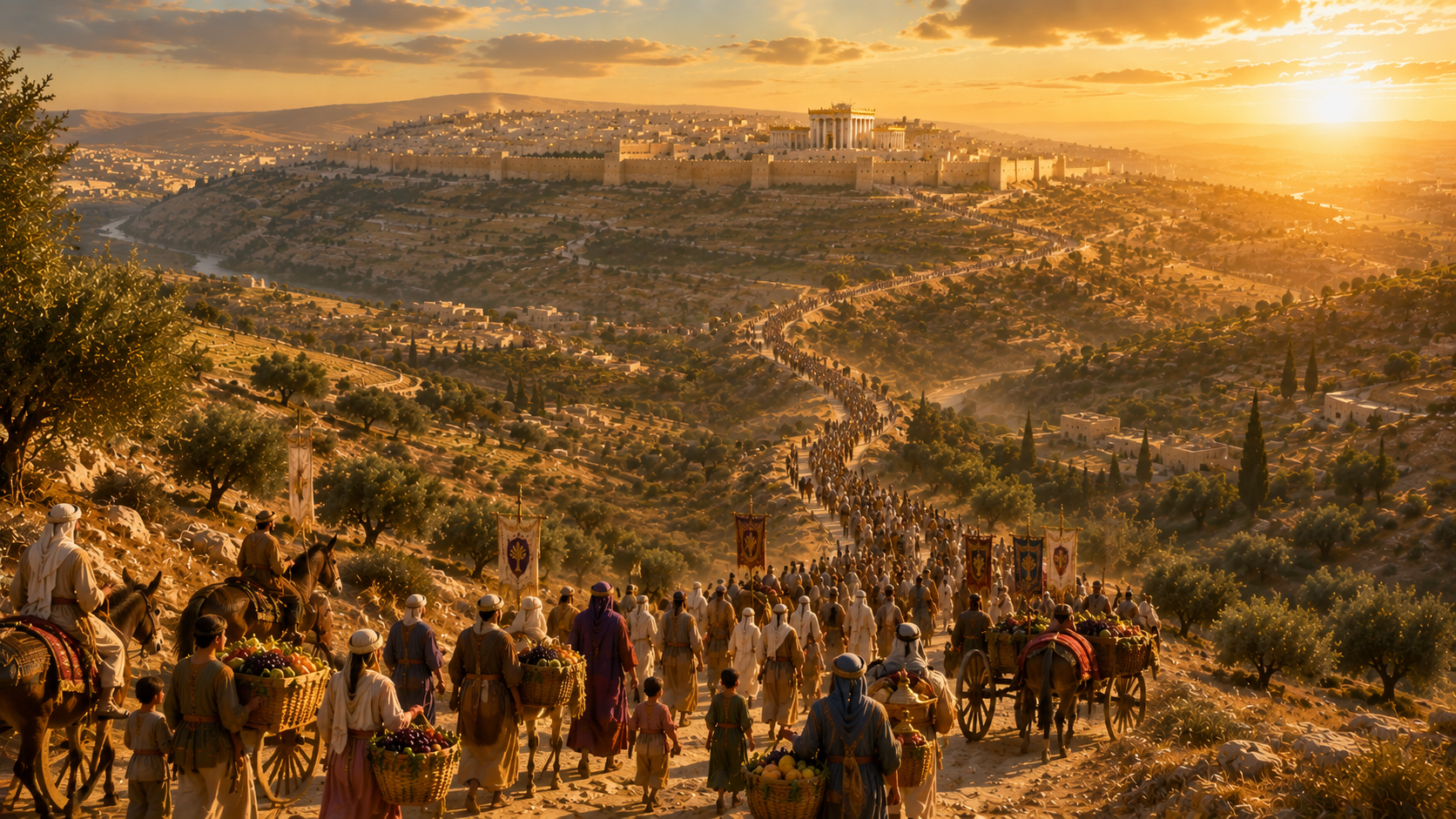
The pilgrimage festivals were never intended simply to commemorate the past. They were living moments when the nation ascended together to renew its covenant with Heaven. As the Zohar explains, the journey itself became part of the mitzvah, transforming thousands of individual footsteps into a single act of national devotion.
Three times each year, the roads of Israel filled with pilgrims. Families came from every corner of the Land. Farmers carried their bikkurim, tithes and offerings of thanksgiving. Rich and poor walked the same roads. Young and old travelled towards the same destination.
As they approached Jerusalem, the elders of the city came out to welcome them. Once they entered the Temple Mount, the Levi’im greeted them with song, while the Kohanim received their offerings in the Azarah. Gratitude was no longer a private emotion. It had become the heartbeat of Israel.
The offerings themselves reveal another dimension of that joy. The farmer did not consume his blessing alone. The stranger, the orphan and the widow all had a place at the festive table.
Yet the mitzvah itself reveals something even deeper. The Sfat Emet notices that the Torah does not ask the farmer to receive his harvest first and give thanks afterwards. Instead, it reverses the order. Before he takes the blessing into his own home, he first brings it to Jerusalem. Only then does he return to enjoy the fruit of his labour. In that quiet sequence, the Torah teaches that gratitude is not simply the response to blessing; it is the way we learn how to receive it.
Yet the pilgrimage revealed something greater still. True unity is found only when many are drawn towards the One. As the Maharal explains, Jerusalem became far more than the spiritual centre of Israel. It was where every tribe journeyed, every offering was brought, and every heart turned towards the same Presence. Standing before Hashem, Israel discovered that diversity was no barrier to unity. From that unity flowed a joy that no individual could ever find alone.
The parashah leaves us with these words:
אִישׁ כְּמַתְּנַת יָדוֹ כְּבִרְכַּת ה׳ אֱלֹהֶיךָ אֲשֶׁר נָתַן לָךְ
Each person according to the gift of his hand, according to the blessing that Hashem your God has bestowed upon you.
(Deuteronomy 16:17)
שבת שלום
שמואל