One Spotlight on Israel, Eyes Wide Shut Around It
Demanding more from Israel is justified, because Israel demands more from itself. What is not justified is selective scrutiny: Israel is judged in full light, while Iran crushes dissent in the dark, Erdogan and al Jolani act under cover, and Kurdish communities are crushed out of sight. Gaza, Iran and northern Syria reveal a system in which Europe speaks the language of values, shakes hands in Damascus, and funds “stability”, while violence continues and responsibility dissolves. This is not moral complexity. It is moral convenience.
In Gaza, even after the fighting subsided, Israel is judged under constant spotlights and an unprecedented moral standard. In Iran, the lights were switched off and the shooting began: thousands killed, bodies stored in refrigerated units, a protest movement crushed with live fire. In northern Syria, under al Jolani and with Erdogan’s direct involvement, Kurdish neighbourhoods are being bombed at this very moment, more than 150,000 people have been displaced, and arrests and disappearances have become routine. Same region, same weeks, but only one place is judged by the rules.
And this is no accident. Israel lives under a permanent magnifying glass, and rightly so. Democracies are judged differently because they are capable of meeting that standard, and Israel does so in precisely this way: open, argumentative in public, self-critical, and paying an internal public price for its decisions.
This is where the line runs between a high standard and a double standard: the first demands more from those who can; the second exempts others from every rule, and, faced with regimes that shatter every norm, the world settles for a sigh of “what a pity”.
In Iran there is no fog. There is a machine. The security forces shoot to break, arrest to intimidate, and label citizens “terrorists” to erase guilt. The regime admits thousands of deaths and tens of thousands detained, and then wraps everything in a single word. In the official propaganda, the protesters are “aghteshashgaran”, “rioters”; the blood is a “quiet night”. Behind the words, a reality of slaughter accumulates: internet blackouts, evidence disappearing, refrigerated units filled, body bags in identification centres. This is not a regime falling apart. This is control through repression.
And the world responds from a distance: statements, condemnations, rotating headlines, with no sustained pressure and no demand to stop the machine. When a possible US strike was briefly considered, concern quickly shifted to “regional escalation”, followed by relief when it was called off, even as the regime remained intact. Even the US president settled for a “promise” that executions would not continue. It is easy to pressure those who stand in front of cameras. It is far harder to pressure those who shoot behind a closed door.
In Syria, the story is sharp and clear – yet far less discussed. What was sold as a “unified state” after Assad’s fall has revealed itself as institutional cleansing. Al Jolani declared unity, and then Aleppo was redivided by force: Kurdish neighbourhoods were declared a closed military zone, shelled, and emptied. More than 150,000 people were displaced in days. Kurdish journalists were arrested, activists disappeared, and the agreement to integrate Kurds into the new state is collapsing in public view.
Erdogan is not watching from the side. He is the architect. Turkey provides political cover, security coordination, and armed factions, then hurries to deny it. Ankara speaks of a “Syrian operation”, but on the ground Kurds experience one coalition acting against them, with tanks, artillery, and drones. That is why in Qamishli they do not erase only al Sharaa’s face. They erase Erdogan’s and Foreign Minister Fidan’s too. Because there is no difference.
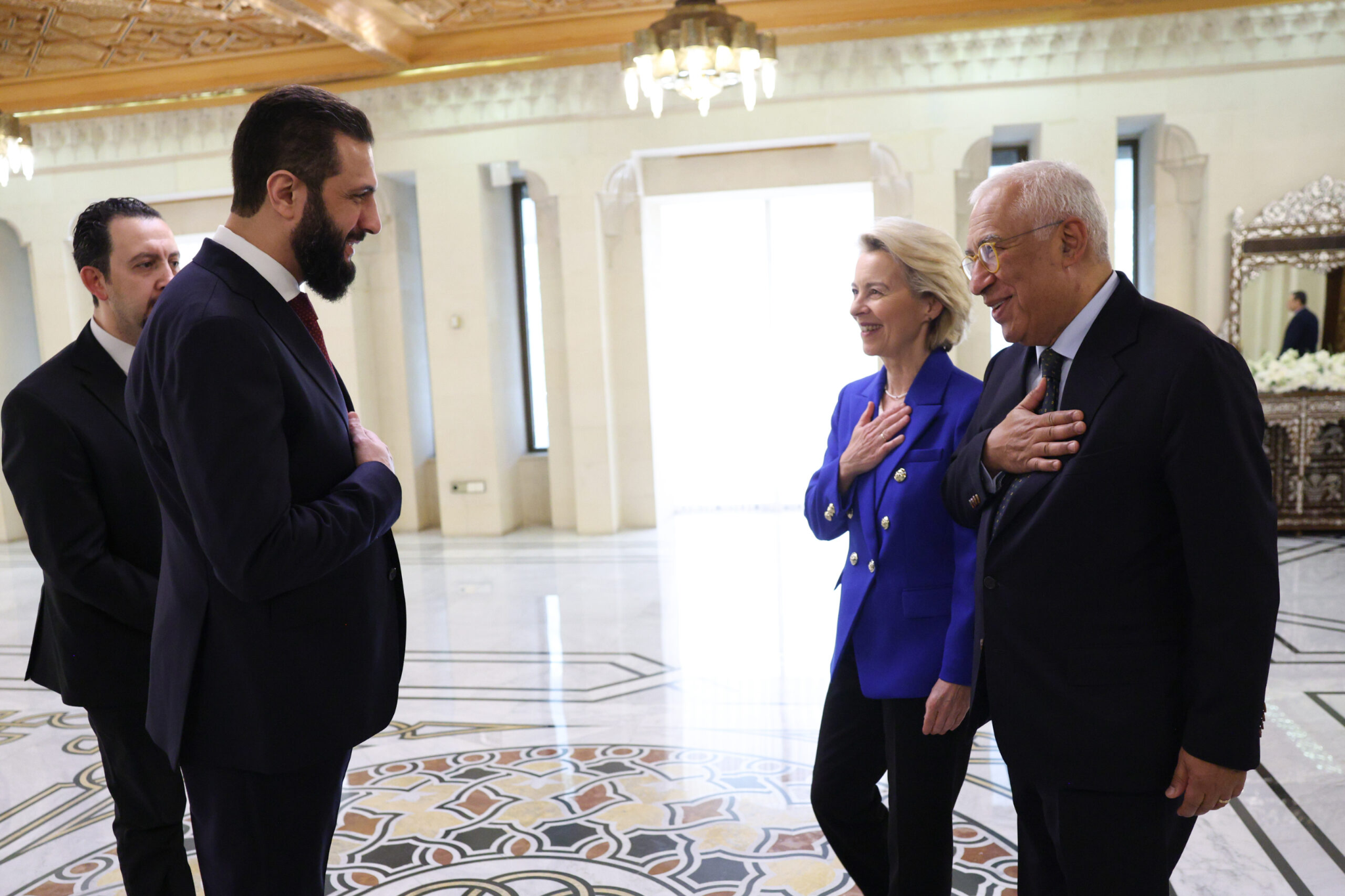
And over all of this, an international laundering unfolds. Last Saturday, Ursula von der Leyen, President of the European Commission, and Antonio Costa, President of the European Council, the two most senior figures of the EU, arrived in Damascus. They shook hands with al Sharaa, spoke of a new partnership, and announced an aid package of about 620 million euros. This happened while Aleppo was still burning. According to people who accompanied the visit, during that very visit al Sharaa stepped out for a few minutes to “deal with an urgent security matter”, and the instructions for continued pressure on the Kurdish neighbourhoods had already been issued. Anyone following Kurdish media that Saturday could see the result: dozens killed in a single day.
If Europe wanted to stop the atrocities, it needed one clear red line: money and legitimacy are not granted without a verified halt to violence and a personal price for decision-makers. In practice, the same leaders who, during the Gaza war, preached an immediate ceasefire and placed relentless public demands on Israel, now settle for “violence is concerning” and continue to hand out legitimacy and money. This is not a mistake. It is a choice. Without conditions, violence is not a glitch. It is part of the deal.
Here Israel enters the picture, not as the accused but as the mirror. More is demanded of it, and I demand more too, because here, in the state Israel holds itself to be, and demonstrably is, morality and rules bind even in wartime, and even when they carry a price.
The problem begins when that demand becomes an alibi, a convenient way for the world to feel moral without confronting those who shoot protesters and expel minorities in the name of security. This is the double standard no one likes to say out loud: Israel is the permitted target; Iran is “difficult”; Syria is “complex”; and Turkey is a “partner”. A double standard is not neutral. It is a prize for regimes, the Iranian, the Turkish, and the Syrian, for which any connection to human rights is not even incidental.
The world should not lower the bar for Israel, but raise it for itself. Israel lives under a magnifying glass, and rightly so, and acts accordingly. That is not weakness, but exactly why it is legitimate to demand more from it, and it is time to demand no less from the world.
—
An earlier version of this essay was published in Hebrew on Walla (Israel) on January 18, 2026, under the title “בין זכוכית המגדלת לסטנדרט הכפול: המחיר המוסרי של ‘היציבות’ במזרח התיכון”. This English version has been revised and updated by the author.