
One Thousand Days, and What Do You Get?
“You load sixteen tons, and what do you get? Another day older and deeper in debt” – chorus from the song “Sixteen Tons” by Merle Travis.
“The gods had condemned Sisyphus to ceaselessly rolling a rock to the top of a mountain, whence it would fall back of its own weight. They had thought for some reason that there is no more dreadful punishment than ceaseless and futile labor.” Albert Camus
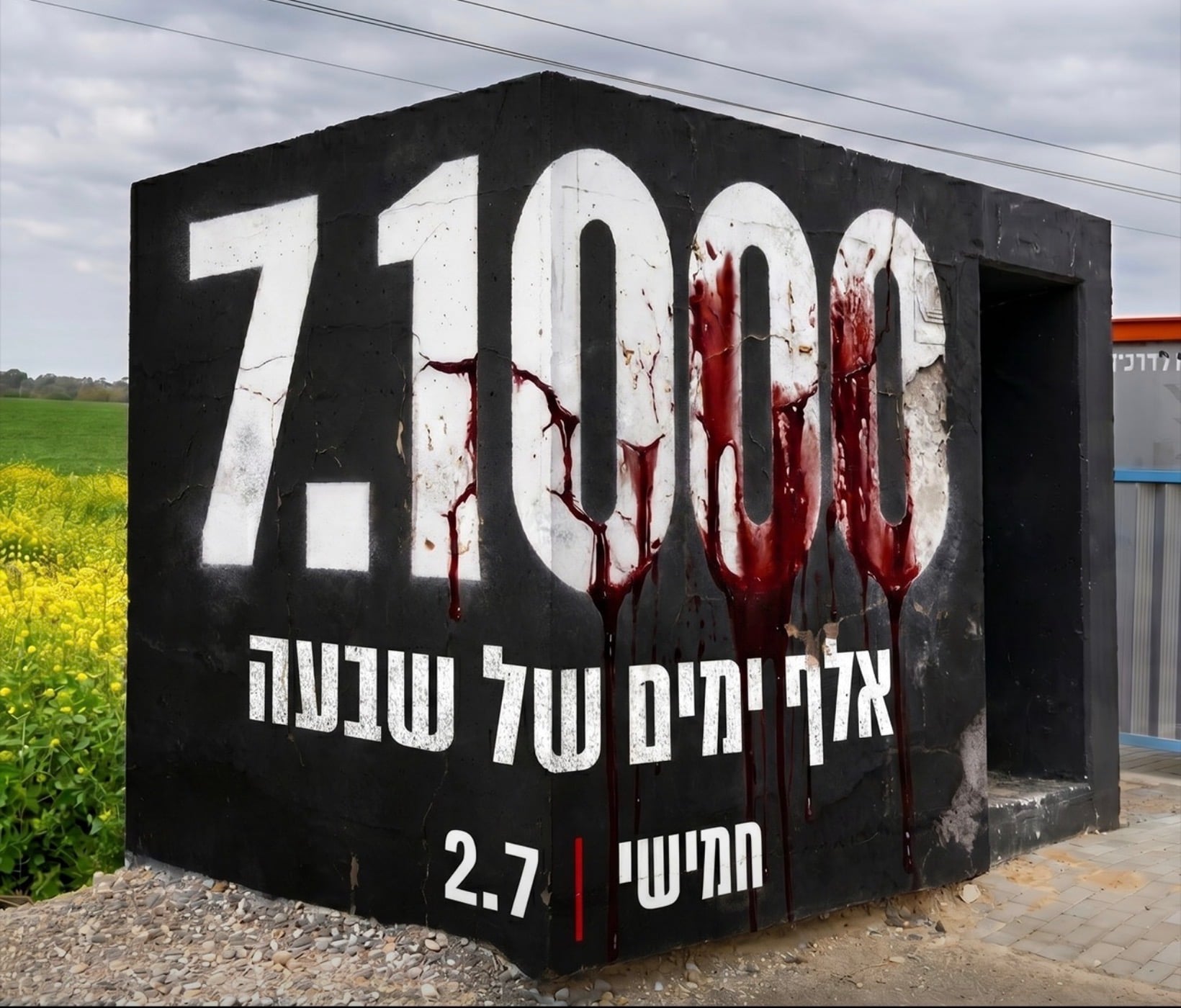
Friday, July 3rd, 2026, marks 1,000 days since October 7, 2023.
History
October 7, 2023, was the worst date in Israel’s history when a total of 1,195 people were killed, and 251 were taken hostage, as a result of Hamas-led terrorists crossing into Israeli territory from the Gaza Strip. This includes at least 828 civilians, including 36 children, 71 foreign nationals, and at least 367 members of Israeli security forces. 364 civilians were killed at the Nova Music Festival.
To this day, 1,000 days later, we still do not know exactly what happened, what systems broke down and failed, and who bears which responsibilities for the failure. Painfully, neither do we know exactly how many fatalities were due to friendly fire. The reason we do not know is that the Netanyahu-led government has consistently refused to allow for the appointment of an independent state commission of inquiry. In the interim, several security, intelligence, and military leaders have resigned, taking full responsibility for their roles in the failures that led to October 7. Not one government minister or politician has taken responsibility or accepted any blame for their role in leading to the failure and the accompanying loss of life.
Subsequently, Israel decided to go to war with Hamas and started what was to be a conflict that has not yet been resolved. A Trump administration-brokered ceasefire came into effect on October 10, 2025, after more than 2 years of war in Gaza. In this period, an estimated 67,000 – 75,000 Gazans were killed and 169,000 wounded. There is no breakdown of how many were combatants; estimates indicate that 56% were women, children, and the elderly. At least 466 IDF personnel were killed in Gaza in that period. More than 20,000 Israel Defense Forces (IDF) soldiers were injured in the conflict. According to the Israel Ministry of Defense, around 22,000 wounded soldiers were added to their Rehabilitation Department treatment program by late 2025, with nearly 58% of them suffering from mental health conditions. About 880 were severely injured, with the most critically injured suffering amputations, permanent paralysis, sustained irreversible gunshot, blast, or trauma. 132 soldiers are permanently wheelchair bound, 5 soldiers have suffered a complete loss of sight, and 64 soldiers have been permanently designated with a 100% disability. 66% of the injured are reservists, which has critically impacted their work and family lives. The total number of named dead Israeli security forces over the last 1,000 days is 1,039, including 969 soldiers and 70 police officers. This total of more than one death a day on average includes another soldier killed in Lebanon a few days ago.
Netanyahu declared two mutually exclusive objectives at the start of the war:
-
- Total victory, although this was never defined, and
- Release of all the hostages.
Subsequently, almost all the hostages were released as a result of negotiations. Tragically, three hostages who escaped were killed by Israeli forces while the escapees were attempting to surrender. Out of the 251 hostages taken during the October 7, 2023, attacks, 85 hostages died while in captivity or during the initial assault. It is still unknown how many hostages died as a result of the Israeli bombardment of Gaza.
To date, 1,000 days later, Hamas is severely diminished but remains the governing and controlling authority in the 40% of Gaza not controlled by the IDF. No official body, authority, or force has accepted the role of disarming Hamas and taking over the rule of the Gaza Strip. The Board of Peace (BoP), an international organization created under a UN Security Council framework and chaired by US President Donald Trump, has secured multi-billion-dollar pledges, commitments to the supply of peacekeeping troops from several countries, some construction, and brokered commitments for specialized relief aid. Despite these paper achievements, the BoP has yet to deliver any of the promised aid, governance, reconstruction, peacekeeping, or other commitments.
On the other hand, Israel continues to send humanitarian relief teams to far-flung disaster zones, as recently as the earthquake in Venezuela on 24 June 2026, while ignoring the crying need for humanitarian aid in its backyard, Gaza.
In the 1,000 days since October 7, 2023, Israel has gone to war twice with Iran, gone to war with Lebanon, which continues while Israel occupies Southern Lebanon, and conducted strikes in Syria while taking and continuing to hold parts of Syrian territory. Israel is also faced with another Iranian proxy, the Houthis in Yemen, who have sporadically launched missiles at Israel over the last 1,000 days.
A less prominent front and continuing war is in the West Bank. Currently, a reported 14,000 Israeli troops are deployed in the West Bank to provide security for more than 500,000 settlers and fight ongoing Palestinian violent resistance to the 59-year occupation. According to the UN Human Rights Office, in the Occupied Palestinian Territory, more than 1,000 Palestinians have been killed. One in five of the victims is a child, including 206 boys and 7 girls. The number also includes 20 women and at least 7 persons with disabilities. At least 59 Israelis have been killed in the West Bank and Israel in Palestinian attacks or armed clashes since October 7, 2023, including 16 women and 5 children.
The 1,000 days since October 7 have seen a marked increase in West Bank Jewish terror. Violence by extremist Israeli settlers against Palestinians in the occupied West Bank, denounced as “Jewish terrorism” by politicians and former Israeli security officials, has surged, with rights groups alleging that masked perpetrators operate in near-total impunity, with multiple reports of IDF forces observing but taking no action to halt the violence or arrest the perpetrators. Between January 2023 and mid-February 2026, at least 4,765 Palestinians from 97 locations have been displaced by settler violence, the UN’s humanitarian office says. Most were from Bedouin and herding communities in Area C. At the start of this year, 600 people were forced from one Bedouin village, Ras Ein al-Auja, in the Jordan Valley.
The damages to Israel’s image and standing in the world have been innumerable. Support for Israel in the United States has dropped to the point where 60% of Americans hold a negative or unfavorable view of Israel. Even more alarming is the age divide, where 70% of Americans aged 18-49 hold unfavorable opinions of Israel. This erosion of support has manifested in Congress. Resolutions to restrict or block specific arms sales to Israel have gained a record number of votes in the US Senate in recent months. The forthcoming midterms may result in a Democrat-controlled House or Senate, which would see a corresponding drop in support for Israel.
Internal support for Israel’s army, the IDF, has not diminished and probably increased during the 1,000 days of war. The 1,000 days of war have been a sharp departure from Israeli security doctrine, which historically has been marked by short wars taken to the enemy’s territory, with little to no impact on the home front. The last 1,000 days have been marked by many barrages of missiles and rockets from Iran and Hezbollah in Lebanon, most of which were intercepted, but some caused extensive damage, injuries, and deaths across Israeli urban centers.
On January 28, 2026, the United States and Israel launched a joint war against Iran without any consultation with or the support of any allies. The stated aims were: assassinate the regime leadership to create regime change, destroy Iran’s ballistic missile capability, and ensure Iran could never cross the threshold to manufacture nuclear arms. None of these aims have been met.
Israel went to war, ostensibly in partnership with the US. In reaction, Iran closed the Straits of Hormuz, an action that neither Israel nor the US anticipated or planned for. Closure of the Straits caused the price of oil to jump from $70 a barrel to $120. So too with the prices of natural gas, fertilizer, vegetable oils, jet fuel, and many other commodities dependent on materials shipped through the Straits of Hormuz.
The resulting impending domestic and international economic disaster, combined with a lack of international support, preceding the upcoming US midterms, left Donald Trump in a desperate position where he was forced to capitulate to the Iranian demands to open the Straits of Hormuz.
Israel’s gamble on regime change in Iran failed the moment the regime survived. Everything that has been destroyed can and will be rebuilt under a new leadership that is more conservative and extreme than the one it replaced. This leaves Israel strategically weakened and increasingly dependent on an American administration that has quickly shifted its priorities away from Israeli interests. The new US-Iran understandings, as laid out in the Memorandum of Understanding (MOU), are arguably no better than the JCPOA negotiated by Obama, which was summarily cancelled by Trump in 2018. Israel’s continuing military presence and engagement on multiple fronts are stretching the country’s manpower, economy, and diplomatic standing beyond sustainable limits. Added to that are the internal challenges of Haredi conscription and West Bank Jewish terror.
Under the present government, Israel initiated more than 200 new settlement points in the West Bank. Each of them requires additional military protection. Israel has taken more territory deep into Syria, expanding its presence from the Golan Heights. This requires more combat soldiers to occupy and hold the new territories. The present invasion of South Lebanon requires yet more combat soldiers, as does the continued occupation of 60% of Gaza. All of these continued military efforts have led to more days of reserve duty and the increased cry for conscription of the Haredim, who have been exempt till now.
Strikingly absent during the last 1,000 days have been any attempts to find non-kinetic, non-military means to resolve the multiple conflicts Israel finds itself embroiled in. The imposition by Trump of a Board of Peace, a ceasefire with Iran, and a ceasefire with Lebanon has been grudgingly accepted by Israel, but in the cases of both Gaza and Lebanon, the ceasefires are fragile and constantly breached by all sides. More recently, under the auspices of US Secretary of State Marco Rubio, Israel has signed a framework agreement with Lebanon, excluding Hezbollah. It is unclear how Hezbollah will react to the agreement or whether the Lebanese army will be able to ensure that Hezbollah withdraws from South Lebanon.
Conclusion
Israeli society is buckling under the stress and increased load. Road accidents are up, mental health providers are overwhelmed with new requests, and emigration of secular elites is increasing, with as many as 250,000 emigrating over the past three years. Millions are grappling with extreme trauma, severe PTSD, depression, domestic violence, and generalized anxiety as a result of direct violence, mass displacement, and prolonged conflict. This is not a sustainable situation.

Courtesy Wikipedia Commons
In short, Israel desperately needs to find a way to live in peace in the region in which it finds itself. 78 years of war have demonstrated over and over that while tactical military solutions can buy periods of peace, only negotiated political solutions can provide Israel with the peace and security it needs to survive. Without peace and security, Israel is doomed over the long term, as the human capital needed both for the economy and the military will flee for better and more secure options abroad. There are no long-term military solutions. Israel desperately needs to achieve negotiated solutions with Hamas, Hezbollah, Lebanon, Iran, Syria, the Palestinians, Saudi Arabia, and all the Arab states in the region. In the absence of negotiated, regional political solutions, the long-term outlook is bleak.
Further information on Gaza can be found at https://bearing-witness.com/ for evidence and testimonies concerning Gaza.