Operation Wings of Dawn: 600 Bnei Menashe returns
This month, the second phase of ‘Operation Wings of Dawn’ will facilitate the return of an additional 600 Bnei Menashe.
After years of waiting, trials, and tribulations, a lifelong dream is finally coming true.
While some people see their dreams fulfilled effortlessly, others find them dismissed as mere imagination or outright delusion.
In 1976, Tamar Helhing Haokip was only 10 years old when her family joined a group of Bnei Menashe pioneers in northeast India, embarking on a remarkable journey to revive Jewish traditions and embrace an Orthodox Jewish way of life.
The formative years of Jewish religious life were marked by both hardship and humorous misunderstandings as the community sought to adopt a culture about which they knew very little. In an era before the internet, their only windows to the outside world were the radio and newspapers.
After years of searching for a connection to the State of Israel, early community leaders finally succeeded in contacting Rabbi Eliyahu Avichail (1932–2015) and his organization, Amishav, which locates and assists descendants of the Ten Lost Tribes of Israel. Under Rabbi Avichail’s guidance, the Aliyah movement took root, and a handful of Bnei Menashe youths made their first homecoming in the early 1990s.
When Rabbi Avichail retired, a more dynamic, globally focused Jerusalem organization—Shavei Israel, founded and chaired by Michael Freund in 2002—carried the mission forward. Under Shavei Israel’s guidance, thousands of Bnei Menashe made Aliyah up until 2025, when the Israeli government approved the state-sponsored “Operation Wings of Dawn” to bring the remaining community of roughly 6,000 people to Israel by 2030.
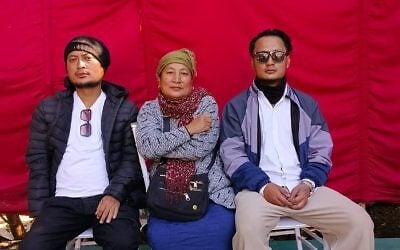
Yet amid this historic collective journey, the path traveled by Tamar Haokip remained clouded by uncertainty and hardship. In 1984, she married Yehuda Haokip, a chieftain of Ankhombung village in the remote Sadar Hills of Manipur. Tragically, her husband passed away in 2001, leaving their shared dream of returning to the Promised Land unfulfilled for her and their three sons and two daughters.
The first ray of Aliyah light shone in 2014 when her middle son and her eldest married daughter’s family were finally selected to make Aliyah. The separation between a widowed mother and her children is unimaginable, yet their love and longing for the Land surpassed every deep and painful thought. Mother Tamar felt a sense of relief and joy, comforting herself with the thought that her children’s homecoming was at least a partial fulfillment of her lifelong dream.
Although Tamar Haokip is the wife of a village chieftain, her family lived in Imphal, the capital city of Manipur. Roughly the size of Israel, this small state has long been plagued by political instability and periodic ethnic violence among its three primary groups: the majority Meitei, the Nagas, and the Kuki-Zo communities. In May 2023, a severe ethnic crisis erupted between the Meitei and Kuki-Zo populations, claiming hundreds of innocent lives. Driven by a complex mix of historical, territorial, economic, and political tensions, the conflict broke out into open violence on May 3, 2023.
On that fateful day, security forces evacuated Tamar and her family without prior warning from Imphal, the heartland of the Meitei people. As members of the Kuki-Zo ethnic group who belong to the Bnei Menashe community, Tamar and her family fled their lifelong home carrying only a few bags of belongings and religious items. They were initially placed in a heavily guarded displacement camp before eventually making their way to their ancestral village in the Sadar Hills a few days later.
After three years of uncertainty, hopelessness, and upheaval, the Israeli government’s historic plan to resume the immigration of the entire Bnei Menashe community within five years has come as a godsend for Tamar and her children.
As they had deeply hoped, they were selected for a personal interview conducted by dayanim (rabbinic judges)—a delegation sent by the Israeli rabbinical authorities. The screening was held in coordination with the Jewish Agency for Israel. Alongside many other families, Tamar and her two sons traveled hundreds of miles from Manipur to Aizawl, the capital city of Mizoram, for the interview. The selection process could not be held in Manipur, where the majority of the Bnei Menashe community resides, due to political instability, security concerns, and logistical challenges.
Tamar and her sons successfully passed the interview, leaving with comforting and hopeful words from the rabbis that they would soon meet in Jerusalem. Returning home, they eagerly awaited the day they would board a flight to the Promised Land. Before long, the long-awaited news arrived: they had been selected under the criteria for candidates who were displaced from their homes and had first-degree relatives in Israel.
However, after passing all document checks and clearances, issues arose with their names on the final list. When they inquired and filed complaints, they were told it was due to bureaucratic and clerical errors—an explanation that felt baffling and impossible to comprehend. Once again, Tamar and her sons missed the chance to fulfill their dream, left behind when the first wave of immigration under “Operation Wings of Dawn” took place in early 2026.
Overwhelmed by desperation and a quiet sense of shame, the family is left enduring the painful wait for a dream that remains out of reach.
Tamar and her children carry a heavy mix of grief and doubt in their hearts: Was Aliyah truly not meant for us? Yet, despite their hardships, they faithfully observe Shabbat and the Jewish festivals. Every Friday and on the eve of holidays, they travel 12 kilometers to Gamgiphai town, staying as guests in a friend’s home to keep the traditions alive.
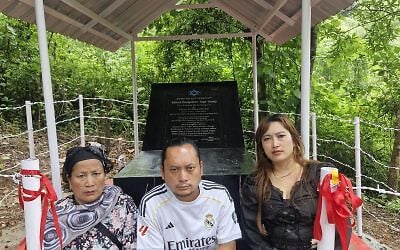
As life dragged on, yet another tragedy struck the Haokip family. On May 13, their youngest son, Rachem, passed away after weeks of medical treatment for hepatitis. He was laid to rest in the village graveyard beside his father—both of them having died with an unfulfilled yearning for Zion.
Why such relentless sorrow? Did they do something wrong to bring down a heavenly judgment that seemed to close every door of hope and prayer? Tamar and her children would have broken under the weight of it all, were it not for the comforting words of their children already in Israel, and the fragile, enduring belief that “Only God knows, and everything is His will.”
When autumn arrived, Tamar received new word from the Jewish Agency that her family had been shortlisted for the upcoming Aliyah in November. Having been through this before, the news stung, and she took it with a grain of salt. Still, for the second time, the Haokip family began making all the necessary arrangements. In their final days, they shared joyful yet emotional farewells with their community, friends, and relatives. Once all government legal documents were finalized, a traditional ceremony was held at the village chief’s house to formally hand over the chieftainship to their closest kin.
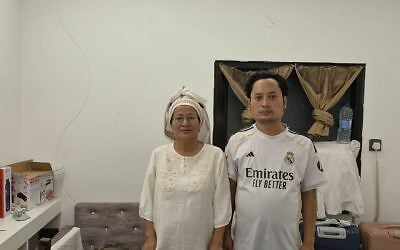
After years of anguish and waiting, Tamar and her eldest son, Chaim, took an early flight to New Delhi for medical treatment. While there, they stayed at the apartment of her daughter, whose family was not yet ready to make the move to Israel.
Finally, Tamar and her son have reached their last stop in India. They have joined the other families at the transit hotel arranged by the Jewish Agency in Mahipalpur, Delhi. It is finally happening! For so long, this was just a dream on a vision board. Now, the bags are packed, and this week, on 18th November, the first charter flight of the second phase of “Operation Wings of Dawn” will carry them to the promised land they call home.
Tamar knows the road ahead will be full of challenges—a new language to learn (let alone master!) and plenty of adjustments. Yet, her heart is overflowing with joy knowing that her grandson Asaf, who was just seven months old when he made aliyah, will celebrate his bar mitzvah in two weeks, on November 28th. Soon, there will be a joyful family reunion at Ben Gurion International Airport, filled with warm embraces that are nothing short of a blessing.
Tamar Haokip’s personal story is a microcosm of the dreams and thousands of years of yearning shared by so many Bnei Menashe women. It is a guiding light on an individual’s journey toward destiny.
Tamar is about to begin a new chapter of her life, carrying the memories of the loved ones who could not make it to the Promised Land in her heart forever. As she completes this leg of her journey, she holds onto the comforting truth that she made it—for her son, and for her husband.