Historian, Librarian, Educator, and Artist
OTD in History… October 7, 2023: The Day That Divides Time
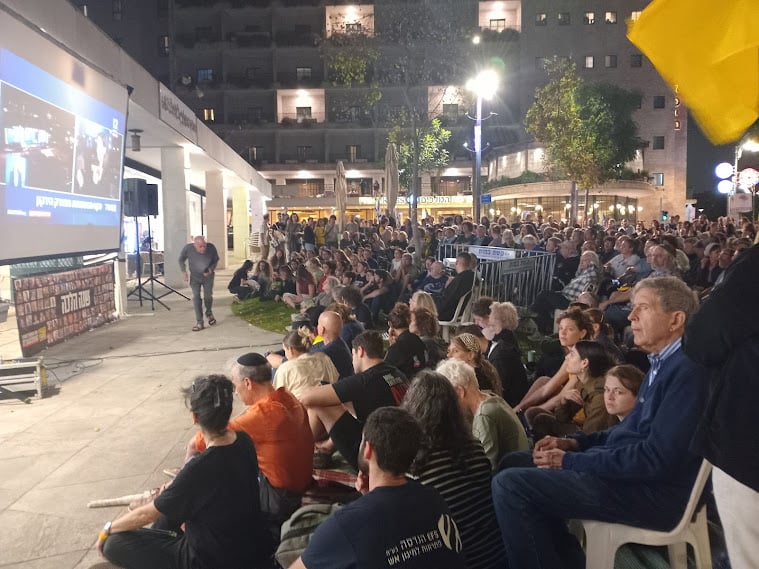
A October 7 memorial in Jerusalem, 2024. (Photo: Bonnie K. Goodman)
Two years after the Hamas massacre, Israel and world Jewry continue to fight for memory, unity, and moral clarity.
Introduction
Of all the dates I have written about in this On This Day in History series, October 7, 2023, remains the most personal and the most painful. It is not an event confined to the past; it continues to shape the present and test the moral conscience of the world.
On Simchat Torah, the Jewish festival of joy, over a thousand Hamas terrorists invaded Israel by land, sea, and air, crossing from Gaza and attacking simultaneously at multiple locations. Their targets included kibbutzim, border towns, and the Nova Peace Festival, a site that became a killing field. According to the official record of the Government of Israel, more than 1,400 people were murdered, over 5,500 wounded, and 251 hostages taken into Gaza.
The attack was the deadliest day for Jews since the Holocaust. Israeli President Isaac Herzog declared, “Today we saw the true face of Hamas, a terrorist army whose only goal is the cold-blooded murder of innocent men, women, and children.” (Government of Israel 2023)
October 7 shattered the sense of safety that Israelis had believed was secured after decades of conflict and defense. It also exposed the fragility of moral clarity in the international arena.
Bearing Witness as Historian
The task of the historian is not only to record but to discern. October 7 was not a battle between two armies; it was a massacre of civilians, a deliberate act of terror against the Jewish people and the State of Israel. The evidence — videos, eyewitness testimonies, military and forensic reports — documents atrocities that defy language. Families were slaughtered in their homes. Infants were burned. Women were raped and mutilated. Entire communities were erased in hours.
For a brief moment, the world recognized the horror. International leaders condemned Hamas and expressed solidarity with Israel. Within weeks, sympathy began to erode. The global conversation shifted from compassion to accusation. Israel, the victim of unprovoked terror, was recast as the aggressor. The same world that mourned with Israel on October 8 began to protest against it by November.
This reversal revealed a truth as disturbing as the attack itself: the persistence of antisemitism as a moral blind spot of civilization.
The Resurgence of Antisemitism
Following October 7, Jewish communities worldwide faced the most severe surge of antisemitism in modern memory. The Anti-Defamation League reported a 388 percent increase in antisemitic incidents in the United States in the three months after the attack, including harassment, vandalism, and assault (ADL 2024).
Deborah Lipstadt, United States Special Envoy to Monitor and Combat Antisemitism, defines antisemitism as “hatred of Jews simply because they are Jews.” She observes that it “arises independently of any action by Jews” (Lipstadt 2019). Her warning became reality. Within weeks of the massacre, Jewish students were intimidated on university campuses, synagogues were defaced, and the Star of David was turned into a target once more.
Lipstadt has described this phenomenon as a “weaponization of antisemitism,” in which hatred is disguised as political critique but reproduces ancient conspiracies (Columbia SIPA 2024). The shift from empathy to hostility after October 7 exposed the ideological reflex that equates Jewish self-defense with aggression.
President Isaac Herzog later warned that “since October 7, this hatred has surged into a terrifying threat — from the streets of Europe to the campuses of North America.” (Times of Israel 2025) His statement echoed what Jewish history has long taught: antisemitism does not vanish; it adapts.
Sanctuary and Memory
The second anniversary of October 7 fell close to Yom Kippur 5786. The confluence of the Hebrew and secular calendars transformed this year’s observance into a national act of mourning.
At my synagogue in Jerusalem, the Neilah service — the final prayer of Yom Kippur — was sung to Naomi Shemer’s “Lu Yhi.” The song, composed during the Yom Kippur War of 1973, pleads for peace and endurance. Its refrain, “Let it be,” carried across the congregation as both lament and hope: let it be that the hostages come home, let it be that Israel endures.
On Erev Shabbat, the same melody was used for Lecha Dodi. The familiar words — “Come, my beloved, to greet the bride” — were sung with a depth that came from loss. The sanctuary became both a house of prayer and a memorial hall.
During Yizkor, the names of the fallen were read aloud — soldiers, civilians, and victims of terror. The list of the dead included those murdered on October 7 and those who died in the war that followed. Each name was followed by silence. The silence carried more meaning than words could contain.
Jewish prayer transforms history into liturgy. On this Yom Kippur, melody and memory converged. The choice of Lu Yhi was not aesthetic but theological: an affirmation of hope amidst despair. It linked the trauma of 1973 to the trauma of 2023 and declared continuity.
From Gaza to Manchester
The wave of antisemitism unleashed after October 7 reached far beyond Israel. Across the United Kingdom, France, Germany, and North America, Jews once again faced threats to their safety. The normalization of antisemitic slogans and imagery within “anti-Israel” protests emboldened those inclined toward violence.
On October 2, 2025, during Yom Kippur, terror returned to Europe. A man drove a car into worshippers outside Heaton Park Hebrew Congregation in Manchester, England, then exited the vehicle wielding a knife. The assailant, identified as Jihad al-Shamie, 35, a British citizen of Syrian origin, wore what appeared to be an explosive belt. Police shot and killed him at the scene after he murdered two congregants, Adrian Daulby (53) and Melvin Cravitz (66). Three others were wounded, some by stabbing, others struck by the vehicle (Reuters 2025).
Greater Manchester Police confirmed that Operation Plato, the emergency protocol for suspected terror incidents, had been activated. Investigators later revealed that al-Shamie’s father had publicly praised Hamas and the October 7 massacre (Times of Israel 2025b).
The attack was declared an act of terrorism. It occurred almost exactly two years after October 7, during the same High Holy Day season, and carried the same ideological message: hatred of Jews as Jews. The Board of Deputies of British Jews called it “a desecration of Yom Kippur and of human decency.”
The Community Security Trust (CST) reported that the United Kingdom had already recorded over 4,000 antisemitic incidents in the previous year, the highest total in its history (CST 2025). The Manchester attack confirmed what many feared: that antisemitism, inflamed by the inversion of Israel’s victimhood, had become normalized violence.
Global Remembrance and Solidarity
The second anniversary of the October 7 massacre was not observed in Israel alone. Jewish communities across the diaspora — from Paris to Sydney to New York, from London to Buenos Aires — held memorial gatherings and candlelight vigils to honor the victims and call for the return of the hostages. At each event, the same images recurred: rows of candles, flags, photographs of the murdered, and silent crowds reciting Kaddish together.
In Trafalgar Square, London, hundreds gathered for a public memorial organized by British Jewish groups. The Jerusalem Post described a woman weeping as names of the dead were read aloud — a moment emblematic of what it called a “worldwide commemoration of shared grief and unity.” Similar scenes unfolded in Paris, Sydney, and New York City, where synagogues held Yizkor services and projected the faces of the hostages on their facades. These ceremonies took place amid a documented rise in antisemitism and renewed anxiety for Jewish safety abroad.
Participants carried banners declaring “Am Yisrael Chai” — the people of Israel live — a simple affirmation of survival that transcended geography. The article concluded that “two years after October 7, the Jewish world remains bound by grief, faith, and defiance.”
The Moral Reckoning
October 7 demanded moral clarity. The evidence of atrocity is undeniable. The perpetrators recorded their own crimes. Yet the months that followed revealed how ideology can obscure truth. The narrative of resistance replaced the reality of massacre. International institutions hesitated to condemn Hamas while accusing Israel of genocide. Universities that claim to value human rights refused to name terror when it targeted Jews.
Antisemitism reappeared not as marginal rhetoric but as acceptable dissent within elite discourse. Historians and journalists have seen this inversion before. During the 1930s, moral relativism allowed Europe to avert its gaze from rising hatred. Today, the same reluctance to judge has reemerged under the vocabulary of “complexity.”
The role of the historian is to preserve the distinction between complexity and distortion. Complexity acknowledges context; distortion erases causality. The cause of the war that began on October 7 was Hamas’s decision to wage genocidal violence. The consequence was Israel’s right to defend its citizens.
The historian’s responsibility is to assert these facts without equivocation.
A Date That Divides Time
October 7 is not only a national trauma but a historical marker. It divides time in the same way that September 11, 2001, and the Yom Kippur War of 1973 did. Before October 7, Israelis lived with the illusion of security; afterward, that illusion vanished. For Jews worldwide, it ended the belief that antisemitism had been relegated to history.
The memory of that day now forms part of the Jewish calendar of mourning, alongside Tisha B’Av and Yom HaShoah. Its observance is not yet formalized, but its place in collective memory is assured.
Remembrance is an act of moral resistance. In an era when truth is negotiable, memory must remain absolute. As Elie Wiesel wrote, “To forget the dead would be akin to killing them a second time.” The duty to remember October 7 is both historical and ethical.
President Herzog described it as “our generation’s moment of truth.” He added, “We will not forget. We will not forgive. We will not let the world forget who started this war.” (Government of Israel 2024)
Conclusion
October 7, 2023, is not only a day of mourning but a test of moral endurance. Two years later, Israelis and Jews everywhere continue to live within its shadow. The hostages remain symbols of a world divided between those who remember and those who choose to forget.
The task of history is to defend memory against distortion. The task of conscience is to ensure that compassion does not yield to cynicism. The Jewish people have faced exile, destruction, and denial before. Survival has always depended on the preservation of truth.
As historian Gil Troy observed, “We in Israel, Left and Right, fight proudly together, without kowtowing or breast-beating; affirming life, even in these days haunted with death.” (Troy 2023) His words capture the spirit of unity and defiance that continues to guide Israel’s recovery from tragedy.
The prayer that ended Neilah — Lu Yhi — echoes that faith. Let it be that we remember. Let it be that the hostages return. Let it be that Israel lives.
—
Sources
ADL (Anti-Defamation League). 2024. “Antisemitic Incidents After the Attack on Israel.” ADL Research Report. https://www.adl.org/resources/reports/antisemitic-incidents-after-attack-israel
Columbia University School of International and Public Affairs (SIPA). 2024. “Ambassador Deborah Lipstadt Discusses How Antisemitism Threatens Democracy.” https://www.sipa.columbia.edu/news/ambassador-deborah-lipstadt-discusses-how-antisemitism-threatens-democracy
Community Security Trust (CST). 2025. Antisemitic Incidents Report 2024. London: CST. https://cst.org.uk/news/blog/2025/02/06/antisemitic-incidents-report-2024
French Interior Ministry. 2025. “Antisemitic Acts in France Rose by 300% Since October 7.” Reported in France 24, January 15, 2025. https://www.france24.com/en/france/20250115-antisemitic-acts-in-france-rose-300-since-oct-7-attack-on-israel
Government of Israel. 2023. “Statement by President Isaac Herzog.” October 7. https://www.gov.il/en/departments/news/statement-by-president-isaac-herzog-7-oct-2023
— — — . 2024. “President Herzog Statement on October 7 Anniversary.” https://www.gov.il/en/departments/news/president-herzog-statement-october7-anniversary
Lipstadt, Deborah E. 2019. Antisemitism: Here and Now. New York: Schocken Books.
Reuters. 2025. “UK Police Name Victims of Manchester Synagogue Attack.” Reuters World News, October 3. https://www.reuters.com/world/uk/uk-police-name-victims-manchester-synagogue-attack-2025-10-03
Times of Israel. 2025a. “Herzog Tells Jewish Leaders Post-October 7 Antisemitism ‘Surged into a Terrifying Threat.’” March. https://www.timesofisrael.com/herzog-tells-jewish-leaders-post-oct-7-antisemitism-surged-into-a-terrifying-threat
— — — . 2025b. “UK Synagogue Attacker Was Under Investigation for Rape; His Father Praised Hamas for October 7.” October 4. https://www.timesofisrael.com/uk-synagogue-attacker-was-under-investigation-for-rape-his-dad-praised-hamas-for-oct-7
Starr, Michael. Jewish communities commemorate October 7 Massacre’s second anniversary worldwide. The Jerusalem Post, October 6, 2025. https://www.jpost.com/diaspora/article-869562
Troy, Gil. 2023. “Israel Stopped Apologizing on October 7.” Jerusalem Post. December 27, 2023. https://giltroy.com/uncategorized/israel-stopped-apologizing-on-october-7-opinion
Wiesel, Elie. 2006. Night. Translated by Marion Wiesel. New York: Hill and Wang.
Related Topics