


Our Old-New City
Our tour guide Eli stood before us in the public garden we had come to visit. He spoke slowly, each word distinct, perhaps because he knew we were ulpan students learning Hebrew. I’m sure I was not the only one who thought, “If more Israelis spoke this way, we might understand them better, or at all.”
The tour site was a cooperative neighborhood garden, adjacent to but separate from the Museum of Natural History.
“Nowadays Jerusalem has many cooperative gardens like this one,” said Eli. “But when we started, there were no others. That was 22 years ago.”
22 years ago! For a landmark in an ancient city, that hardly seemed like a long time.
Herzl called his visionary novel about a reborn Jewish state Altneuland, Old-New Land: a land with ancient roots, yet brand-new. We live in an old neighborhood in this ancient city, but much of what one comes across here, even if it looks old, is really pretty new. And I am not talking about the flocks of cranes putting up luxury skyscrapers or the work teams laying beds for light-rail tracks all over the place.
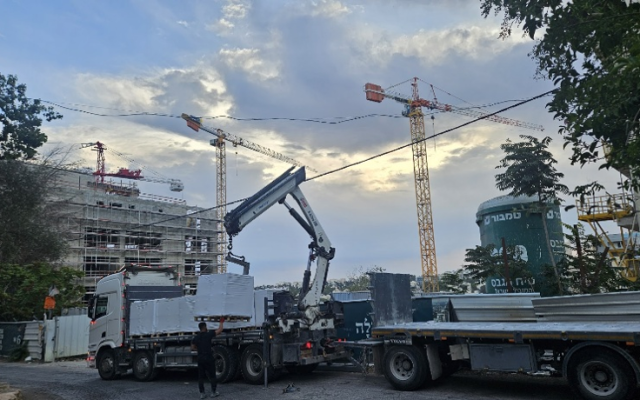
For instance: we live in what is considered an old building, far too old to have a ma’amad, a reinforced safe room. Those were not mandated till 1993. Our apartment house was built all the way back in 1971.
By comparison, the house we used to live in, in Massachusetts, was put up as an afterthought, for the gardener of the grand house next door that dates from 1915. Our house was built in 1937. Did we move to an Old City or from one?
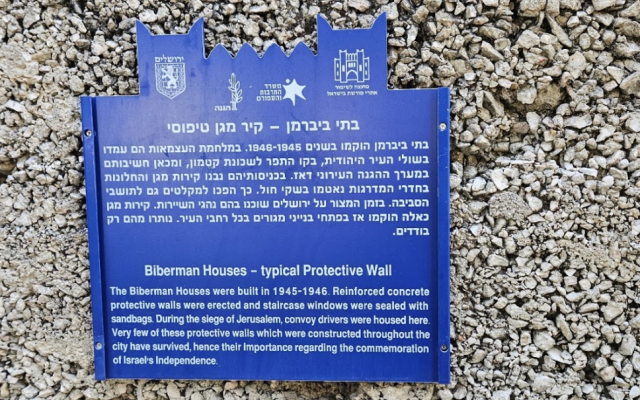
The flat we formerly rented here was, by Jerusalem standards, really old, built in the mid-1940s. Remnants of concrete reinforcement walls remain; they were added for protection during the War of Independence, in 1948. All the streets around our current neighborhood are named for military units from that era: Ha-Tayasim, the pilots, Ha-Khish, the Field Corps, Kheil Nashim, the Women’s Corps, Ha-Gedud Ha-Ivri, the Jewish Legion of the British army during WWII.
In comparison, many streets in our US town–Fenno Road, Pulsifer Street, Bothfeld Road–were named for town mayors from the late19th century: older, maybe, but fully irrelevant to current inhabitants.
So: What’s old and what’s new? Which past is pertinent to the present and which is not?
On Yom HaZikaron, the Day of Remembrance that precedes Yom Ha’Atazma’ut, Israel’s Independence Day, one commemoration takes place right around the corner from us, near the local monastery, San Simon. A pivotal battle took place there in 1948, one whose outcome was far from assured at the time, and which shaped the present contours of the neighborhood and the city in ways that would have been very different had the battle turned out otherwise. 1948–not really so long ago.
***
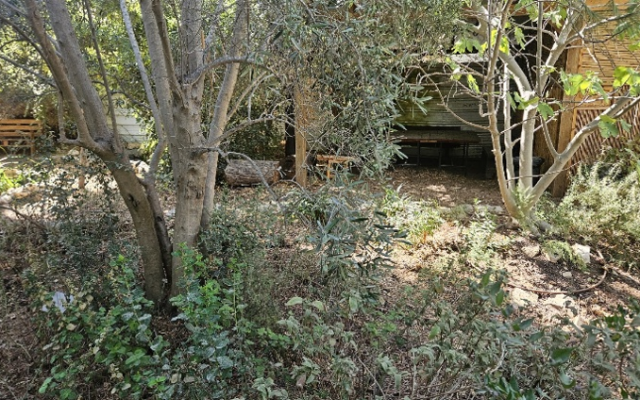
The community garden Eli took us around includes a pond, once dry and now rebuilt and stocked with fish, as well as several examples of local flora. One of those is a male (!) mulberry tree. (I couldn’t tell by looking.) Eli explained that this tree was allowed to stay, whereas a female tree would have dropped mulberries all over the place and forced the gardeners to clear out many surrounding plants unless they uprooted the tree.
One of the garden’s signs describes an “Exhibition of Pictures of Jerusalem Trees.”
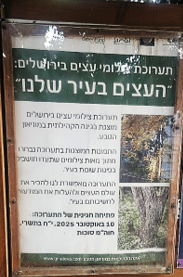
The third paragraph of text reads: This exhibition makes it possible for us to recognize the world of trees and to raise awareness of their importance in the city.
Eli spelled out some of the goals he and his neighbors had for their community garden: a quiet refuge from urban bustle, a cause to bring neighbors together, a boost for environmental awareness. But he also hinted at a deeper motive: to be familiar with “The Trees in Our City.”
In part, then, this is about roots—the trees’ and ours. In other words: indigeneity.
Of course. We live in a region where the Holy Temples of our Tanach and our tefillot are dismissed by some as figments, where the Jewish connection to the Land of Israel is scorned in some circles as imaginary, invented by settler-colonialists with aboriginal pretensions. Our world includes Israeli restaurants that are picketed or vandalized for the sin of cultural appropriation of falafel and za’atar.
Nathan Slifkin, the “Zoo Rabbi” who founded the Biblical Museum of Natural History in Bet Shemesh (right near IKEA!), devoted his recent book, The Lions of Zion, to document the animal species mentioned in Tanach, in part, as he says explicitly, to counter assertions that Jews never lived around here. He cites polemics making such claims, and disputes them.
Even more than arguments from archeology, battles over animal and plant life over indigeneity often get muddled.
Take the sabra, for instance. Israelis have chosen the sabra cactus as a national symbol, epitomizing Israelis–prickly on the outside, soft on the inside. Opponents dispute this: they had sabras first!
So guess where Sabra cactuses actually originated? Mexico!
There are no cacti native to Palestine or anywhere nearby, explains Slifkin. All the prickly-pear sabras that grow in Palestine came from a stock brought in from the Americas around two centuries ago for planting as natural fences.
The public garden is a short walk from our place. It offers a quiet retreat from bustle, honking, polemics. We can rejoin stress and stridency later. They will still be there.
Old story.