


Our Sicilian Adventure
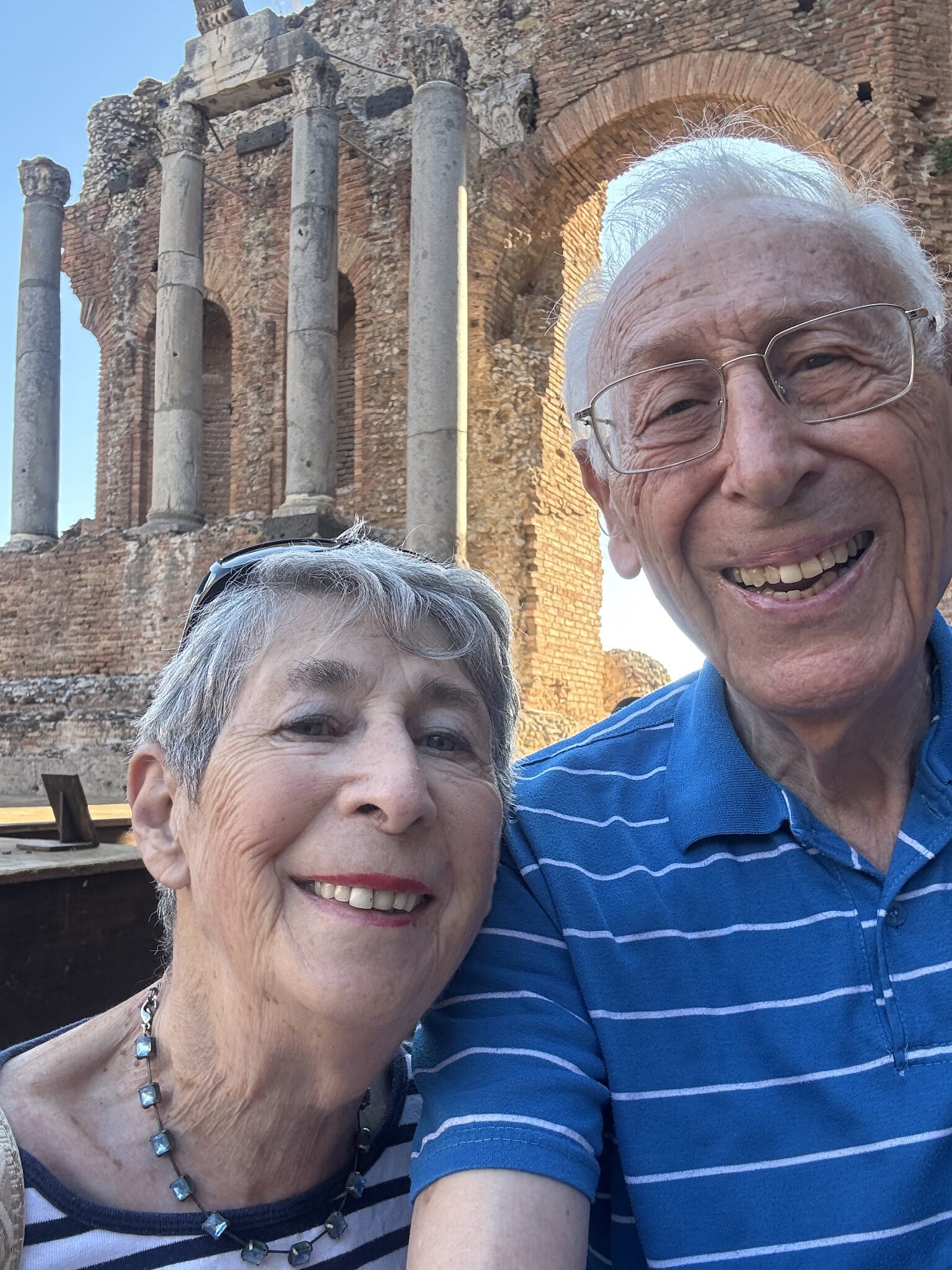
The trip we had planned to celebrate our sixtieth wedding anniversary (an achievement not to be sneezed at) did not get off to a good start. The Catania airport, where we were supposed to land, was closed because of its proximity to the Etna volcano, which had just erupted. This entailed delays and alternative routes which prevented us from reaching the hotel we had booked in Catania and obliged us to spend an unexpected night in Rome, before embarking for Palermo, the Sicilian capital, a long way away from our destination.
From Palermo airport we were able to take a shared taxi to Catania, an expensive three-hour journey in an inelegant vehicle with poor suspension in the company of seven other passengers. When we eventually reached our hotel (another taxi ride from Catania airport) we were astounded to find that the ‘hotel suite’ we had booked involved climbing sixty-six steps up an ancient stone staircase. The hotel manager explained that the buildings of the town are all protected and no changes can be made or elevators installed.
In its long and checkered history, the island of Sicily has been occupied in turn by the ancient Greeks, the Romans, the Byzantines, the Arabs, the Normans, and various other nations until in the 1880s it became part of the independent state of Italy. Each occupier left their mark, for good ot for ill, and the island is essentially a reflection of the various stages of Western civilization.
Catania itself is a lively town on Sicily’s eastern coast and, like most Sicilian towns, is full of historic buildings, impressive sculptures, fountains and a lively nightlife. At night the streets are strewn with fairy lights and people walk about or sit in the many restaurants and cafes. One of its streets is called Aetna Street, and from it one can see the volcano. From Catania we took a tour to Agrigento, a destroyed town which was once part of the ancient Greek empire, and now all that remains of it is a few crumbling walls and several ancient temples in various states of preservation. One of these, known as the Temple of Concordia, was converted to be used as a church in the sixth century C.E. and so is better preserved and bears a strong resemblance to the Parthenon in Athens.
Our next stop was the hill-top town of Taormina, with its stunning views down the hillside to the sea below. Here, too, the Greeks and Romans left their mark, with an impressive amphitheatre where plays were performed and gladiatorial spectacles staged. The narrow streets are full of tourists from every part of the globe who seem to be determined to get to the next restaurant or café, of which there are many. We made our own little excursion from Taormina, taking an intercity bus to the town of Messina, further along the coast. From the window of the bus we were treated to beautiful views of the coast and the sea, and in Messina itself we made a bee-line for the museum, which holds two paintings by Caravaggio.
We ended our stay in Sicily with a week in a rural retreat not far from Siracusa (ancient Greek Syracuse). In a tree-shaded area containing several small buildings, each one with one or two small apartments, we were treated to a lavish Sicilian breakfast and the attentions of our host, Vincenzo and his loyal staff. The area contains a large swimming pool but has no dining facilities and is far away from the restaurants that line the beach. Although Vincenzo kindly ordered pizza for us and even went to collect it a couple of times, we had no option but to rent a car so that we could go and have lunch. Our favourite restaurant, Zia Adatino, is situated right on the beach and provides an enchanting vista over the nearby villages and Siracusa itself. It serves delicious food as well as the best Tiramisu I have ever eaten.
Siracusa also contains a Greek and a Roman amphitheatre, an archaological museum with extensive expanses of cabinets displaying a seemingly endless array of ancient pottery and other priceless archaeological artefacts, and a church displaying another painting by Caravaggio.
The Sicilians we encountered were almost invariably kind, helpful and friendly, including when we said that we were from Israel. Sicily itself is a beautiful Mediterranean region full of history, art, architecture and archaeology. We found ourselves overwhelmed by the wealth of its treasures and only wished we had the strength and energy needed to be able to see everything.