Our Yevamot Moment
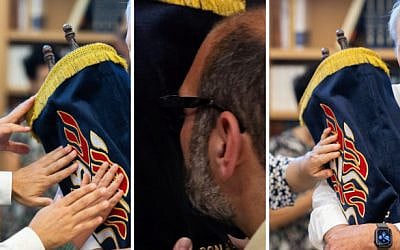
My wife and I recently donated a Torah to Kibbutz Merom Golan, a secular kibbutz founded 58 years ago. In a remarkable series of developments, the kibbutz has recently built a synagogue, begun a series of shiurim, and now owns its first Sefer Torah.
After thanking the members of the kibbutz for their desire to receive the Torah and for accepting our gift, and the JNF-USA for introducing us to the kibbutz, I made a few remarks aimed at underscoring the significance of the moment.
Here’s what I said.
We commissioned the writing of this Torah and are donating it in honor of our 50th wedding anniversary — but that is not the only reason. Our anniversary is not the only thing that motivated us.
Let me explain.
Rav Avraham Yitzchak Kook, the first Chief Rabbi of the Yishuv — the predecessor to the modern State of Israel — asked a question that remains particularly relevant to us today. In the early 1930s, Rav Kook wondered why Seder Nashim, the section of the Talmud focusing on family law, begins with Masechet Yevamot.
Yevamot covers many topics, but its primary focus is the laws of Yibbum and Halizah — the laws governing Levirate marriage. Yevamot explains when and how a woman is obligated to marry her deceased husband’s brother.
Rav Kook’s question was both poignant and straightforward: why does the Talmud begin the discussion of family law with a marriage that ends in tragedy?
Wouldn’t it be more appropriate to follow the family lifecycle? Wouldn’t it have been more logical to start with Masechet Kedushin, which discusses the laws of marriage?
According to Rabbi Shlomo Carmy, who has studied Rav Kook’s works, Rav Kook looked beyond the details of individual laws and answered his question with deep insight: the rabbis placed Masechot Yevomot first in Seder Nashim to emphasize the importance of family and to demonstrate that even when the usual structure breaks down, the Torah is there to help reassemble it. His chidush — his insight — is worth repeating: even when the usual structure falls apart, Torah is there to help put it back together.
Rav Kook’s insight is deeply rooted. The story of Yehuda and Tamar, told in Sefer Bereshit, centers on Levirate marriage and teaches lessons about responsibility and protecting the family unit. This story is foundational; it took place long before Matan Torah at Sinai and well before the rabbis of the Talmud discussed the order of Seder Nashim. Yibbum also plays a key role in the story of Ruth and the subsequent birth of David HaMelech — in this case, it’s a story about healing a family, an act that greatly influenced the future of Am Yisrael.
Rav Kook was different from many rabbis of his time: famously, he saw holiness where others did not. He saw Orot HaKodesh, holy light — which is the title of a collection of his essays — shining on all who have good character because, in his words, “every good character trait and derech eretz is part of the Torah.” Therefore, he reasoned, everyone with good character possesses the qualities of a Torah-observant Jew. That, too, deserves repeating: everyone with good character possesses the qualities of a Torah-observant Jew.
He believed that people should, in his words, “follow their inner inclination.” Orot HaKodesh shines equally on a person working as a shoemaker in Haifa, a machine operator in Be’er Sheva, and a rabbi studying holy texts in Jerusalem. Rav Kook visited all types of people throughout the country to offer support and encouragement.
I’m confident he would have come here in July of 1967 when you established Kibbutz Merom Golan. He would have offered support and encouragement, and he would have congratulated you on your initiative, chutzpah, and your Orot HaKodesh.
Today, Orot HaKodesh is clouded by hatred, bias, and lies. But as Rav Kook and the rabbis of the Talmud demonstrated through the placement of Masechet Yevamot, the Torah is there for us in this very situation: a time when the usual structure has broken down; the Torah is there to help us rebuild it.
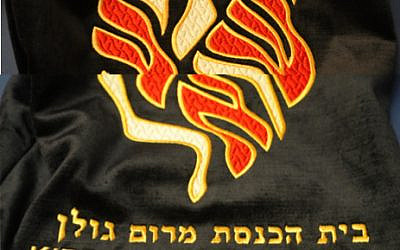
That’s why we commissioned the writing of a Sefer Torah — we believe the world needs more Torah and Torah-based wisdom. And it needs it now.
Yes, we were inspired by our 50th wedding anniversary, but we are here today because we are responding to the call of family — the family of Klal Yisrael. The family of Am Yisrael. And because this is our Yevamot moment.
This is our Yevamot moment, a time when we should look to the Torah and to Torah-wisdom to rebuild what is broken.
This is our Yevamot moment, a time to acknowledge family with the priority it deserves and a time to seek the Orot HaKodesh that is in front of us.
Yes, this is our Yevamot moment.
I’ll conclude with the words Moshe Rabbeinu spoke whenever the Torah was carried in the desert — words you will say when you read from your Torah in HaBeit Knesset Merom Golan:
קוּמָה ה’ וְיָפֻצוּ איְבֶיךָ. וְיָנֻסוּ מְשנְאֶיךָ מִפָּנֶיךָ
Arise, Hashem, and may Your enemies be scattered.
May those who hate You flee before You.
May Moshe’s words and your new Torah be a bracha for you here in Kibbutz Merom Golan, for the hostages whose release we anxiously await, for everyone here in Israel, and for Am Yisrael worldwide.
Thank you.