

Where history exposes power and moral failure
Outposts: Nothing Here Is Yours – An Intervention Into Dispossession
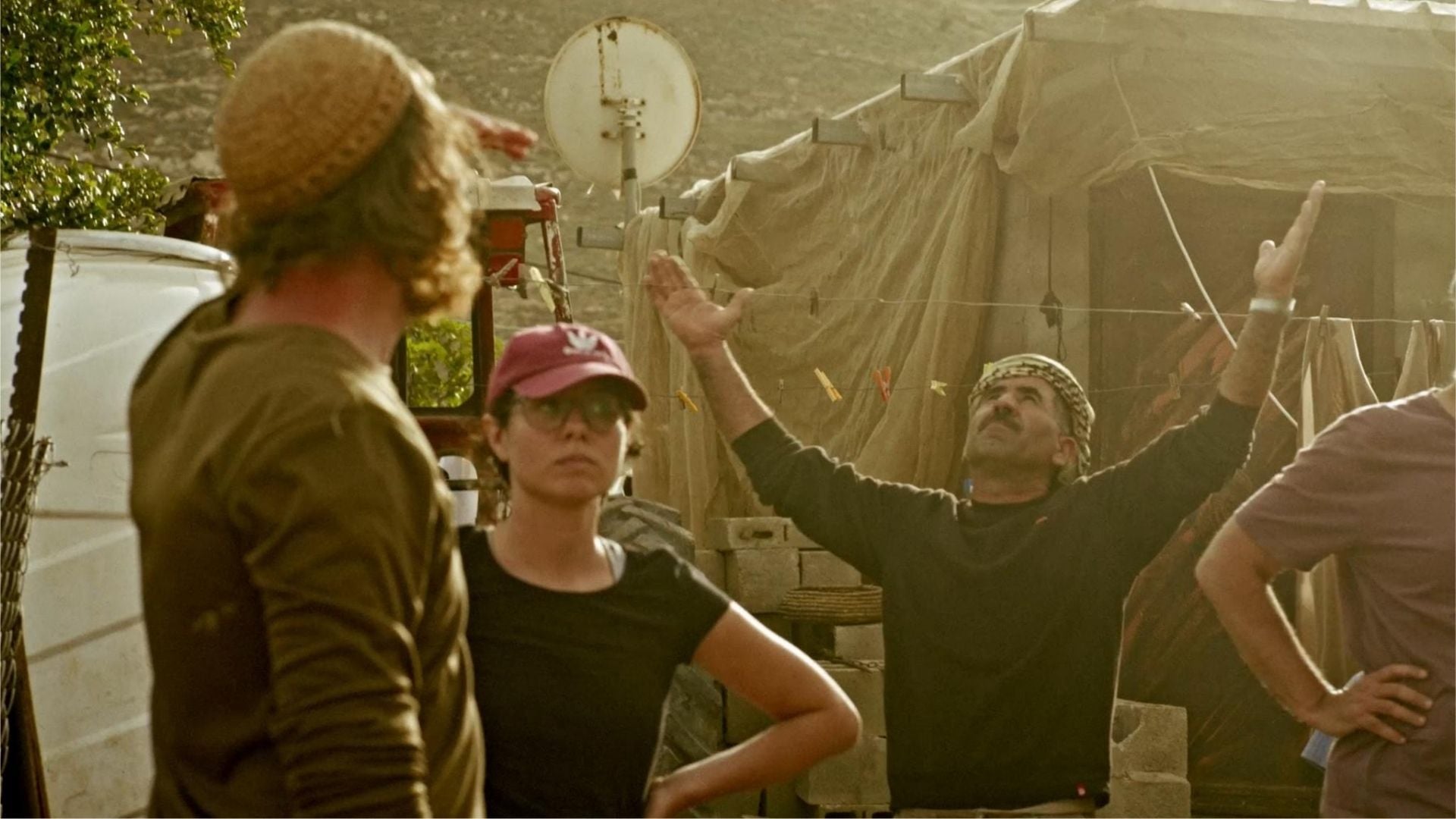
Outposts: Nothing Here Is Yours (2026), directed by Hilla Medalia, documents Jewish Israeli activists confronting settler violence in the West Bank. (Courtesy of Falco Ink)
At DOC NYC 2026, Hilla Medalia’s documentary follows Jewish Israeli activists confronting settler violence in the occupied West Bank, where Palestinian families are fighting to keep their land, their water, and their homes.
A Palestinian farmer stands in his olive grove while goats eat his crop. Settlers carrying clubs remain nearby as more men arrive, and the farmer, unable to stop the damage without risking a violent confrontation, cries, “I’m alone, what can I do?” A Jewish Israeli human-rights volunteer accompanying the Palestinians calls the police and warns that someone is going to get killed. The land is being cultivated by one man, consumed by animals belonging to others, and defended by people who may themselves become targets for intervening.
Hilla Medalia’s Outposts: Nothing Here Is Yours, screening at DOC NYC 2026, records the activities of Jewish Israeli volunteers, including Rabbi Arik Ascherman and activists associated with Rabbis for Human Rights, who accompany Palestinian families confronting settler harassment and violence in the occupied West Bank. The documentary identifies more than ten outposts, most established since October 7, 2023, amid an effort to drive Palestinian residents from their land.
Much of the harassment depicted relies upon actions whose apparent mundanity makes them difficult to address through ordinary means. Sheep wander onto Palestinian agricultural property. Settlers enter family homes. Vehicles are driven onto people’s feet. Children approach houses where adults have been instructed to remain away. Palestinian residents face the prospect of being injured if they resist, or arrested if their resistance provides an excuse to summon the Israeli military.
One activist describes the arrangement: “There is a systemic plan that relies on low-level violence; it uses teenagers, it even uses animals, to make light of it, and make it seem like… Violence? What are you talking about? It’s just some kids and goats.”
The ownership of the animals is rather more consequential than their innocence.
Ben Pazi, identified in the film as a settler leader, has reportedly been prohibited from approaching within fifty meters of Palestinian houses. A child from the outpost nevertheless appears nearby, followed by camels. The restriction upon Pazi’s physical presence has done little to settle the question of whether the people living in those houses can expect to be left alone.
In an exchange between a Palestinian husband and wife, the couple discusses a settler’s apparent desire to provoke a physical response. “He wants someone to hit him.” The conversation includes the recollection of his laughter as their son was pushed away, and the consequences of resisting: “They bring in the army to take our son to prison.”
The circumstances of this conversation suggest a degree of calculation extending beyond the immediate threat of assault. A family must assess the possibility of criminal consequences before acting against somebody entering its home or threatening its children. The settler’s willingness to provoke an altercation becomes another means of exploiting that vulnerability.
Medalia and cinematographer Avner Shahaf have filmed these confrontations under bright, frequently harsh sunlight, with handheld footage that sometimes shakes as the arguments develop. The contrast is vivid, the proximity uncomfortable, and the dialogue often difficult to disentangle as frightened residents, volunteers, settlers, and soldiers speak over one another.
There is remarkably little conventional interviewing. Medalia dispenses with narration and explanatory music, allowing the encounters to proceed without the usual cinematic assistance in determining who has said what or how an incident ought to be understood.
During one confrontation, a man claims that a Palestinian farmer committed an attack that the preceding footage does not substantiate. He declares that people who dislike the circumstances should leave the country and alleges that the farmer wants to eat Jewish livers and kidneys, offering the accusation as justification for violence against him.
Medalia’s handling of this sequence places the viewer in the uncomfortable position of trying to reconcile two incompatible accounts of an event, one preserved by the camera and the other delivered with apparent certainty by somebody who was there. The cognitive dissonance develops without an explanatory interruption. I found myself returning to the images I had just watched, checking my own comprehension against the man’s words, while the confrontation proceeded with little indication that the discrepancy could be resolved.
This was among my strongest impressions of Outposts as filmmaking. The recording establishes what the camera witnessed, yet the people present remain able to make contradictory claims about it. The Jewish Israeli activists repeatedly encounter this same difficulty when describing incidents to Israeli soldiers.
“I saw it with my own eyes,” one volunteer insists. Others demand that soldiers “use their heads” and remind them that they are “grown men.” Some of the harshest disputes involve Israelis confronting other Israelis: “Get away from me!” “I warn you!” “Don’t touch me!” “You do not have the authority.”
Ascherman’s interventions are firm and often remarkably restrained in the face of provocation. His standing as a rabbi also makes the religious disputes unusually direct. Jewish Israeli volunteers challenge settlers who appear in keffiyehs, confront people on the Jewish Sabbath, and claim to act with divine sanction. The volunteers accuse them of being “not religious men” and deny that they speak for God.
Palestinian residents, meanwhile, repeatedly invoke divine punishment against those threatening them. Both religious language and religious authority are contested in the fields and around the houses, sometimes within earshot of people who share Jewish identity but disagree violently about what conduct it permits.
The Jewish Israeli volunteers discuss their comparative privilege openly. Settlers can establish structures where Palestinians are denied permission to build. A Palestinian who defends himself against an intrusion may face arrest. Jewish Israeli activists can approach soldiers, challenge their explanations, and invoke rights whose practical protection is unequally distributed.
At a checkpoint outside Ramallah, soldiers examine identification belonging to a Hebrew-speaking volunteer associated with Rabbis for Human Rights, including her Australian passport. The encounter is almost bureaucratically ordinary beside the footage of agricultural destruction and intimidation, but it belongs to the same immediate struggle over who may travel, intervene, and demand an explanation.
Other scenes record the volunteers learning Arabic, speaking with Palestinian children, and helping to restore water infrastructure damaged by settlers. The repair work receives deserved attention alongside the confrontations because preserving a community involves maintaining the physical conditions necessary for its inhabitants to remain there.
A cut water line can impose a more sustained hardship than a shouted threat. Drinking water, agricultural irrigation, and access to food are matters of daily survival. The volunteers’ work includes restoring supplies damaged by settlers, including activity associated in the film with Noam Jackson.
These observations reminded me of several historical fields in which I have worked as a historian and which have personal connections, particularly Irish colonial history, Native American dispossession, and the occupation of modern-day Slovenia during the Second World War.
The Plantations of Ireland involved confiscating established landholdings and introducing English and Scottish settlers under Crown authority. The Cromwellian settlement intensified dispossession, while later Irish tenant resistance, particularly during the nineteenth-century Land War, involved organized opposition to eviction and the power of landlords over agricultural households.
The nineteenth-century forced removal of the Choctaw and other Native American peoples similarly involved state authority employed to transfer control of inhabited land. Andrew Jackson’s 1830 defense of removal treated Indigenous occupation as an impediment to the expansion of American settlement. My own family history includes the Choctaw experience of removal, which has particular relevance to how I understand the destruction of communities through territorial policy.
I am of Irish and Choctaw heritage. My husband’s grandfather was imprisoned in Dachau and Neuengamme for anti-fascist resistance activity. In occupied Slovenia, Nazi authorities pursued Germanization through expulsions, persecution, and the destruction of political and cultural opposition. The historical circumstances differ, but the language used to designate people as unwanted occupants of their own communities has an unmistakable continuity.
“Clean this area of unwanted guests,” is how a settler describes his mission in Outposts.
The words recall an administrative and political habit extending through these histories: once the established population has been characterized as an obstacle, removing it becomes an apparently legitimate task. Agricultural land, houses, water supplies, and the physical presence of inhabitants are then reorganized around the interests of those claiming authority over them.
There is also a history of resisting these processes through accompaniment, intervention, and the refusal to recognize an occupier’s asserted rights. Irish tenant movements, Native American resistance to removal, and European anti-fascist networks differed substantially in organization and purpose, yet each included people defending homes or communities against authorities attempting to displace them.
“I don’t want you to get to him,” a volunteer says during one of Medalia’s confrontations.
“Nothing here is yours.”
The latter words give the film its title, spoken amid an immediate dispute over access to land and the legitimacy of those claiming control over it. Medalia records people attempting to enforce that boundary while knowing how readily their own bodies may become the next objects of violence.
The film’s handling of identification also remains complicated. Some settlers’ and soldiers’ faces are blurred, while others are shown. Medalia offers little explanation within the footage for why particular faces remain visible, an editorial choice that sits beside the volunteers’ persistent efforts to document and identify those involved in the confrontations.
Even the closing credits appear over additional footage. The encounters have continued throughout the film, and they continue while the names of the people who made it appear on screen. Among the communities documented are Khirbet al-Tawil, Kheila, al-Taybeh, and al-Hathura, places whose existence is tied to houses, fields, and the water necessary to sustain them.
I was particularly struck by the persistent practical limitations of the Jewish Israeli volunteers’ work. They can intervene when a settler threatens a Palestinian resident, challenge soldiers, record an incident, and return to repair a damaged water supply. They recognize that their ability to do these things rests partly upon privileges denied to the Palestinians whose homes they are defending.
The olive farmer’s distress consequently remains unresolved. He has land to cultivate and a crop to protect, but preserving either requires help from people who may have to argue with the Israeli military merely to prevent the next intrusion.
Medalia leaves that condition intact. The credits finish, and the people whose lives she has documented are still living with the possibility that tomorrow another group of settlers, another flock of animals, or another military encounter will arrive at their homes.
Outposts: Nothing Here Is Yours (2026), directed by Israeli filmmaker Hilla Medalia, is a 39-minute documentary and DOC NYC Short List selection, as well as a finalist for the Louie Awards. It screens at the Louie Awards ceremony on November 12 at Village East by Angelika and at DOC NYC on November 13 at 11:45 a.m. at the IFC Center. I very highly recommend seeing it.