
Life Member, Hadassah Westchester, Hadassah Writers' Circle
Overtaxing the Metaphor: Chopped Salad as a Concept and in Real Life
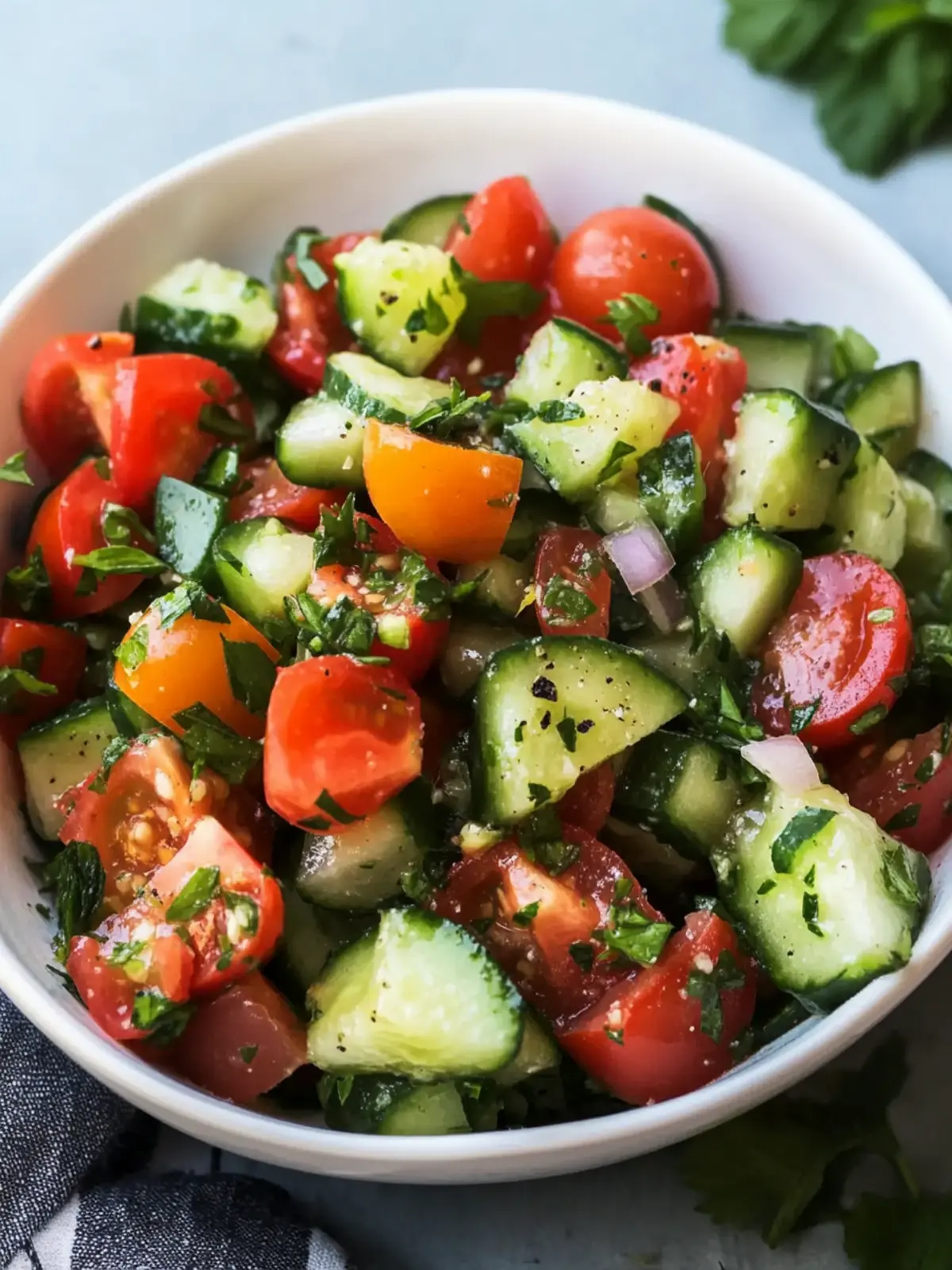
Israeli tomato and cucumber salad photo courtesy of Hadassah.
Tomatoes and cucumbers. This essay concerns tomatoes and cucumbers.
In October 1973, in the midst of a war, I arrived at Israel’s Kibbutz Ein Gedi, along with maybe a dozen other students.
We were there as volunteers to help with the planting, to augment a workforce depleted by the many kibbutzniks who were called up to serve in the military reserve (מִלוּאִים, miluim) after the Yom Kippur attacks.
We were not trained agriculturalists – just a bunch of 18-year-olds starting Young Judaea’s Year Course in Israel and eager to help however we could. We laid out drip pipes and plastic sheets, poked holes and planted seeds as we learned low-evaporation planting techniques, which permit crops to thrive in the rich soil of this semi-arid area along Israel’s Dead Sea.
As I recall, that autumn we planted tomatoes, peppers and eggplant. Some in my group worked in the greenhouses, tending roses destined for English and European markets, or learned to care for the community’s turkeys. A few weeks later, as reservists returned home and schools started up again, we returned to our dorm and classrooms in Jerusalem.
The following spring, I returned to Kibbutz Ein Gedi for a three-month stint as a volunteer worker. As the seasons worked out, this time I harvested tomatoes, eggplant, cucumbers and peppers. I also took on other tasks.
Sometimes I helped out in the gan yeladim (גַן יְלָדִים), the children’s house. My first morning with the four-year-olds, the lead teacher told me to cut cucumbers and tomatoes to prepare the iconic Israeli salad for the kids’ lunch. Now, I’d been in kitchens my whole life because my mother had determined that her kids would grow up knowing how to cook (something she had not learned until she married). So I washed the produce and started cutting.
Well into this task, the teacher came by and said, “I can tell you are American.” Huh? “You cut the vegetables in big chunks.” I hadn’t thought so, but I quickly learned that, for “Israeli salad,” the pieces must be fairly small, cut into little dice. This took longer to do, but I learned. Once well-chopped, the vegetables were dressed with lemon juice and olive oil. Maybe a bit of salt.
Fast forward to 2020 or so when I attended a multi-day conference organized by the European Central Bank in Frankfurt, Germany. Participants came from central banks all over the world to learn and share information about payment systems. I met folks from Sweden, representing the oldest central bank, a young woman from tiny Seychelles in the Indian Ocean, who invited me to visit their pristine beaches, and many others.
One evening, I found myself at a table with a representative from the Palestinian Monetary Authority. Instead of talking payments this woman wanted to critique US society. She questioned a number of US policies that had nothing to do with central banking, or the businesses of economics or finance. Mostly, her accusations challenged the notion of the US as a society committed to fairness and equality.
While I no longer recall many details, I do recall feeling startled to find myself cast as the defender of all things American when I viewed myself simply as a fellow conference attendee. Finally, she opined that the US didn’t seem like much of a melting pot to her. (Do you, like me, remember reading Daniel Patrick Moynihan’s Beyond the Melting Pot in college? This is the book that upended the notion of the US as a homogenous community, while also appreciating its diversity.)
I conceded that there might be other metaphors more appropriate for an immigrant nation with a diverse population. I prefer a “stew metaphor,” in which a wide range of ingredients are able to keep their own features while simultaneously taking on other flavors, all drenched in a rich broth. But after some further wordplay, she argued that a better characterization might be a bowl of salad. I saw no reason to disagree.
I’m pretty sure that this person had not pegged me as a Jew, never mind committed Israel supporter. Under those circumstances, I imagine, the conversation would have flowed differently. In any case, she seemed to feel that with the salad bowl image she’d scored a victory. But at the risk of pushing the metaphor too far, let me suggest that aspiring to be a chopped salad isn’t such a bad goal.
Faced with cucumbers sliced in large chunks, diners will spear them with their fork one piece at a time, separate from the tomato or other ingredients. And the flavors remain largely separate. Chopped smaller and dressed, the vegetables become infused with each other’s flavors while retaining much of their own character and crunch. Think about cabbage and carrots: not terribly enticing on their own but quite tasty as coleslaw. (On the other hand, a quarter head of iceberg lettuce topped with a dollop of dressing doesn’t, in my book, count as salad.)
The US is a nation infused with immigrants. I am one-and-a-half generations in, with friends whose families arrived before the American Revolution and friends who themselves immigrated to the US. We are different but we also share the “dressing” of our Constitution.
By this analysis, Israel is also a salad — a blend of descendants of peoples long present in the region and immigrants from most countries around the world, bound by the dressings of democracy and a variety of various religious traditions.
At the risk of pushing the metaphor even further, for this essay, I considered suggesting that it’s up to us, US residents, to decide what kind of salad we want to be — finely chopped, chunky or a single vegetable. But it’s not entirely true that we get to decide.
Given the open society and diversity that I value, I have to recognize that some fellow voters will prefer uniformity and others different blends. Still, I am not naïve or, in the lyrics from South Pacific, “a cockeyed optimist.” I understand that we need to negotiate ingredients or offer options. And I am certain that the world is more interesting because we are not all the same.
I love a plate of sliced bright red, in-season tomatoes, even better when drizzled with a bit of olive oil and salt. But the result is even tastier when complemented by crunchy cucumbers, tangy red onion, tart lemon juice, and mellow olive oil. And, perhaps, made even better by a surprise ingredient.
I still make many salads this way. In season, I might even add a bit of peach plus blue cheese or crumbled feta for added saltiness. But always chopped fairly small, so a spoonful contains many diverse elements. As I said, the world is more interesting that way!
The author does not speak on behalf of Hadassah and the views expressed herein are the author’s own and not necessarily those of Hadassah.
Michele is a member of the Hadassah Writers’ Circle, a dynamic and diverse writing group for leaders and members to express their thoughts and feelings about all the things Hadassah does to make the world a better place. It’s where they celebrate their personal Hadassah journeys and share their Jewish values, family traditions and interpretations of Jewish texts. Hadassah members are proud of their Zionist mission and their role as keepers of the flame of Jewish values, traditions and beliefs as well as advocating for women’s empowerment and health equity for all. Since 2019, the Hadassah Writers’ Circle has published nearly 900 columns in The Times of Israel Blogs and other Jewish media outlets. Interested in writing? Please contact hwc@hadassah.org.
Related Topics