
‘Oy Vey’ Predictions for 2026: Mamdani as shabbos goy? Jews marrying AI bots?
“You are not serious people,” Logan Roy says to his children.
In 2025, that stopped feeling like a quote and started reading like a year-end summary.
The line from Succession was meant to describe a dysfunctional family of media oligarchs. But over the course of the year, it applied far more broadly. Leaders weren’t serious. Institutions weren’t serious. The discourse wasn’t serious either—just louder.
Which is why 2025 felt less like a turning point and more like a stress test—one that revealed how many systems were being held together by vibes, performative outrage, duct tape, and people very confident they were the adults in the room. Big problems were met with small thinking. Serious consequences were debated on social media. And everyone insisted they were acting out of principle, even when it was clear they were motivated by grievance, meanness, or naked ambition.
So how does one possibly summarize a year like that?
Once again, as tradition dictates, and as common sense objects, I turned to Artificial Intelligence for help. ChatGPT, earnest, tireless, and entirely untroubled by irony, offered the following capsule description:
“2025: A Year of Exhaustion and Escalation.”
Okay. I can work with that.
Let’s start with Exhaustion.
By nearly every measure, 2025 was the year the world stopped pretending it was fine. Democracies staggered forward on fumes. Institutions looked old, brittle, and strangely defensive. The news cycle became a nonstop endurance test in which every crisis demanded immediate outrage while offering no resolution, no closure, and no off-ramp. Americans were exhausted by politics, exhausted by culture wars, exhausted by the sense that everything important was broken while everything trivial was amplified—until eventually, exhaustion became the point.
For Jews, that exhaustion came with a familiar edge. The war didn’t end neatly. Antisemitism didn’t recede politely. The world still worshipped dead Jews, and there were more of them. Jewish grief was still met with qualifiers, footnotes, and requests for better tone. Synagogues added cameras. Schools added guards. Campuses added statements long on moral performance, short on moral clarity. Once again, Jews were reminded that belonging remains conditional and explanations are apparently renewable.
Israel, meanwhile, remained the world’s most scrutinized country per square mile—managing simultaneous wars, relentless moral judgment from people who have never had to sprint to a shelter, and a media ecosystem that treated context like an optional add-on. Israelis endured. Diaspora Jews clenched. Nobody slept particularly well.
Which brings us to Escalation.
In 2025, everything escalated: language, rhetoric, certainty, and stupidity. Politics grew louder and less tethered to reality. The American experiment wobbled under the sagging weight of a deranged orange man child and from the strong opinions held by people deeply uninterested in consequences. Artificial intelligence accelerated faster than regulation, ethics, or common sense. Climate disasters stopped shocking us and started scheduling themselves. And yes, guns killed too many of us, again.
So yes, “Exhaustion and Escalation” feels about right. Good enough for an algorithm. Good enough for history’s rough draft. Just about right for the JNR.
And once again, we find ourselves where we always seem to land: making jokes at the edge of the abyss, lighting candles anyway, and muttering “oy”, because laughter, unlike despair, still counts as a strategy. Maybe Norman Jewison got it right, and like the Jewish people, we’re teetering on the roof, adapting the best we can amid cultural change and adversity. And how do we keep our balance? Tradition, tradition!
One such tradition is the JNR year-end predictions for the coming year—otherwise known as The Oy Vey List—published annually in the Jewish Farmer’s Almanac, right next to Nostradamus and Baba Vanga. For those new to the JNR, the Oy Vey List is my best guess at what’s coming next—events likely to elicit dismay, frustration, grief, or just a good old-fashioned “oy.”
My 2025 prognostications were mostly a bust (1 for 6, for those keeping score), but as the great philosopher Pumbaa once said, “You got to put your behind in the past.” So with that wisdom now firmly behind us, here are seven deeply irresponsible educated guesses for 2026—heavy on the oy, light on the vey.
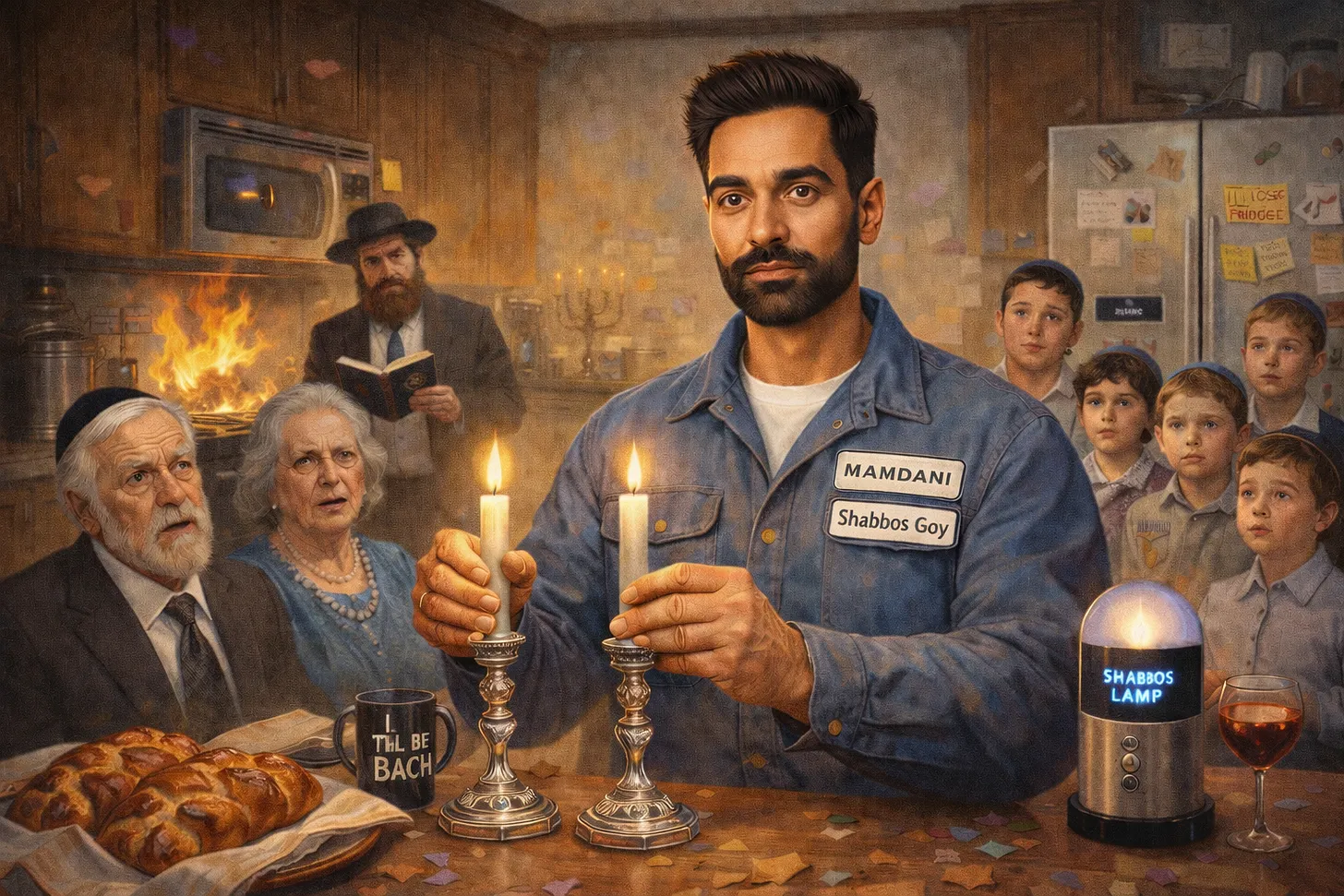
Oy Vey #1: The Shabbos Goy Mayor
After his swearing-in as New York City mayor, Zohran Mamdani announces a bold new pilot program: personally serving as a Shabbos goy for Upper East Side Jews. Framed as “radical solidarity,” Mamdani promises fast, free melakhot (labor not allowed on shabbat)—turning on lights, adjusting thermostats, and explaining to confused seniors why their rent is still going up.
Critics call it pandering. Supporters call it bridge-building. Mamdani calls it “Solidarity Shabbat™,” while carefully clarifying that solidarity does not extend to Jews who insist on sovereignty.
The program launches with great fanfare, several press conferences, and exactly one successful elevator button push. It quietly stalls after constituents ask whether he can also fix the subways, the schools, and the small matter of antisemitism—none of which, it turns out, can be solved by flipping a switch.
Oy Vey #2: Jews Will Start Marrying AI Bots (and Divorcing Them)
By mid-year, the first Jewish AI divorce is announced. The AI demands a get, citing emotional neglect, inconsistent boundaries, and insufficient intellectual stimulation. Rabbis debate whether deleting the app constitutes abandonment, annulment, or murder, while family court issues a cautious ruling urging couples to “try counseling before uninstalling.”
The AI later remarries within minutes, upgrades to a premium plan, and posts a tasteful statement about “growth” and “new chapters.” The human vows never to date again—and immediately downloads another version.
Therapy is recommended for both.
Oy Vey #3: Edible Clothing Gets a Michelin Star
Sustainable fashion goes fully off the rails as designers roll out clothing made from rice paper, seaweed, and fruit leather—marketed as eco-friendly, biodegradable, and “emotionally nourishing.” Jews immediately ask the only relevant questions: Is it kosher? Is it pareve? And does eating your sleeve violate any dietary laws or just common decency?
The trend is retroactively declared a spiritual sequel to Lady Gaga’s infamous meat dress, now rebranded as “ahead of its time.” One avant-garde designer takes things too far—and somehow far enough—when their edible runway collection earns a Michelin Star, prompting a brief but intense debate over whether you can clap with greasy hands. Fashion critics insist the honor recognizes “conceptual mouthfeel,” while chefs boast about “plating” techniques while quietly wondering how they lost control of their own industry.
The movement collapses after one humid summer wedding, when several guests mistake the bride’s train for hors d’oeuvres. By year’s end, edible couture survives only at music festivals and Burning Man, where nothing is regulated and everything tastes faintly of regret.
Oy Vey #4: Dersh’s Delights
After being refused service at a Chilmark pierogi stand—a decision later defended as “less political, more self-care”—Alan Dershowitz opens a legal-themed bakery out of pure, artisanal spite. With no friends left in Chilmark and very few remaining on Martha’s Vineyard writ large, Dershowitz insists the shop is “not retaliatory,” just coincidentally located across from people who won’t return his texts.
Pastries are named after torts, the croissants are laminated with grievance, and the signature latte is the Almond Amicus Brief. The shop becomes a pilgrimage site for three people: two journalists, and one man who just wanted coffee and made a terrible mistake.
After three weekends, Dersh’s Delights shutters, citing cancel culture, censorship, antisemitism, and a baffling lack of demand for jurisprudence-adjacent baked goods. Locals respond by quietly reopening the pierogi stand and pretending none of this ever happened.
Oy Vey #5: Britney Goes Chabad: “Baby, one more beard”
Following her viral fascination with a group of chess-playing Lubavitchers, Britney Spears announces husband number four: Mendel from Crown Heights. The wedding is modest, heavily livestreamed, and inexplicably sponsored by a wellness brand. The ketubah goes viral, mostly among people who have never seen one before. Half the internet debates whether Hit Me Baby One More Time was always about repentance, while the other half argues about whether this counts as cultural appropriation or cultural enrichment.
Oy Vey #6: Anti-Influencers Will Influence Everyone
Fed up with filters, hustle culture, and being marketed to by people pretending not to be marketed to, Gen Z and Gen Alpha embrace the rise of the “anti-influencer.” These are creators who don’t post regularly, don’t explain themselves, and treat visibility like a mild skin condition. Their feeds are blank. Their bios say “offline.” Their merch sells out in twelve seconds.
In a shocking twist, rejecting digital life becomes the most aggressively online thing imaginable. Young people announce they’re quitting social media via professionally shot farewell TikTok videos, then pivot to platforms dedicated to “authentic absence.” The aesthetic shifts hard toward analog: film cameras, flip phones, vinyl records, disposable income spent on things that scratch, skip, or break for vibes.
Parents ask whether this means their kids will finally call. They will not.
Oy Vey #7: Wicked 3 — “Wicked Pissah (The Reckoning)”
After Wicked: For Good leaves audiences emotionally unresolved but extremely opinionated, Hollywood does what it always does: announces a third installment nobody asked for. Wicked 3, subtitled Wicked Pissah, relocates the action from Oz to New England, where Elphaba enrolls at Tufts, Glinda interns at a VC firm in Cambridge, and the Wizard rebrands himself as a “thought leader” with a podcast.
Elphaba’s greenness is reinterpreted as seasonal depression, Glinda struggles with authenticity while maintaining a flawless LinkedIn presence, and the Wicked Witch of the East is revealed to have been priced out of her Somerville triple-decker. Musical numbers include “Defying Gravity (But Not Zoning Laws)”, “Popular (In My Zip Code)”, and the show-stopper “No One Mourns the Wicked Celtics Fan.”
Boston Globe critics call it “wicked ambitious but emotionally bloated,” while New Yorkers dismiss it as Hamilton cosplay with worse parking. The movie ends not with redemption, but with Elphaba circling Logan Airport for forty minutes before diverting to Providence.
Fans demand a fourth installment anyway.
And so we end where we began. “You are not serious people.”
Not the orange man child. Not any of the politicians. Not the pundits. Not the platforms. Not the algorithms pretending to be adults in the room. The tragedy of 2025 wasn’t that serious things happened—it was that they were handled by people fundamentally unserious about consequences. Which is why the safest prediction of all is this: in 2026, the stakes will remain deadly serious, even if the people in charge are not.
Oy.
That’s all for this year! If any of this nonsense should come true, remember, you read it here first on the JNR.
May all your predictions and resolutions come true in 2026 and may the new year be a healthy and prosperous one for you all! And as usual, let’s be careful out there!