
The views expressed herein are solely mine.
Pacific Abraham Accords: Blocking China’s Advance
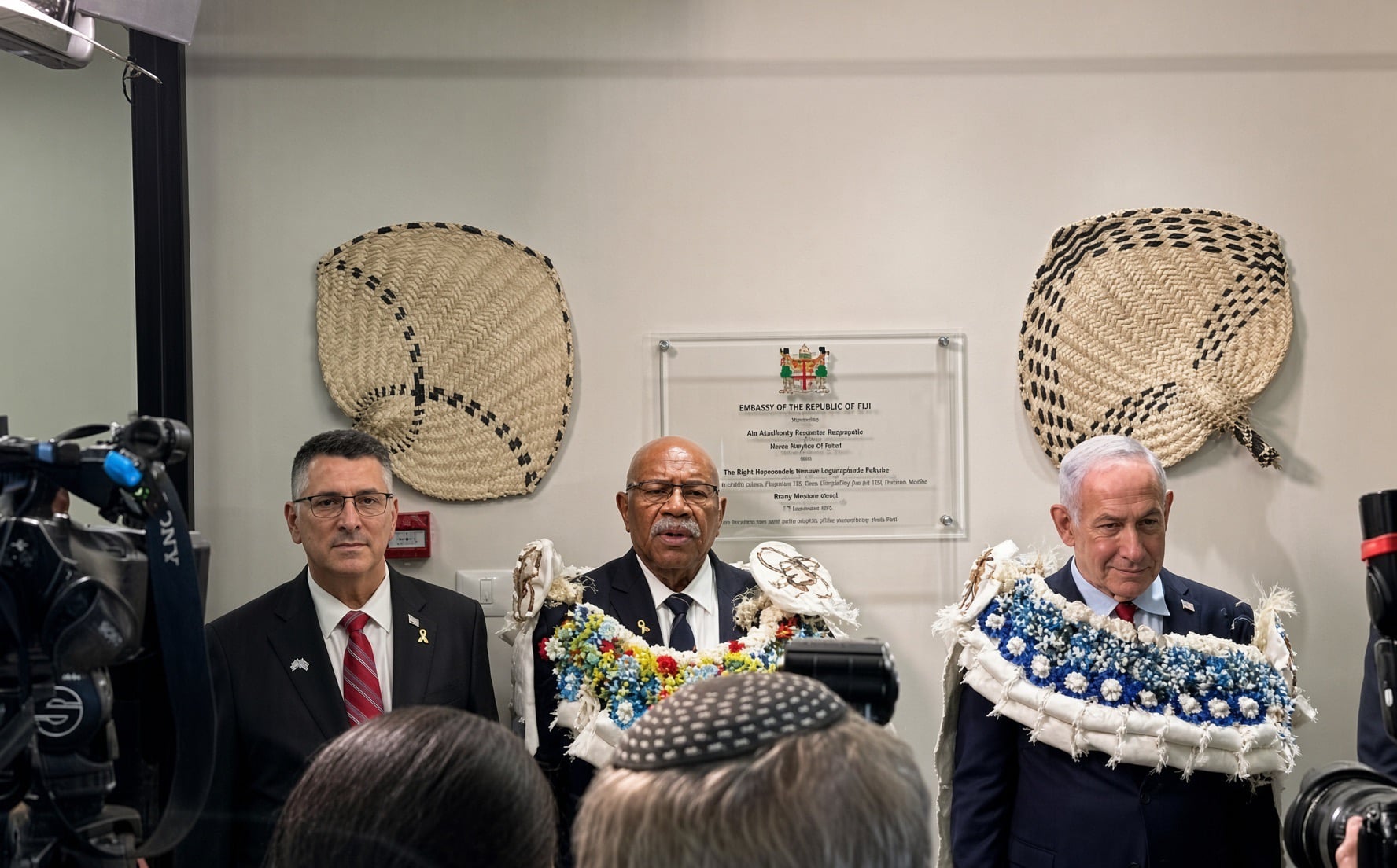
From left: Foreign Minister Gideon Sa'ar, Fijian Prime Minister Sitiveni Rabuka and Prime Minister Benjamin Netanyahu at the opening of the Fijian embassy in Jerusalem on September 17, 2025. (Rafi Ben Hakoon/GPO).
Israel’s admission into the Pacific Islands Forum (PIF) as a partner will turn sympathy into a powerful foreign policy tool to pressure the periphery. For decades, PIF members have backed Israel with crucial votes at the United Nations General Assembly, something that most Western powers avoid doing these days. In the summer of 2025, seven Pacific island nations voted against a United Nations unilateral ceasefire. Moreover, the Federated States of Micronesia has consistently refused to vote against the Jewish state at the United Nations for more than a decade. Furthermore, Papua New Guinea, Fiji, and Nauru have recently opened embassies in Jerusalem.
This diplomatic resilience is the payoff for President Chaim Herzog’s 1980s visits to Fiji and Tonga during the ‘First Intifada.’ Israel became the first non-Pacific state to recognize Palau in 1994, thanks to an initiative led by Jewish-American Ambassador Stuart Beck, who aligned the tiny Pacific state into Israel’s international voting orbit. However, Chinese state-linked firms are putting all of this at risk by aggressively installing Huawei networks and dual-use undersea cables in exclusive economic zones covering more than India’s land area. Through this modus operandi, Beijing will have constant visibility of the critical Compact of Free Association sea lanes used by American, Australian, and Japanese naval traffic.
Neutralizing this threat requires Israel to leverage its new PIF Sectoral Partnership status by establishing a ‘Pacific AI Resilience Hub’ operating from the Jewish state’s Suva embassy. Israeli engineers should help island authorities monitor freshwater supplies and lagoon water quality, and separately develop software to flag suspicious vessel activity near undersea cables; in tandem, island governments should control the AI models and data. Patrol boats should also process radar and camera feeds on onboard computers without internet access, with battery backup, solar charging where practical, and satellite links for essential messages during network outages. Cyclone Winston damaged Fiji’s power and telecommunications networks in 2016, demonstrating the need for such backup systems. Meanwhile, a permanent cell in Suva, staffed by rotating officers from Israel’s Unit 8200, should also be created to help local authorities map suspected illegal fishing and threats to undersea cables in the waters around Pohnpei in the Federated States of Micronesia and off Port Moresby in Papua New Guinea.
Expanding this architecture into an official AI security annex to the Compacts of Free Association would install Israeli inference software on island networks, with encryption keys physically secured in Koror, Majuro, and Palikir. Crucially, Timor-Leste seals the last great geographical fissure. The unresolved maritime boundaries between Dili and Jakarta (which, after showing some neutrality about the Israeli-Palestinian conflict, has recently rejoined the anti-Israel camp), together with police arrests of suspected scammers in raids during 2025 and 2026, would provide the hook for a ‘Scam Shield Pact’. Timorese officials also identified workers coerced into criminal activity and called for their protection as trafficking victims. This deal would embed Israeli AI-fusion platforms, digital forensics tools, and blockchain transaction tracing within Timorese analytical cells; an ‘Island Resilience Laboratory’ using commercial satellite tasking could produce independent economic-zone data packages for boundary negotiations; and a tropical arid-tech center and ‘Sovereign Digital Governance Stack’ could shield assets from foreign syndicates.
Ultimately, two muscular steps would transform the defensive partnership into an active regional deterrence strategy. First, Israel should provide coastal surveillance radars, unmanned aerial vehicles, and loitering munitions to selected PIF members and Timor-Leste, under a dual-purpose maritime-security program, while training their forces in aggressive anti-smuggling interdiction measures. Second, a ‘Blue Pacific Periphery Pact’ should connect Israeli technology with partners that have demonstrated regional interests. The UAE’s $50 million Pacific Partnership Fund financed renewable-energy projects in 11 Pacific island nations, including a solar plant on Pohnpei; Israel should propose joint solar and battery backup for maritime monitoring stations. Morocco’s 2025–2027 cooperation roadmap with Palau, which supports Rabat’s Western Sahara position, provides a channel to propose fisheries training. Bahrain should have no standing role unless it and an island government agree on a funded cyber-training project. Taiwan, a PIF development partner, could be approached for telecommunications equipment and training. Each contribution would require a funding agreement and island-government consent.
Delivering these capabilities through the Forum’s sectoral stream and the Suva hub keeps the network modular, lethal, and operational, not merely declarative. The Pacific island governments that already vote with Israel and host Jerusalem embassies have provided the institutional opening. Now, the Jewish state must humbly respond with hardware, algorithms, and security measures before Chinese digital infrastructure finishes its lock-in of the Pacific and threatens Israel’s interests and the Western geostrategic alliance in the region.
Related Topics
Related Posts