The views expressed herein are solely mine.
Pakistan Betrays America—Again
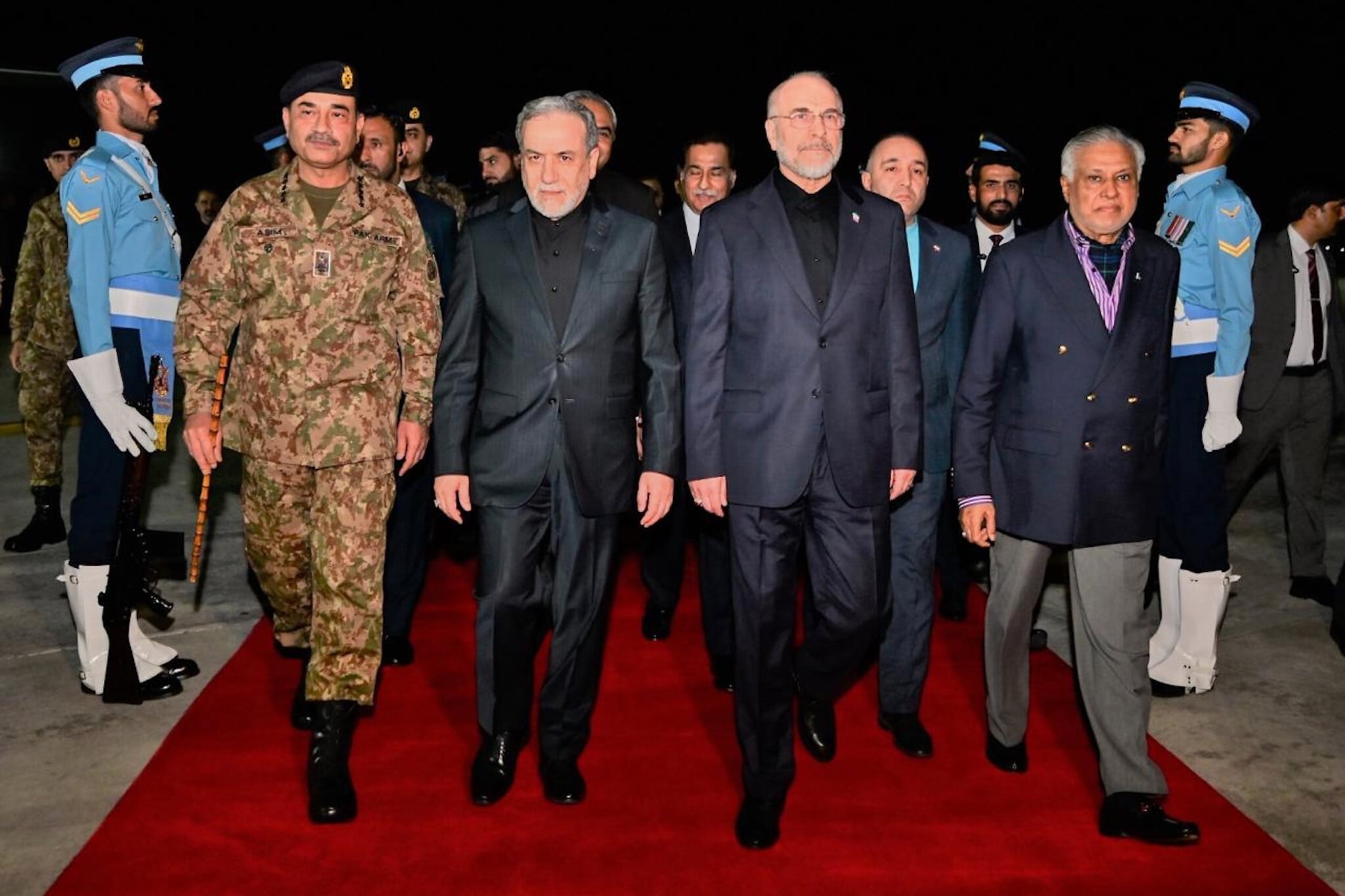
In this photo released by the Pakistan Foreign Ministry, Iran's Parliament Speaker Mohammad Bagher Ghalibaf, center right, and Iran's Foreign Minister Abbas Araghchi, center left, are greeted by Pakistan Foreign Minister Ishaq Dar, right, and Army Chief Field Marshal Gen. Asim Munir, left, upon their arrival at Nur Khan airbase in Rawalpindi, Pakistan, April 11, 2026. (Pakistan Ministry of Foreign Affairs via AP).
Pakistan is stabbing America in the back. While masquerading as a neutral “mediator” in the U.S.-Israel-Iran conflict and hosting the ceasefire talks that shattered the April 8, 2026 agreement, Islamabad has been quietly cutting sordid side deals with Tehran. These pacts secure safe passage for its energy imports and, according to multiple reports, provided shelter for Iranian military aircraft at Nur Khan Airbase. In doing so, Pakistan is tightening the mullahs’ grip on the Strait of Hormuz and once again exposing the strategic duplicity that defines its foreign policy: milking Washington for military aid, diplomatic legitimacy, and economic favors while accommodating America’s adversaries behind closed doors.
Behind the scenes, Pakistani negotiators struck a bargain with Tehran to guarantee safe transit for its vessels and critical Qatari liquefied natural gas cargoes through the Strait of Hormuz under Iran’s newly imposed “regulated access” extortion racket. This cynical mechanism lets the Ayatollah regime charge bitcoin fees to survive the current naval blockade.
From a policy standpoint, Islamabad is openly conceding Iranian control over one of the world’s most vital maritime chokepoints. Rather than resisting Tehran’s weaponization of global energy routes, Pakistan has legitimized it. The arrangement handed the Islamic Revolutionary Guard Corps (IRGC) greater leverage, conferred fresh economic and political legitimacy on Iran’s pressure campaign, and strengthened Tehran’s ability to manipulate the artery through which roughly one-fifth of global oil supplies pass.
At the same time, U.S. officials and satellite imagery exposed another glaring breach of neutrality. Iranian aircraft, including an RC-130 reconnaissance platform, reportedly arrived at Nur Khan Airbase near Rawalpindi in the days following the April 8 ceasefire. American assessments viewed the deployment as an effort to shield sensitive Iranian assets from potential Israeli or U.S. strikes while preserving Tehran’s intelligence-gathering capabilities.
Pakistan claimed the flights were tied to diplomatic logistics and pointed to its simultaneous troop deployments to Saudi Arabia as proof of “loyalty” to Washington. That explanation collapses under scrutiny. Housing a high-value Iranian reconnaissance asset at one of Pakistan’s most strategically important military installations strongly suggests operational coordination, not mere diplomacy.
Pakistan’s role matters because it wields real geopolitical leverage. It borders Iran, anchors the western flank of the China-Pakistan Economic Corridor, sits astride critical Indian Ocean routes, and maintains a rapidly expanding nuclear arsenal estimated at roughly 170 warheads, with projections nearing 200. By coordinating with Iran on Hormuz transit and allegedly protecting Iranian intelligence assets, Islamabad helped Tehran sustain pressure on global energy markets, elevate shipping risk premiums, and complicate American and Israeli deterrence. More broadly, these actions reinforce the emergence of a China-Iran-Pakistan axis increasingly hostile to American influence from the Persian Gulf to the Indo-Pacific.
Islamabad’s behavior is driven not by ideology but by cold strategic calculation. Pakistan faces a conventionally superior India, depends heavily on China for economic and military support, and requires functional ties with Iran to offset chronic energy vulnerabilities. These realities push it toward a familiar hedging strategy: publicly cooperating with Washington while privately accommodating revisionist powers opposed to the American-led regional order. In this framework, alliances are transactional instruments subordinate to regime survival and strategic flexibility.
Nor is this pattern new. Pakistan’s Inter-Services Intelligence Directorate maintained long-standing ties to Al-Qaeda and Lashkar-e-Taiba, the jihadist group responsible for the 2008 Mumbai attacks that killed 166 people. The Abdul Qadeer Khan proliferation network directly aided Iran’s nuclear ambitions while spreading sensitive technology across rogue regimes.
For decades, Islamabad has relied on proxy warfare, covert balancing, and terrorist intermediaries to offset India’s conventional superiority while preserving maneuverability between competing power blocs. Its conduct during the 2026 crisis fits squarely within that tradition.
Pakistan therefore emerged from the conflict having secured diplomatic credit for brokering the April 8 ceasefire while simultaneously helping preserve Iranian operational capacity and legitimizing IRGC oversight of the Strait of Hormuz. That dual-track strategy weakened American leverage, heightened uncertainty across global shipping and energy markets, and further eroded trust between Washington and Islamabad during a period of escalating regional instability.
Indeed, the United States should stop treating Pakistan as a dependable strategic partner. A nuclear-armed state that materially assists the IRGC, reportedly shelters Iranian reconnaissance assets, and sustains a decades-long history of proxy relationships cannot credibly be viewed as a reliable pillar of regional security. Continued engagement without meaningful consequences merely incentivizes further duplicity.
Pakistan’s leadership has made its strategic calculus unmistakably clear: cooperate with Washington when convenient while simultaneously empowering forces openly hostile to American interests. Washington should respond accordingly—with tighter scrutiny, conditional engagement, and a far more hard-nosed understanding of Pakistan’s role in the evolving balance of power across the Middle East and Indo-Pacific.
President Trump must recognize Pakistan for the duplicitous farce it is—no different from Oman, which last week reportedly negotiated with Iran over sharing prospective Strait of Hormuz toll revenues they seek to impose together. Washington cannot afford another delusion disguised as diplomacy. Any agreement with Tehran that leaves the Ayatollahs with influence over the Strait of Hormuz, preserves its nuclear infrastructure, or allows unrestricted ballistic missile and drone development is not a peace deal. It is a strategic surrender. These self-described “neutrals” are not neutral at all. They are aligned, openly or quietly, with the forces driving instability, coercion, and terror across the region.
Related Topics
Related Posts