


Middle East Forum Fellow/North Africa Risk Consultant
Pakistan’s $4B Libya Gambit: How Washington Outsourced the Quagmire to Islamabad
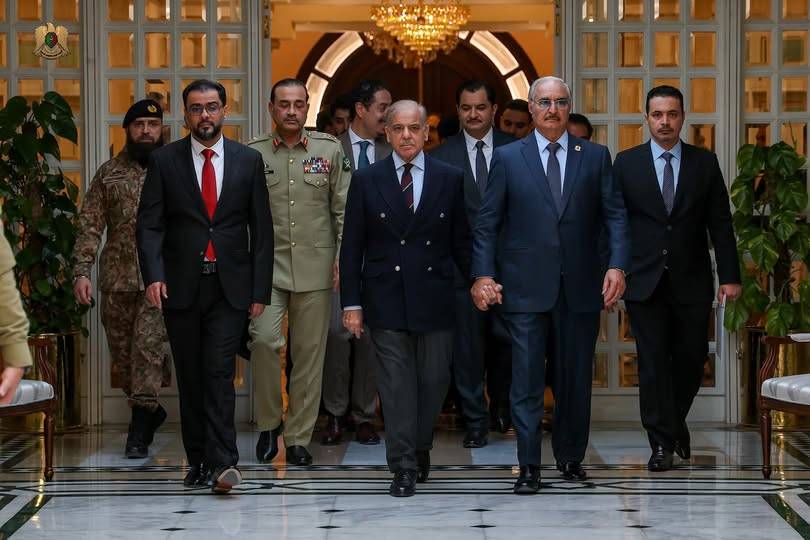
Pakistani Prime Minister Muhammad Shehbaz Sharif welcoming Haftar in Islamabad last February (General Command of the Libyan National Army)
The foundational hypocrisy of this mediation tracks directly back to a massive four-billion-dollar weapons deal finalized in Benghazi in December 2025. In a blunt display of realpolitik, Pakistan’s Army Chief Asim Munir met with Saddam Haftar to seal one of Islamabad’s largest-ever military exports, an order encompassing sixteen JF-17 fighter jets, basic trainers, and long-term technical training. That this massive transaction moved forward in blatant defiance of the long-standing United Nations arms embargo highlights the hollow nature of international law when cash and weapons change hands. For Pakistan to now claim the mantle of an objective, neutral arbiter is structurally absurd. A state cannot act as a primary arms supplier to one faction in a civil war while simultaneously presenting itself to the other side as an unbiased peace broker. This double game has predictably triggered profound skepticism and open hostility across western Libya, where political and military factions in Tripoli and Misrata correctly perceive Islamabad as deeply compromised by its financial and military alliances with the Haftar family. The rhetoric of neutrality quickly dissolves when confronted with the physical reality of Pakistani-supplied hardware reinforcing the eastern military apparatus.
This entire diplomatic architecture serves a broader, equally cynical American initiative spearheaded by Washington’s senior advisor Massad Boulos. The American strategy deliberately bypasses genuine state-building or democratic development in favor of an elite family bargain designed to divide Libya’s massive oil revenues among its most powerful actors. The power-sharing arrangement proposes an administrative marriage of convenience where Saddam Haftar assumes control of a newly empowered Presidential Council with expansive executive authority, while Abdul Hamid Dbeibah, or a chosen proxy from his family, remains entrenched as prime minister. By unifying the national budget and institutions while indefinitely deferring democratic elections, this initiative simply institutionalizes the status quo under a new corporate banner. It treats Libyan sovereignty as liquid equity to be partitioned among rival warlords, prioritizing short-term conflict management over the political self-determination of the Libyan population. The citizens of Libya are left as mere spectators to a financial realignment masked as a peace process.
For the United States, importing Pakistan into this equation is a classic exercise in risk management and plausible deniability. Rather than committing its own personnel or political capital to the hazardous, messy work of militia disarmament and institutional integration, Washington has chosen to outsource these security tasks to a foreign military establishment that is eager to please and desperate for revenue. Pakistan is essentially acting as a low-cost security subcontractor, brought in to handle the volatile field logistics of collecting weapons and policing rival militias while the primary Western architects remain safely insulated from direct exposure if the deal unravels. This arrangement relies on the illusion that external enforcement can substitute for domestic legitimacy. In reality, it guarantees that Libya’s stabilization remains a distant mirage, sacrificed to satisfy the financial necessities of a broken South Asian economy and the geopolitical convenience of a detached American foreign policy. By reducing international diplomacy to a series of subcontracted security agreements and resource distributions, the architects of this plan ensure that the underlying structural failures of the Libyan state are never addressed, leaving the country trapped in a cycle of perpetual transition managed by external actors for their own gain.