
Pakistan’s Double Game Undermines Its Claim
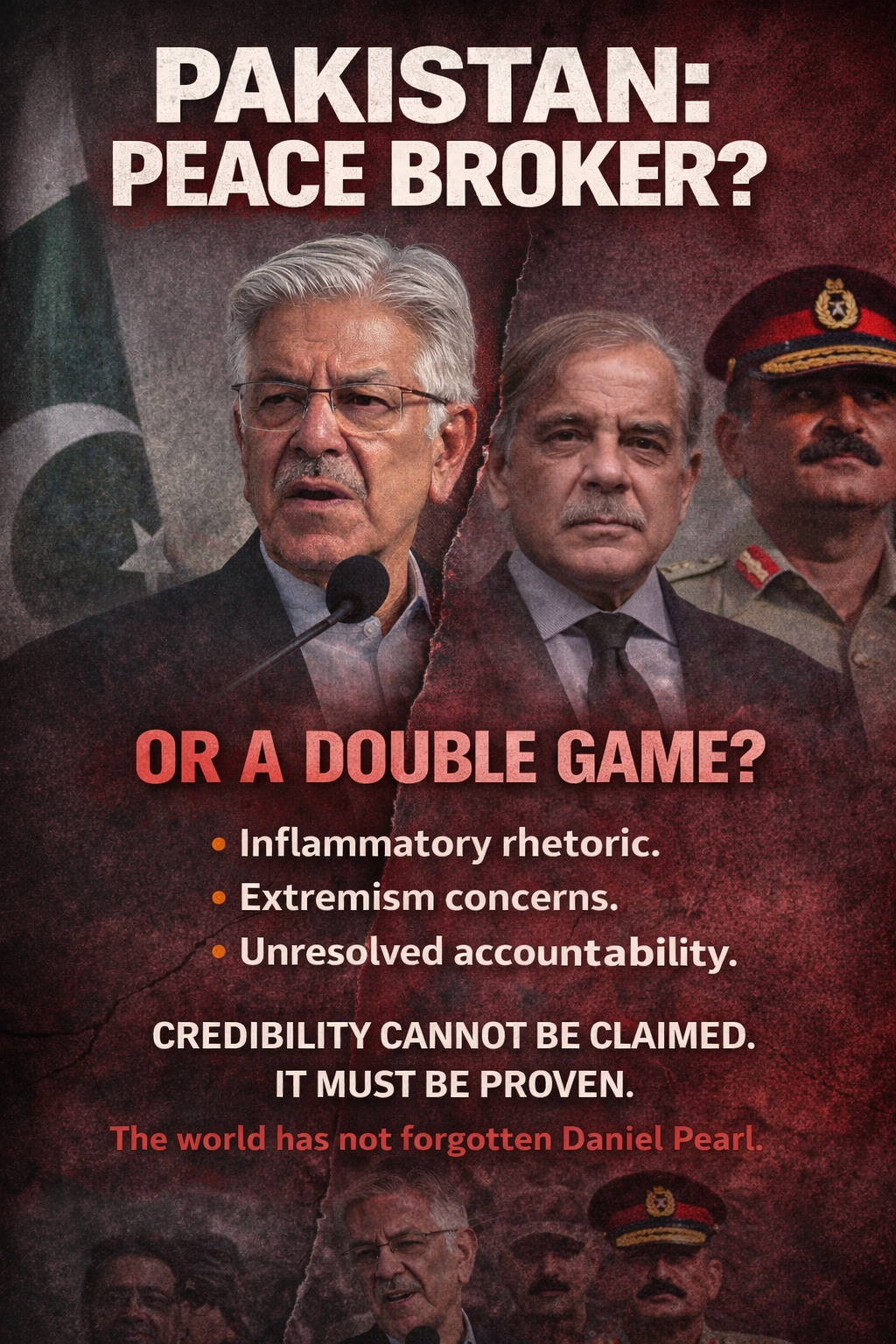
At a moment when the Middle East faces heightened tensions and the need for credible mediation has never been greater, Pakistan has sought to position itself as a potential facilitator of dialogue.
But diplomacy rests not on declarations, but on credibility. And credibility, in turn, depends on consistency.
Recent remarks by Pakistan’s Defense Minister, Khawaja Asif, raise serious questions in this regard.
Rhetoric and Responsibility
Public criticism between states is not unusual, particularly in times of conflict. However, the tone and substance of official statements matter.
The Defense Minister’s recent comments about Israel went beyond conventional political criticism, employing language that many observers would view as inflammatory and dehumanizing. When such rhetoric comes from a senior government official, it carries weight far beyond domestic politics. It shapes international perception and signals intent.
At a time when restraint is essential, language that escalates rather than moderates undermines efforts to build trust.
A Pattern of Contradiction
This episode reflects a broader and longstanding tension.
For decades, Pakistan has attempted to balance two competing roles: presenting itself as a partner in global diplomacy and counterterrorism, while grappling with persistent challenges related to extremist networks within its own environment.
This duality has not gone unnoticed.
During the post 9/11 era, Pakistan was a key ally in counterterrorism efforts. Yet, over time, concerns continued to surface about militant groups operating within or from its territory. This contradiction has shaped global perceptions and continues to influence how its actions are interpreted today.
The Daniel Pearl Tragedy and Its Lasting Impact
Any discussion of extremism in Pakistan cannot ignore the profound impact of the murder of journalist Daniel Pearl.
In 2002, Pearl was abducted in Karachi while investigating extremist networks. He was later brutally murdered in a case that shocked the world and became a defining symbol of the dangers posed by global jihadist movements.
The tragedy did not end with his death.
Subsequent legal developments, including overturned convictions and reduced sentences for individuals linked to the case, raised serious international concerns about accountability and the ability of institutions to deliver consistent justice in cases involving extremism.
For many, the Daniel Pearl case remains more than a historical event. It is a lasting reminder of the stakes involved when extremist networks operate within a society—and of the consequences when justice appears uncertain.
Signals That Undermine Trust
Diplomatic credibility depends on consistency—between what a country says and what it does.
When official rhetoric appears to align with narratives that deepen division, it complicates efforts to present as a neutral or constructive intermediary.
Neutrality is not simply declared.
It is demonstrated, over time, through measured language and responsible conduct.
Concerns Raised Internationally
Concerns about Pakistan’s dual role have been echoed by policymakers and analysts over the years.
United States Director of National Intelligence Tulsi Gabbard has pointed to the risks associated with inconsistent approaches to extremism, emphasizing that credibility in global security depends on confronting these challenges directly.
While views may differ, such warnings reflect a broader pattern of concern that continues to shape international perception.
A Question of Credibility
Pakistan’s participation in diplomatic discussions is not in question.
Its credibility as a neutral mediator is.
That credibility depends on alignment—between rhetoric and responsibility, between internal realities and external ambitions.
Without that alignment, trust becomes difficult to sustain.
Looking Ahead
Pakistan has an opportunity to strengthen its position by ensuring that its words, policies, and actions reflect the principles it seeks to promote.
In a volatile region, where tensions can escalate rapidly, clarity and consistency are essential.
Peace is not built through positioning alone.
It is built through trust.
And trust, once undermined, is not easily restored.