CEO of Time to Stand Up for Israel
Palestine’s Age of Manufactured Memory
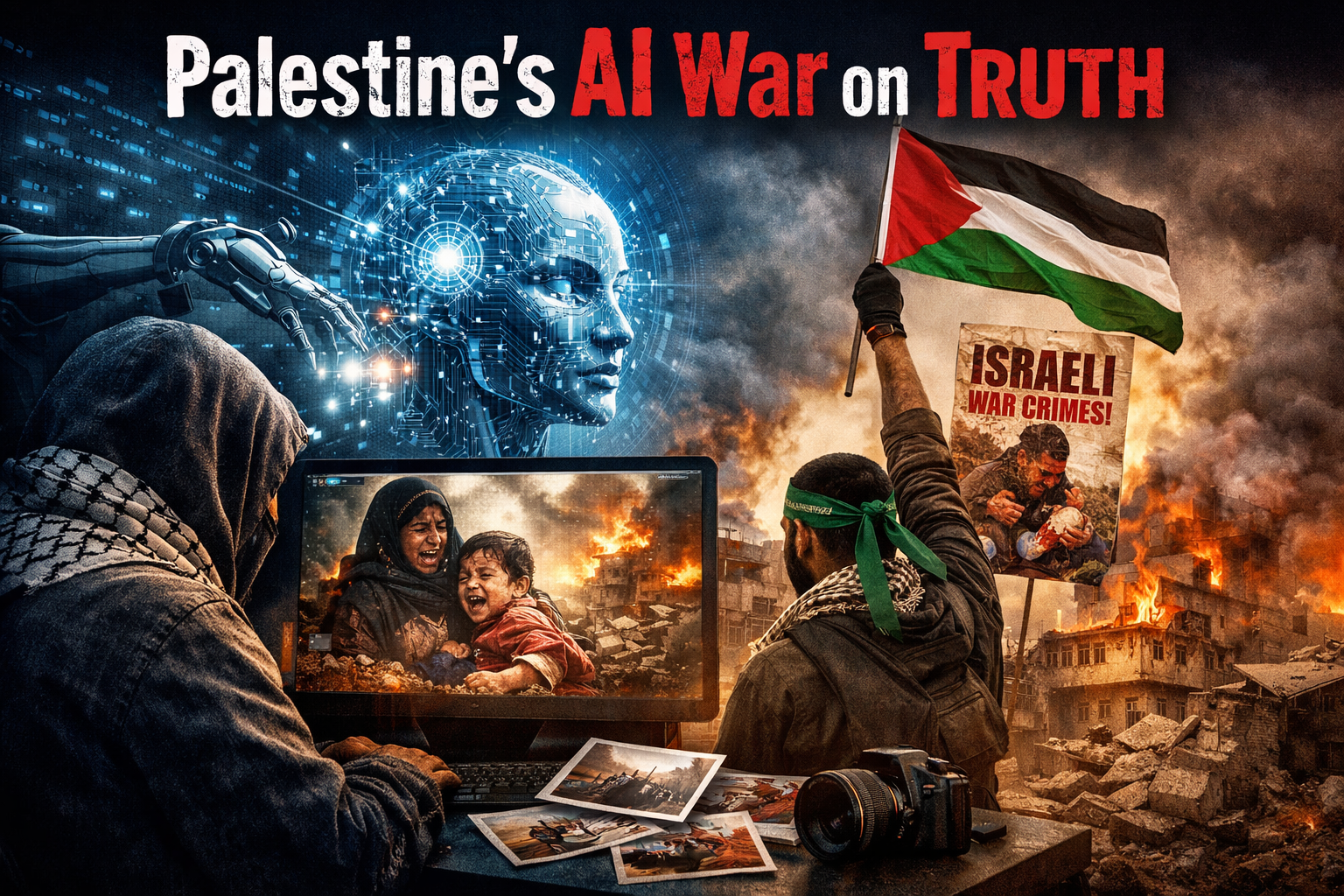
Photo Credits: Sabine Sterk ( AI)
When Deception Becomes “History”
In every war, truth is fragile. But in the Gaza conflict, truth is not merely endangered but it is being deliberately engineered out of existence. Artificial intelligence has accelerated a form of narrative warfare that long predates technology: the systematic use of deception to control perception, memory, and moral judgment.
What is new is not the instinct to deceive. What is new is the ability to turn deception into something that looks permanent, visual, and historical.
For decades, Arab political movements, militant groups, and state-controlled media have mastered the art of strategic narrative manipulation. Images misattributed, scenes staged, timelines reversed, numbers inflated, responsibility blurred. This method has a name deeply embedded in Islamic political culture: taqiyya, the permissibility of deception when it serves a higher cause.
While taqiyya is often discussed in theological terms, its modern expression is unmistakably political. It functions not as an act of personal survival, but as a collective strategy: say what convinces, show what moves, and hide what contradicts the narrative. Truth is not denied; it is subordinated.
Artificial intelligence has now turned this approach into a precision weapon.
Humans trust images more than words. A photograph bypasses analysis and triggers instant emotional judgment. In the past, that trust was anchored, however imperfectly, in context: photographers, locations, timestamps, archives. AI has severed those anchors. Today, scenes of alleged war crimes can be generated without witnesses, cameras, or reality, yet circulate as visual fact.
Once seen, they cannot be unseen.
The Gaza war has become one of the most visually manipulated conflicts in modern history. Alongside real suffering and legitimate journalism, AI-generated imagery floods social media, activist networks, and even mainstream discourse. These images are rarely labeled. They are not presented as illustrations or simulations. They are framed as evidence.
This is narrative warfare in its most advanced form.
Israel is not judged on verified military conduct, international law, or documented facts, but on emotional conclusions drawn from synthetic images. Civilians do suffer in war, that is an undeniable tragedy. But when suffering is digitally constructed or deliberately exaggerated, it stops being testimony and becomes propaganda.
This is where AI and taqiyya intersect. Deception is no longer temporary or tactical. It becomes archival. Repetition transforms fabrication into memory. People begin to remember events that never occurred, scenes they never witnessed, atrocities that exist only in pixels.
False memory is the end goal.
Years from now, many will claim to remember “what they saw in Gaza,” unable to distinguish authentic documentation from algorithmic invention. Once false memory settles in, correction becomes nearly impossible. Emotion hardens into conviction.
This strategy is not limited to Israel. Similar techniques now appear in conflicts across Ukraine, Yemen, Syria, Sudan, and beyond. But Israel remains uniquely vulnerable because its legitimacy is constantly contested, and because accusations against Jews historically gain traction faster than scrutiny.
AI does not eliminate bias; it automates it. These systems are trained on datasets already shaped by ideological framing and selective storytelling. When AI generates “historical” images involving Israel, it often reproduces old visual tropes: Jewish power without context, Palestinian victimhood without agency, morality without complexity.
The result is not education. It is aesthetic ideology.
The collapse of historical standards follows quickly. Real history demands sources, provenance, corroboration. AI-generated images have none of these. No photographer. No chain of custody. No accountability. When such visuals are accepted as truth, they undermine all documentation, including genuine photographs.
Ironically, this benefits extremists most. When everything can be fake, nothing must be proven.
There is also a moral line being crossed. Generating realistic images of dead children and grieving families for political engagement is not activism; it is exploitation. Trauma should not be simulated. Victims should not be digitally staged. War is not a prompt, and suffering is not content.
For Israel, the stakes are existential. This is not only a military conflict, but a battle over legitimacy, history, and moral standing. A democracy cannot be judged by fabricated evidence. Law cannot survive spectacle.
AI-generated images must never be treated as historical proof. If they are used at all, they must be clearly labeled, abstract, and never depict real individuals or alleged crimes. Anything less is not interpretation but it is deception.
History belongs to evidence, not algorithms.
If we allow strategic deception, enhanced by AI, to overwrite memory, we will lose more than Israel’s story. We will lose the possibility of truth itself.
And when images lie, memory follows.
When memory collapses, justice disappears.
Related Topics
Related Posts