


Peacemaker, Motivational Speaker
Palestinian Anti-Normalization Makes Peace Impossible for Those Who Yearn for Peace

The podcast - Conversations at the PeaceTable- Photo credit Soraya
In the months following October 7, a painful question echoed across Israel, the Palestinian territories, and the diaspora: Were all Palestinians supporters of Hamas, or were there Palestinians who opposed the massacre and longed for a different future?
My search for that answer led me to a Facebook post by a man in Gaza named Moataz Al-Mansi.
His words were not the words of a propagandist or an ideologue. They were the words of a Palestinian who looked at Israel’s achievements in science, technology, education, and economic development and asked why Palestinians could not build the same for their own children.
“The future of Palestine is not built on hatred or on the dreams of cancelling the other,” he wrote. “I dream of a relationship based on good neighbors, shared interests, and mutual respect, so that borders become a bridge to cooperation rather than a line of conflict.”
I reached out immediately and invited him to appear on my podcast, Conversations at the Peace Table.
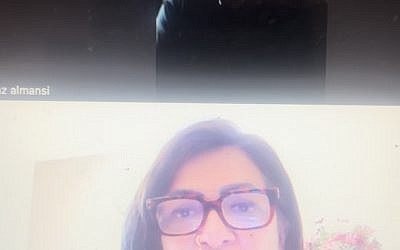
Photo credit Soraya a capture from the program.
Even arranging the interview revealed the harsh reality of life in Gaza. Moataz said that since October 7th, Gazans depended on solar power and they lived in darkness when the sun went down. So we scheduled our conversation during daylight hours when solar power was available. For me in California, that meant waking before dawn. What was supposed to be a 30-minute interview lasted more than an hour.
Moataz told me he had advocated for peace long before October 7. He had lost both of his businesses during the war. His children had not attended school in years. Yet despite his losses, he refused to abandon his belief that Israelis and Palestinians must one day live as neighbors rather than enemies.
As I listened, I realized that his story was not unique, it was one I had heard many times before
My friend Inbal, who worked closely with Palestinians in the West Bank for years, often told me that many Palestinians quietly desired coexistence but were afraid to say so publicly. Those who engaged with Israelis risked being labeled collaborators or traitors. An unwritten hierarchy of approval within their own communities discouraged any effort to build relationships with Jews or Israelis.
Another Jewish friend, deeply committed to grassroots peacebuilding, eventually concluded that genuine reconciliation could not be carried by isolated individuals alone. It required respected leaders from both communities to step forward together, giving others the legitimacy and protection to pursue peace without fear of ostracism.
Again and again, I heard the same story: Palestinians who sought dialogue often faced pressure from their own society, while Israelis who sought partnership struggled to find counterparts who could safely engage.
These experiences helped me understand a central obstacle to peace: the culture of anti-normalization.
What Anti-Normalization Means
Anti-normalization is often presented as a political strategy. In practice, it has become something much broader. It discourages dialogue, joint initiatives, business partnerships, cultural exchanges, and even personal friendships with Israelis or Jews. A Palestinian who speaks publicly about cooperation can be accused of betrayal. An activist who attends a joint event can be shamed. A peace builder who seeks common ground can be treated as suspect.
The result is devastating: peace itself becomes socially dangerous.
When moderation carries a higher personal cost than extremism, the public square becomes dominated by those who reject coexistence.
The Same Pressure Exists in America.
I discovered that anti-normalization is not confined to Gaza or the West Bank.
After publishing my conversation with Moataz, my social media accounts were flooded with attacks. Ironically, some of the criticism came not because I had spoken with an Israeli, but because I had given a Palestinian peace advocate a platform.
In parts of the American diaspora, dialogue itself has become controversial. Speaking with Israelis can make one a “normalizer.” Speaking with Palestinians who seek peace can make one a “sellout.” Ideological purity is increasingly valued above human connection.
This imported culture of anti-normalization has spread through activist circles, campuses, community organizations, and even some faith communities.
Then Came the Warning
Two days ago, Moataz contacted me again.
An article had appeared in a Gaza newspaper calling him a traitor. He told me he feared the consequences. In Gaza, where dissent can carry enormous personal risk, he believed the danger to his life had become immediate.
He did not ask me for money. He did not ask me for political support. He asked me to tell his story.
“If something happens to me,” he wanted the world to know, “it is because I chose peace.”
Here was a Palestinian father who had lost his businesses, whose children had been deprived of normal schooling, and who nevertheless remained committed to the idea that Israelis and Palestinians could build a different future together.
We often ask, “Where are the Palestinian partners for peace?”
Perhaps we should ask a different question: What happens to the Palestinians who dare to become them?
The Question the Diaspora Must Answer
Is the Palestinian diaspora truly interested in the suffering of Gazans?
Or has the struggle to isolate and delegitimize Israel become a higher priority than supporting Palestinians who seek a peaceful future?
People like Moataz should be the voices amplified by anyone who claims to care about Palestinian dignity and opportunity. Instead, they are often marginalized, threatened, or abandoned.
Peace will never be achieved solely through negotiations between governments. It must first become socially acceptable among ordinary people. That requires protecting—not punishing—those courageous enough to see humanity in the other side.
Moataz is not the obstacle to peace.
The ideology that condemns him for reaching across the divide is.
Until Palestinians who seek coexistence are free to do so without fear, and until diaspora activists stop treating anti-normalization as a moral virtue, those yearning for peace will continue to pay the highest price.
The tragedy is not that there are no Palestinians who desire peace.
The tragedy is that too many have been taught that saying so aloud may cost them everything.
“Peace is not a political choice for me—it is a human value that I will never give up, no matter the cost.” – Moataz Al-Mansi