

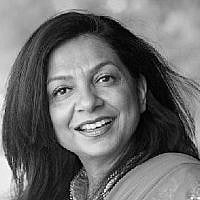
Peacemaker, Motivational Speaker
Paradigm Shifts: Road to Jewish – Muslim Healing!
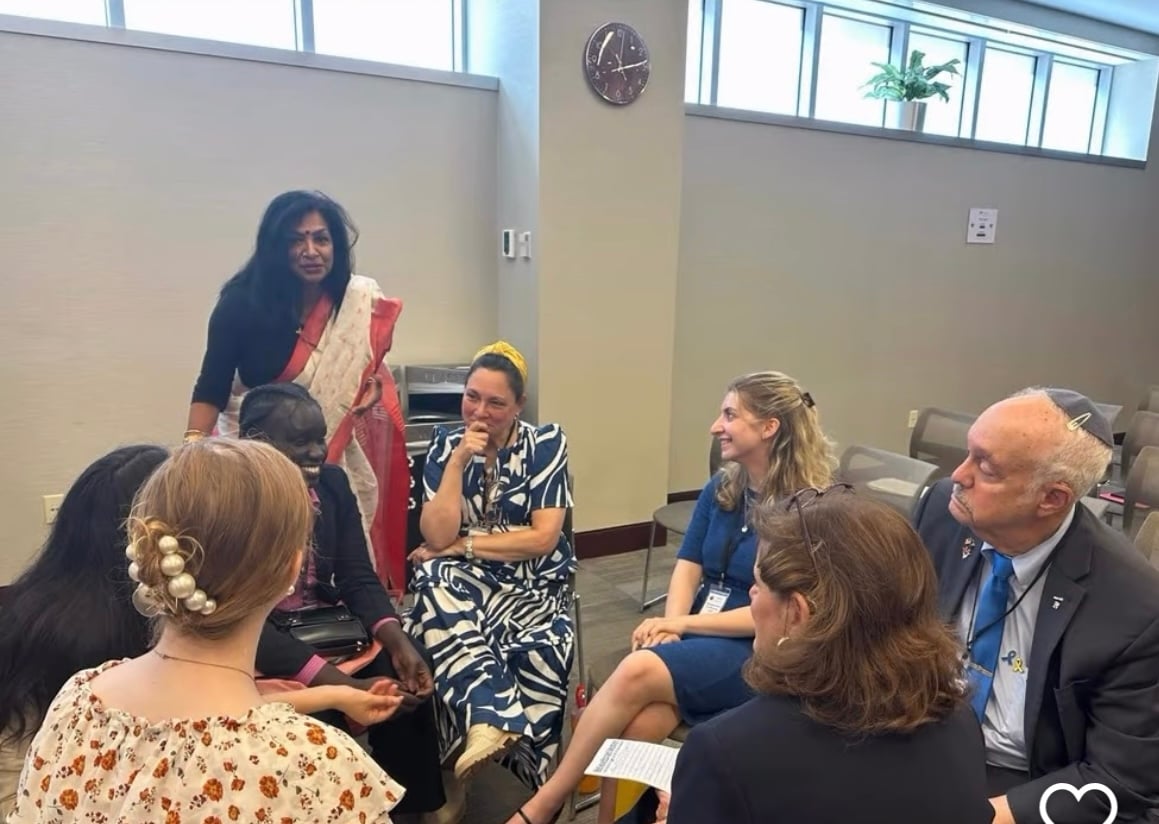
Soraya, teaching Community Organizing Skills at the first AMMWEC - Muslim Summit on Extremism & Antisemitism in DC
The third weekend of our training on Community Organizing was intense. We had ten people from many parts of the world attend. They were eager and there was full participation from the group. It was our 18th Cohort.
My colleague and I taught them how important it is that as leaders, we be willing to embody paradigm shifts.
To provide an example on the concept of Paradigm Shifts, I went further, to share the story of a man who had boarded a crowded train with his three children. All through the ride, the three children were making noise and behaved in a very unruly manner. The travelers were visibly annoyed, they were impatient and looked at the man with contempt, as they wondered – “Why was he not asking his children to quieten down?”
After several stops, the man alerted his children that they were getting off at the next station. The train came to a stop, and as he left the train, he turned to the travellers apologetically and said, “I am sorry, we are just coming from the hospital and they just lost their mother.”
Initially perceived as a negligent parent, he transformed the train’s atmosphere with this simple explanation. This shift fostered empathy and understanding among the passengers, demonstrating the power of story and compassion, in overcoming preconceived notions.
Paradigm shifts often redefine our perceptions and attitudes, as illustrated by this story. At the end of the class, I always do an evaluation. When I asked the participants what the most memorable learning for the day was for each of them, a majority of them said it was the story of the man, who had lost his wife and the practice of making paradigm shifts.
In exploring Jewish-Muslim healing, we face a similar need for paradigm shifts. The historical suffering of the Jewish people, compounded by the Palestinians’ pain from occupation in the Westbank and the loss of dignity, creates a complex landscape. Both communities have endured trauma, fear, lack of security, that fuels division and distrust. The massacre of Jews on October 7th has deeply eroded any trust or possibilities of co-existence. The Palestinians reliance on organizations like Hamas often complicates the quest for peace, framing the decades long conflict as insurmountable.
Yet, healing is attainable. In an era characterized by heightened polarization and conflict, fostering constructive Jewish-Muslim relationships necessitates paradigm shifts that transcends entrenched narratives and generational trauma.
Historically, Jewish and Muslim communities have coexisted, sharing cultural, intellectual, and spiritual legacies. However, contemporary tensions often overshadow this rich history. Thus, a conscious reevaluation of intercommunity dynamics is imperative.
By reflecting on shared values, such as the Islamic principle of “Bismillah Rahman Rahim” (In the name of God, the Most Gracious, the Most Merciful) and the Jewish practice of “Tikkun Olam” (repairing the world), we can cultivate a spirit of generosity and accommodation. Embracing these ideals invites dialogue, compassion, and ultimately a path toward reconciliation.
Here are three concepts that can promote and facilitate paradigm shifts
- Public Narrative
- Listening
- Organizing
Public Narrative
“Stories have immense power to connect, persuade, and even shape our understanding of the world. It is the single most powerful weapon in a leader’s arsenal.”
Public narrative is a compelling construct that interweaves individual stories with collective identity and social action. Here we must aim to build a framework through which individuals can articulate their personal experiences to address broader societal issues, thereby fostering community engagement and shared purpose. The goal is to enable others through story telling.
Originating from the principles of storytelling in social movements, public narrative emphasizes the importance of three key elements: the “story of self,” the “story of us,” and the “story of now.”
The “story of self” allows individuals to convey their personal motivations and experiences, creating an authentic connection with audiences. In contrast, the “story of us” establishes a collective identity, highlighting shared values and communal ties that transcend individual experiences. This element cultivates empathy and solidarity among diverse groups. Finally, the “story of now” situates these narratives within a context of urgency, prompting action by illustrating the present challenges that require immediate attention and responses. (Marshal Ganz/Harvard)
By harnessing the power of narrative, Muslim and Jewish leaders and activists can effectively mobilize communities, inspire collective action, and challenge prevailing narratives and commit to stay connected. Public narrative thus becomes a vital tool in advocacy, serving not merely as a vehicle for individual expression, but as a catalyst for meaningful social change and democratic engagement.
Through story, we get to see each other’s humanity and illustrate the urgency for action when our deeply held values are being desecrated. Stories are how we learn to make choices
Stories speak the language of emotion, the language of the heart, they teach us not only how we “ought to” act, but can inspire us with the “courage to” act.
Organizing events where individuals from both communities share personal stories of loss, suffering, and resilience is crucial. These can be in the form of spoken word, written narratives, or visual art. Creating a safe space to share these narratives allows participants to see their shared humanity. Focusing on common themes such as persecution, survival, and hope, highlighting ways in which both communities have been resilient can be helpful.
We must commit to a learning process. It is not writing a script or rehearsing someone else’s facts. It can be learned only by being authentic, being vulnerable by telling, listening, reflecting, and telling again – over, over and over.
Listening
“How many of us, certified broader-minded souls, act as though complex problems are prepackaged with our singular interpretation of them?
Listening is rare and not happening these days between the Jews and Muslims. Not only are we not listening to each other, we refuse to even be in the same room. Israeli-Palestinian issues and broader tensions, have often bred mistrust and animosity between Jewish and Muslim communities. And heightened post October 7th.
Listening is an art that transcends mere auditory engagement; it is an act of profound connection and empathy. To listen effectively, one must prioritize understanding over reaction. This approach is capable of fostering an environment where Jews and Muslims can feel genuinely heard and valued. When we listen with our hearts, we open ourselves to the emotions and experiences of others, allowing for deeper conversations.
It is essential to make the other person feel felt—this means acknowledging their feelings and validating their experiences. By paraphrasing their words, we demonstrate that we are not only hearing but also processing their message. For example, restating what they’ve said in our own words can reveal our understanding and encourage them to elaborate further. This technique is particularly vital in discussions where emotions run high, as it evokes trust and creates a safe space for open dialogue.
Clarification is another vital component of effective listening. Asking questions not only deepens our understanding but also signals to the speaker that their thoughts and feelings matter. Ultimately, listening to understand rather than to react cultivates meaningful connections and allows for more productive interactions.
In a world often filled with noise, mastering the art of listening is a powerful skill that can transform relationships, that can resolve conflict and shift paradigms.
It can help understand shared values. Promoting mutual respect, empathy, and understanding can reshape perceptions and create a foundation for collaboration.
A paradigm shift so emerged can ultimately pave the way for stronger Jewish-Muslim relationships founded on trust and mutual respect.
Through shared discussions of values, beliefs, and experiences, participants can begin to dismantle stereotypes and misconceptions that fuel conflict.
Jewish and Muslim individuals and organizations can develop partnerships that emphasize shared goals, end hostilities and create a foundation for stronger intercommunal relationships.
Organizing –
Community Organizing will engage and promote leaders, who will step up in times of uncertainty.
In the field of community organizing, we define power as “Organized People.” The greater the numbers, the stronger the power. Stronger the power, greater the likelihood of changing hearts and minds.
Repairing ruptured relationships, building solidarity and resolving conflict, ensuring civic responsibilities, requires that both Jews and Muslims participate as organized citizens. They are then able to harness each other’s gifts, talents and abilities to uphold the communities shared goals and interests.
Committing to organizing develops a new class and level of leadership. A leadership rooted in building relationships, where the primary question asked will be “Who are my people?” And a community that will come alive to ask two more questions –
“What challenges do they face?” and
“How can they turn their resources into the power they need to meet these challenges?”
Organizers have the distinct ability to identify, recruit and develop leaders and build power from the available resources
The leaders build highly effective teams and entrust and promote the proliferation of more teams. It resembles a snowflake model. Leadership ithen becomes not top down, but bottom up! Everyone is a leader. They will resemble Paulo Freire’s concept of conscientization- which involves the recognizing of the root causes of social problems and injustices, understanding how power structures operate, and identifying one’s own role within these structures.
Jews and Muslims can then begin to work together to achieve real outcomes in pursuit of a shared purpose. Individual responsibility becomes the hallmark of this model.
They can create joint projects that involve both communities working together towards a common goal. Collaborative efforts in a shared space will help build relationships and foster purpose
In a climate where radicalization can take root amid prejudice and fear, initiating, pursuing, committing to dialogue can serve as a bulwark against extremism. By promoting a narrative of coexistence and collaboration, these dialogues challenge the ideologies that seek to divide us, thereby contributing to a more peaceful societal environment and upholding our communal contracts. In doing so we will be able to influence broader Communities. The gatherings can extend beyond the participants to influence the wider communities. Successful dialogues can serve as models for intercommunity relations, demonstrating that cooperation and mutual respect can lead to tangible benefits.
This ripple effect can inspire similar efforts across different regions and contexts.
mobilized in response to contemporary events that threaten to rekindle historical tensions. By issuing joint statements or organizing joint events in response to violence or discrimination, these coalitions can demonstrate solidarity and a commitment to peace, signaling to their respective communities that collaboration is possible even in difficult circumstances.
Historic hostilities must end. Theologies that are quoted devoid of contexts, must be challenged. Not only change but both parties must reclaim the truths. Muslims must do it for ourselves. No one will do it for us.
Peace-making always tells a simple story of countries and communities valuing diplomacy over politics and the preservation of human life. In a world too often marked by prolonged violence, this measured approach serves as a reminder that true strength lies not only in military power but in the wisdom to choose peace over destruction and terror.