Parashah Korach
When the Centre Is Not Taken but Revealed
The camp still breathes the accumulated tension of the desert.
Not a calm silence — something heavier, full of questions no one dares to voice. Then Korach appears. Not as a visible enemy, but as someone already within the sacred circle. His voice does not begin with threat. It begins with a phrase that sounds just: the entire community is holy.
And in that moment, something shifts.
Korach does not rise against obvious oppression. He rises against his own place. He looks at Aaron and feels that the difference between them is a wound — not an injustice to be argued, but a fact that has lodged in him and will not move. He does not wish to destroy the sacred. He wishes to redefine it according to his own perception. He gathers allies who carry the same old discomfort, men who know the desert and are tired of waiting for a reason that never fully arrives.
Words multiply, and the camp reorganizes — without weapons, without declaration.
Moshe listens and falls face to the ground. He does not defend his position or argue with political logic. He understands that what is at stake is not a debate. It is the invisible tension that holds the people together when everything else has frayed.
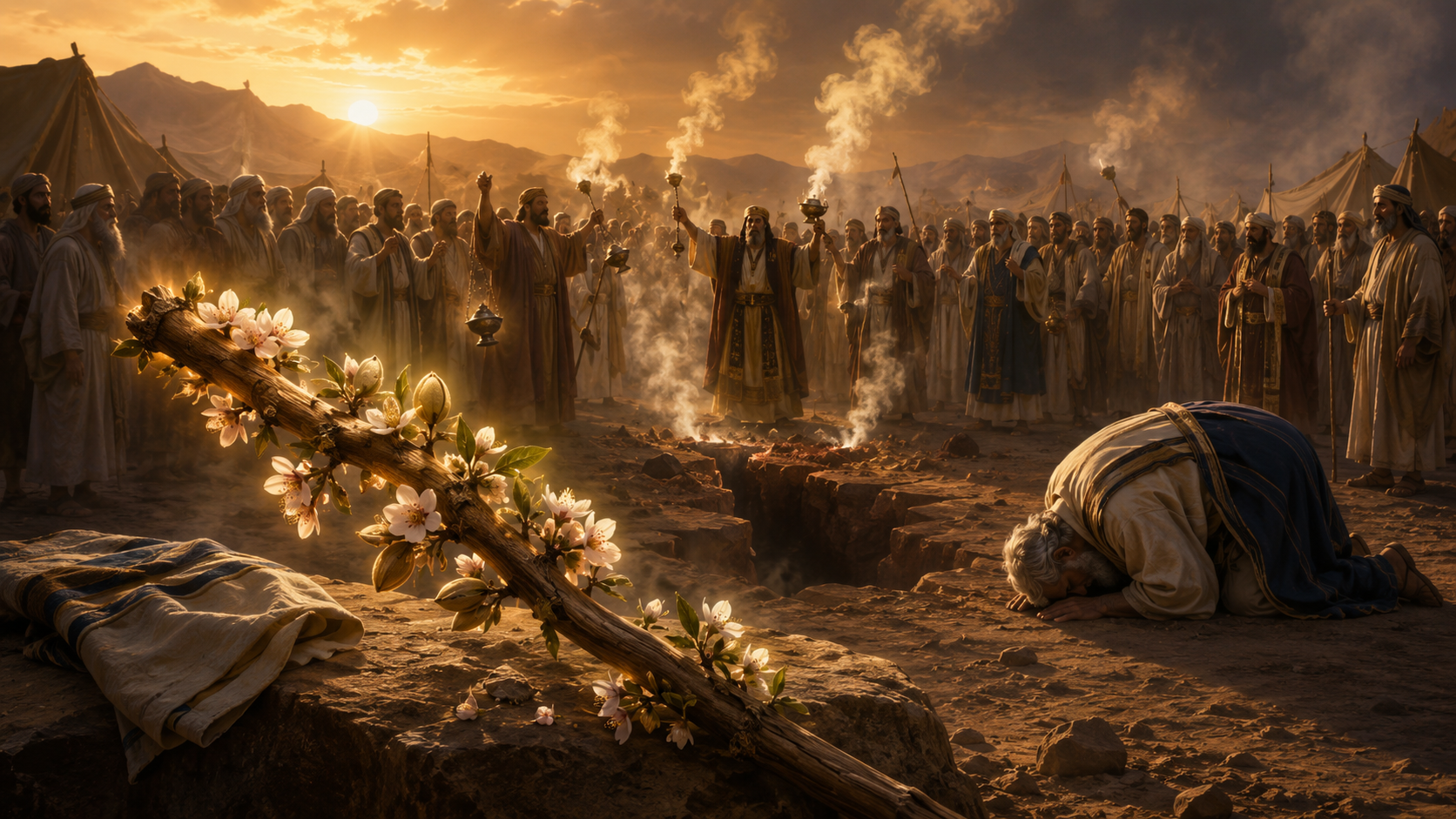
At dawn, the camp fills with smoke. Censers burn in the hands of men who believe they are close to the centre. But the air does not brighten. It grows heavy, then heavier still. The earth itself responds first — it opens and swallows Korach and his company. There is no cry of victory, no moment of relief. Only a silence that takes the breath away. Then fire consumes the two hundred and fifty leaders. The symbol meant to unite becomes the instrument of judgement.
Each tribe then places its staff in the sanctuary. Dry rods lie aligned in the dark.
By morning, one staff has done something the others have not. Aaron’s rod has produced buds, flowers, almonds — where there had only been dead wood, where no one was watching, where nothing was asked of it.
The staff that blossoms without speech
Korach does not appear as an external enemy. He arises as a voice within the camp itself — which is precisely why his rebellion is so difficult to answer. You cannot point at it from a distance.
That is what makes this parashah speak not only to an ancient rebellion but to something every person recognizes at some point in their own interior: the moment when the soul stops orienting itself toward service and begins, almost without noticing, to measure itself against the place occupied by another.
Envy does not always arrive as darkness. It can disguise itself as justice. As equality. At its most sophisticated, as spirituality — the genuine sense that the sacred should not be concentrated in one place, in one lineage, in one set of hands.
Aaron’s blossoming staff introduces a contrast that the narrative has not prepared us for. After all the noise — the censers, the earth opening, the fire — what appears is not vindication. Not triumph. Something quieter and stranger: life, in a place where no one expected it, carrying the argument the entire crisis could not resolve through confrontation.
What is authentic does not need to impose itself. But that is not a consolation. It is a description of something genuinely difficult to sustain — to remain in your place, to do what the place asks, when the entire surrounding pressure is organized around the question of whether your place is legitimate.
The true centre is not a position conquered. It is what becomes visible when a person has been faithful long enough that the question of legitimacy simply stops mattering to them.
Korach in the present time
Korach does not belong only to the ancient desert. His voice resurfaces whenever a community enters the particular tension between freedom and structure — and that tension, in our time, is almost permanent.
We live in a moment when equality and personal autonomy carry enormous cultural weight. That is not a mistake. But alongside it has grown something harder to name: a sustained suspicion toward any form of guidance or functional difference, a suspicion that does not always distinguish between abuse and necessary architecture. Not every hierarchy is domination. Not every centre is an occupation.
Contemporary rebellion often does not arrive as open confrontation. It emerges as discourse — a language that questions all hierarchy in principle, leaving no room for the kind of structure that a shared life actually requires.
And underneath that, often: the older problem. Visibility has become a central value. The desire to be seen, to occupy a recognized place, can be confused with the search for purpose — because both feel urgent, and the difference between them is not always legible from the inside.
When the desire to be seen grows stronger than the desire to serve, something in the shared life begins to corrode. Slowly, then faster.
The blossoming staff offers a different reading of what validation means. Not applause. Not victory. Not the crowd recognizing you as right. Something more like: the work continues to bear fruit, and the person doing it has stopped needing the crowd to confirm that it should.
Inner activation
The question Korach leaves behind is not rhetorical.
From where does your criticism arise?
If it comes from clarity — from seeing something genuinely misaligned with the purpose the community exists to serve — then it can strengthen. If it is born from comparison, from the particular pain of watching someone else occupy a centre you believed should be yours, then it fragments. Not because the criticism is wrong in its content, but because its source will shape everything it touches.
Sustaining that question without certainty, without the comfort of a quick answer — that is the actual discipline. Not the absence of questioning. Not the suppression of doubt. But fidelity to the purpose that makes shared life possible, even when that fidelity does not resolve into clarity.
What moves you — truth or wounded pride? And can you tell the difference when both feel equally urgent, equally dressed in the language of justice?
Closing
“The centre is not conquered: it blossoms when the soul ceases to dispute it.”
The camp rises again at the next dawn. Something has shifted — not in the landscape, but in what the people now know they are carrying.
It is no longer only about walking toward a future land. It is about learning to inhabit the present place without comparing it to another’s — without the constant conversion of where you are into evidence of where you are not.
True closeness to the sacred is not born from the desire to occupy the centre. It grows from the quiet fidelity that lets the centre reveal itself — in its own time, without announcement, to whoever has stopped fighting for it.