
Parashah Mishpatim — Where Fire Learns to Walk
Parashah Mishpatim — Where Fire Learns to Walk
The mountain is still burning — not with visible flames, but as an inner pressure, a vibration that did not leave when the thunder fell silent. Anochi settled in the chest like an ember: it does not burn, yet it does not go out. The cloud is still there, utterly still, as if waiting, as if saying without words: now it is your turn. Because the Voice spoke, but it did not finish.
Yitro opened the ear. Mishpatim opens the hands.
What you heard above must now live below, in dust and queues, in conflict and money, in fatigue and repetition. Here, you cannot hide behind lightning. Either revelation enters your gestures, or it dies. There is no middle ground. What remains in heaven without descending into life evaporates.
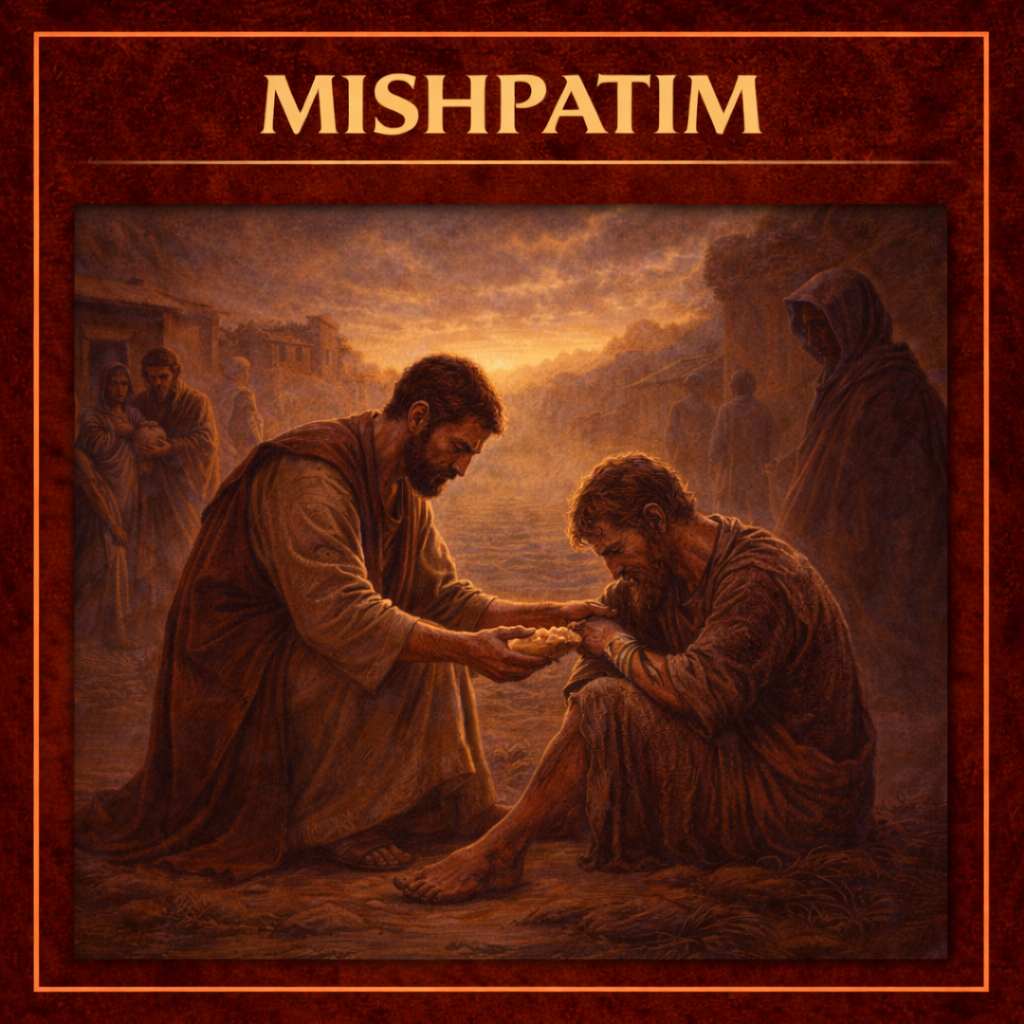
Life continues with its disputes, damages, mistakes, abuses, and weaknesses, and precisely there, in what seems unspiritual and messy, Sinai descends. Not as fire, but as responsibility. Fire becomes the hand that returns what does not belong to it. The Voice becomes the foot that stops before stepping on another. Returning a cloak, not humiliating the fragile, not exploiting the weak, not twisting your gaze — these weigh as much as hearing HaShem on the mountain.
Then they appear: the widow, the orphan, the stranger, the poor. Not as statistics, not as social categories, but as a spiritual test.
Kol almanah ve-yatom lo te’annun — “You shall not afflict them.”
Shamoa eshma — “If they cry out, I will surely hear.”
God does not measure your faith by your words. He measures it by how you treat those who cannot defend themselves. There it is decided whether your Sinai is real or theatre. Whoever strikes the weak strikes against HaShem. Whoever upholds them upholds the covenant.
Then come the details. “If an ox gores…” It sounds small. It is not. Every damage breaks a thread of the world, and sometimes it takes years to weave it back. Repair is not paperwork. It is creation. It is saying, without excuses: here, where I broke, now I hold. When you repair, Sinai descends again.
Then comes the gaze. “You shall not take a bribe.” And you realize that bribery does not begin in the hand. It begins when you look away. When your eye knows and decides not to see. When you tell yourself that it is not so serious, that it is not your problem, that someone else will deal with it. When the eye is corrupted, the cosmos tilts. A sold judge does not break only a law. He breaks creation. Justice is born in the pupil.
Then time appears. Six years, and the seventh — rest. The land breathes, and so do you. Without limits, freedom becomes a whip. Without pause, the Exodus turns into another slavery. Whoever does not know how to stop remains a slave, even whilst walking free.
Then the covenant enters the blood.
Na‘aseh ve-nishma — “We will do, and we will hear.”
First the act, then the ear. First the yes, then the meaning. You say yes with a tight throat, without understanding, without seeing, without guarantees. And there, in that knot, your name is born. Understanding comes later, when the path has already been walked.
At the end, the fire rises again. The glory of HaShem appears as consuming fire. Moses ascends, carrying with him the lived law. What you did on earth is recognized in heaven. The ascent is not escape. It is bringing your upright life into the Presence.
And then you understand.
Mishpatim is not about rules. It is about embodiment. About how thunder learns to walk, how heaven learns to breathe in the street, how God becomes visible in how you treat another. Revelation does not live above. It lives in what you do when no one is watching.
There is justice when you return the cloak to the one who forgot it, when you do not pronounce his name with contempt, when you lower your gaze because another is hungry and you have bread. There, Sinai returns.
Where there is justice, Sinai descends again.
And finally,
it learns to walk.